


A newsletter for modern marketers.

TRUSTED BY THE WORLD'S SMARTEST MARKETERS


Free ad performance benchmarks every week.

Live webinars and strategy sessions with industry leaders.
Watch all previous episodes on our YouTube channel.
Insider strategies from the smartest brands in ecommerce.
SEE LATEST POSTS:

Why New Customer ROAS Matters More Than Blended Metrics

Marketers love tidy numbers, and few are tidier than a single, blended ROAS.
But if growth is the goal, blending acquisition and retention into one metric is exactly how you end up scaling the wrong things.
In my work in media strategy, the simple truth is this: the lines that grow your business are the lines that grow new customers, and the only way to hold yourself accountable to that is to optimize to New Customer ROAS (nROAS) and New Customer CAC (nCAC) every day.
To see the full webinar I did on optimizing your ads, click the video below:
Defining the Metrics
Let’s get precise. Blended ROAS is total revenue divided by total spend; useful for broad reporting, but it’s blind to mix quality.
New Customer ROAS (nROAS) is new customer revenue divided by spend; the cleanest lens for whether your dollars are generating net-new buyers.
Why does the distinction matter?
Because blended ROAS often looks great when returning customers are carrying your dashboard.
You can show “profitability” while your top-of-funnel is starving. I showed this live in our webinar: in a real account, Meta read 0.36 ROAS in our Northbeam view while the platform reported 2.7 — not because one tool is “wrong,” but because a multi-touch, acquisition-first lens shows contribution differently and surfaces whether those dollars actually created new demand.
Why nROAS Drives Growth
Northbeam is built to help teams scale new customer acquisition; full stop.
Retention absolutely matters, but acquisition comes first; you can’t retain a customer you never reached, and you can’t compound LTV if your pipeline of first purchases dries up.
That’s why I call nROAS + nCAC the “golden metrics” for decisioning — they anchor your daily calls on profitability and growth velocity, not vanity efficiency.
Operationally, our daily framework steers budget on nROAS/nCAC at the campaign and ad set levels, then uses supporting metrics (CTR, CPM, eCPC, conversion health, RPV) to diagnose bottlenecks after the scale/trim call.
This keeps acquisition front and center and prevents the classic mistake of falling in love with retargeting math that doesn’t expand the pie.

The Blended-ROAS Traps I See Most
Blended ROAS isn’t “bad” — it’s just insufficient for growth decisions. Here are the pitfalls it hides in plain sight:
- You scale campaigns that mostly convert returning customers. Blended looks green; New Customer% tells you the truth about mix quality and whether you’re actually growing the base.
- You misread lower-funnel channels as demand drivers. In acquisition views, our Clicks-Only model intentionally removes branded search, email, SMS, and direct from taking credit they didn’t create — those touchpoints capture demand, they don’t typically generate it.
- You think you’re “profitable,” but you’re underinvesting in prospecting. Retargeting lines often plateau on volume. Prospecting is the growth engine; resource it accordingly and measure with nROAS and New Customer% to keep yourself honest.
- You trust siloed platform ROAS over a multi-touch source of truth. Platforms over-credit themselves by design; you need an omnichannel view that fractionalizes credit across touchpoints to understand true contribution to new customer growth.
How I Operationalize nROAS (Daily)

Here’s how my team runs this in practice — simple, fast, and repeatable.
Start with the primary decision: Are we at/above our nROAS target or under our nCAC ceiling with sufficient data to trust the signal? If yes, scale with intent; if no, trim and fix.
Keep everything in a standardized decision window (I like 1D Clicks-Only for fast reads; use 7D CO for week-level calls) so benchmarks, stoplights, and budget moves all speak the same language in accrual accounting — which aligns revenue to the touchpoint date and avoids mid-week bias toward older assets.
Then, use your tools to compress time-to-decision. Benchmarks & Stoplights turn profitable-day profiles into green/yellow/red signals at every level (channel → campaign → ad set → ad).
Crucially, evaluate first-time (new customer) performance separately from blended so you don’t confuse retention wins for acquisition momentum.
Finally, diagnose precisely and ship a fix:
- Weak nROAS, high nCAC, low New Customer% → your mix is drifting to existing customers. Tighten audiences/creative to reach net-new or reallocate toward prospecting-heavy channels that historically lift New Customer% (measure the lift, not the vibes).
- Good clicks but low new customer conversion → fix ad-to-landing-page message match. The psychology of the click should meet the page; when it doesn’t, qualified traffic bounces and your nROAS suffers.
- Strong new customer conversion but low RPV → improve the offer. Bundles, cross-sells, post-purchase offers, or price tests can lift order economics without sacrificing acquisition quality.
Build saved views for your roles with tiles for nROAS, nCAC, New Customer%, CTR, CPM, ECR, and RPV so everyone (buyers, leads, execs) sees the same signals and acts in the same window. Source of truth matters at scale; consistency compounds.
Conclusion
Growth is a new-customer game. If you optimize to nROAS and nCAC, standardize your decision window, and let Benchmarks & Stoplights guide your daily moves, you’ll scale the lines that actually expand your customer base — and you’ll stop confusing blended efficiency with durable growth.
To watch the full webinar, click here. Additionally, you can download our handy guide to keep at your side for when you're optimizing your campaigns, straight from the playbook our media strategists run. Download it for free here.

Channel Strategy: How to Choose the Right Marketing Channels for Your Business

In an era where marketers juggle a dozen platforms before breakfast, choosing the right marketing channels has never mattered more.
The best marketing channel strategy isn’t about chasing trends, it’s about connecting with your audience efficiently, maximizing ROI, and aligning every campaign with a clear purpose.
Without a structured approach, channels overlap, results blur, and performance stalls. The key is to be selective, strategic, and data-driven, building a channel mix that supports growth.
This article walks you through how to choose the right marketing channels by defining your audience, evaluating each option by ROI and scalability, and using data to prioritize what works.
You’ll learn how to audit your current mix, test new channels effectively, and avoid common pitfalls like overlap, saturation, and attribution distortion so your marketing strategy becomes more focused, efficient, and impactful.
The Problem: Why Channel Strategy Often Fails
Many teams still treat marketing channels like a buffet: piling on whatever looks appealing without considering how it all fits together.
Budgets get scattered across platforms, results flatten, and leaders are left wondering which effort actually moved the needle.
When channels overlap, costs rise and attribution gets fuzzy. One campaign cannibalizes another, and performance metrics stop telling a coherent story. The result isn’t a growth engine; it’s noise.
A solid marketing channel strategy brings order to that chaos. It aligns every touchpoint with clear objectives (awareness, acquisition, retention) and ensures each dollar supports a measurable outcome rather than a hunch.
87% of marketing leaders report experiencing campaign performance issues, with poor channel fragmentation and other channel strategy issues being the primary driver.
In other words: it’s not about being everywhere. It’s about being strategic about where and why you show up.
Core Decision Criteria for Channel Selection
A disciplined channel strategy starts with clear evaluation criteria. Each potential channel should be measured against consistent axes, not just gut instinct or trends.
The goal is to understand where your audience actually engages, what outcomes the channel supports, and whether it’s sustainable to scale.
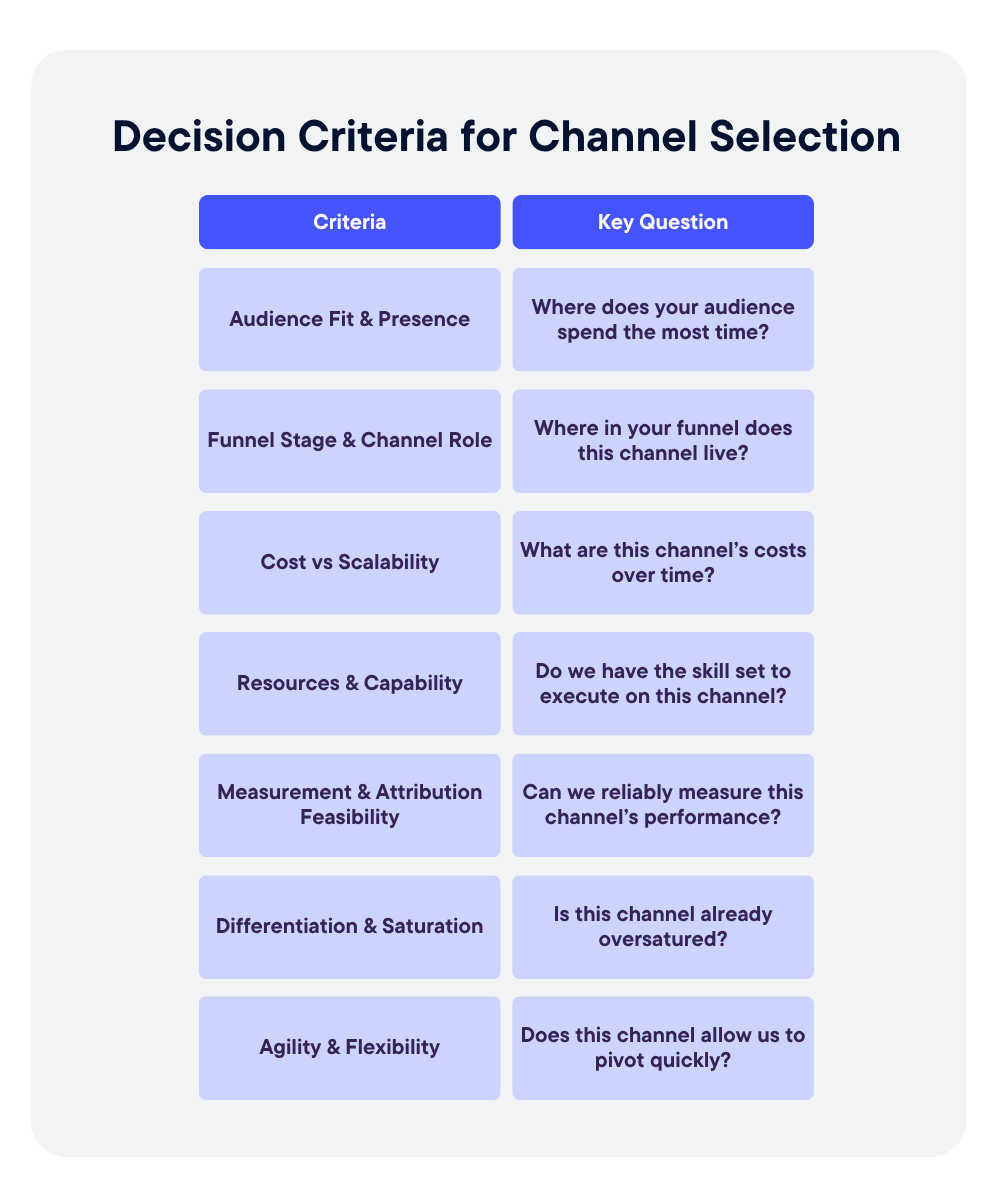
Audience Fit & Presence
The best-performing channels are the ones your audience already lives in.
Before investing, confirm where your target customers spend time and what content formats they respond to: short-form video, newsletters, long-form education, etc.
Funnel Stage & Channel Role
Every channel should serve a defined purpose: building awareness, driving acquisition, or nurturing retention.
Mapping this alignment ensures you’re not running top-of-funnel tactics where conversion is the goal, or vice versa.
Cost vs. Scalability
Evaluate each channel’s economics over time. Some channels deliver strong ROI early but taper off as competition rises or bids inflate.
Assess both upfront costs (setup, creative, tech) and marginal costs (CPC, CPM) to gauge long-term scalability without diminishing returns.
Resources & Capability
Even high-potential channels fail without proper execution. Do you have the in-house skill sets (copywriting, design, ad operations, data analysis) to manage the channel effectively?
If not, factor in outsourcing costs or training time before committing.
Measurement & Attribution Feasibility
If a channel can’t be reliably measured, it can’t be optimized.
Make sure you know how to choose marketing channels that integrate smoothly into your analytics and attribution models, so you can connect spend to results and continuously refine performance.
Differentiation & Saturation
Overcrowded platforms drive higher costs and lower impact. Look for channels where your competitors are not dominant; emerging or underutilized spaces often yield better ROI and creative opportunities.
Agility & Flexibility
Markets shift fast. Channels that allow you to pivot quickly (test creative variations, adjust bids, or redeploy spend) offer resilience in volatile conditions.
Agility often beats perfection in modern marketing.
Channel Types & Their Roles
Before mapping specific channels to your strategy, it helps to understand the broader framework they fall into.
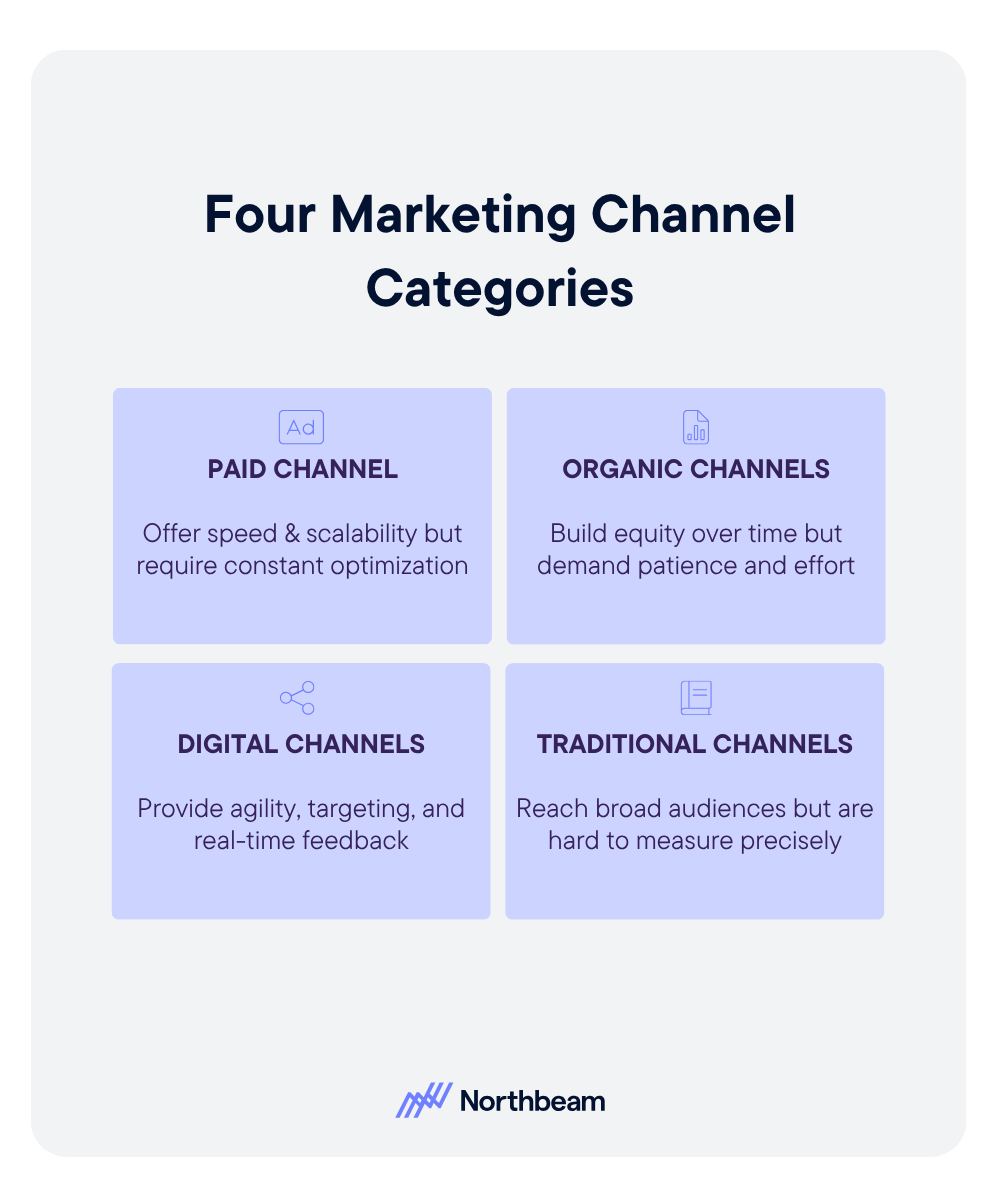
Keen Decision Systems divides marketing channels into four major categories, each with different strengths and tradeoffs:
- Paid channels offer speed and scalability but require constant optimization as costs rise.
- Organic channels build equity over time but demand patience and consistent effort.
- Digital channels provide agility, targeting, and real-time feedback.
- Traditional channels like print, radio, and direct mail reach broad audiences but are harder to measure precisely.
These dimensions highlight key tradeoffs: speed versus sustainability, reach versus control, experimentation versus consistency.
The most effective strategies blend these forces rather than relying too heavily on one.
Once you’ve defined your evaluation criteria, the next step is mapping them to the major channel types within this framework.
Owned/Organic (Blog, Social Media, SEO)
Owned channels are the long game. They require time and consistency but build durable brand equity and compound over months or years.
Blogs, social media profiles, and SEO-optimized content give you full creative control and low incremental cost once established.
They’re ideal for awareness and education but demand patience before measurable ROI appears.
Paid/Performance (PPC, Ads, Sponsored Content)
Paid channels deliver speed and precision. They’re easy to test, quick to scale, and provide fast feedback loops, which is perfect for validating new offers or audiences.
The tradeoff: rising competition and cost volatility. As performance channels saturate, ROI can erode without constant optimization.
Earned/Shared/Partner (PR, Influencer, Content Syndication)
Earned exposure adds credibility and reach you can’t buy directly. Whether through PR mentions, influencer collaborations, or partner syndication, these channels extend your visibility to new audiences and reinforce trust.
However, they’re less predictable and harder to measure, which means they work best alongside more controllable tactics.
Direct/Relationship Channels (Email, In-App, Push)
Direct channels nurture retention and loyalty. They allow you to communicate with customers without intermediaries or algorithms, giving full control over timing and message.
Direct channels also present high potential for personalization, especially when integrated with CRM data.
Hybrid/Emerging Channels (Affiliate, Podcast, Events)
These channels blur the lines between organic and paid. They’re often niche, with lower competition and high creative potential, but require experimentation to find traction.
Podcasts, affiliate programs, and live events can build deep audience engagement if aligned with your brand voice and goals.
Keen’s framework divides channels into paid, organic, digital, and traditional categories to emphasize their different tradeoffs: speed versus sustainability, reach versus control, experimentation versus consistency.
The most effective strategies blend these dimensions rather than relying too heavily on one.
Framework for Building Your Channel Strategy
A channel strategy isn’t a one-time plan, it’s an iterative system for testing, learning, and scaling what works.
The process moves from exploration to execution through a disciplined set of steps that keep decisions data-driven and aligned with business goals.
Audit Existing Channel Performance
Start by taking inventory. Gather data on each active channel’s cost, reach, conversion rate, and incremental value, not just vanity metrics.
Look for overlap between channels (e.g., paid social clicks converting customers already reached via email) and identify attribution blind spots.
This snapshot becomes your baseline for smarter investment.
Hypothesis Scoring & Ranking
Treat each potential channel as an experiment. Score it against your decision criteria, including audience fit, ROI potential, risk level, and resource requirements.
The goal isn’t to predict the future perfectly but to rank channels by the strength of their hypotheses. This keeps you focused on the opportunities with the highest strategic upside.
Pilot & Test Approach
Before you commit to a given budget, validate your assumptions through small-scale pilots.
Keen’s research emphasizes testing early and often: running controlled experiments to see how each channel performs in practice.
Use clear KPIs like cost per lead, engagement rate, or conversion lift to decide what deserves more spend.
Role Definition & Funnel Mapping
Once you’ve identified the most promising channels, assign them clear roles in your funnel. Which ones drive awareness? Which nurture conversion or retention?
Mapping these interactions helps prevent duplication and ensures every channel feeds into the next stage of your customer journey.
Attribution & Feedback Loops
Decide how success will be measured. Whether you use last-click, multi-touch, or marketing mix modeling (MMM), attribution should provide actionable insight rather than inflated numbers.
More advanced teams are turning to Bayesian models for a nuanced view of multi-channel influence. Build dashboards that update automatically so performance data continuously informs allocation.
Scale, Reallocate, and Iterate
Once your tests identify clear winners, double down on what’s working and pause what’s not. Revisit your mix quarterly to adjust for seasonality, cost shifts, or audience fatigue.
Source: Eshghi et al., “Optimal Resource Allocation in Influence Networks,” arXiv:1702.03432.
A strong channel strategy is alive, not static. It grows with your business, your data, and your audience, compounding insight and ROI over time.
Tradeoffs, Risks, & Channel Pitfalls
Even a well-planned channel strategy can stumble if the moving parts aren’t managed carefully. Most failures don’t come from bad ideas, they come from invisible tradeoffs, misaligned timing, or operational friction.
Understanding these pitfalls upfront can help you prevent costly detours.
Overlap & Cannibalization
Not every channel expands your reach. Sometimes two or more hit the same audience, doubling your spend without adding new prospects.
Overlapping audiences between, say, paid social and remarketing can drive up costs and muddy attribution.
Use audience exclusions and cohort analysis to ensure your channels complement, not compete.
Attribution Distortion
When success metrics give too much credit to one channel (for instance, last-click conversions inflating search ROI) teams can make the wrong optimization calls.
Attribution distortion leads to overinvestment in easy-to-measure channels while undervaluing long-term drivers like content or PR. Cross-channel models and data triangulation help correct the imbalance.
Saturation & Diminishing Returns
Paid channels are efficient until they’re not. As spend increases, competition drives up bids and ROI erodes.
Recognizing this curve early lets you shift from high-cost acquisition to nurturing and retention before performance flattens.
Resource Dilution
More channels don’t always mean more results. Spreading teams thin leads to sloppy execution, slow response times, and half-baked creative.
A lean, well-managed mix consistently outperforms an overloaded one. Focus on mastery, not mere presence.
Dependence on External Platforms
Platforms change faster than you can plan. Algorithm updates, privacy policies, or ad pricing shifts can instantly rewrite your playbook.
Balance external reliance with owned channels like email or SEO that you fully control.
Ramp Time Mismatch
Every channel operates on its own timeline. SEO and content marketing may take six months to mature, while paid ads can drive traffic in days.
Mismanaging these timelines (for example, expecting organic to deliver at launch) can create gaps in visibility or pressure on paid spend.
Fragmented Messaging & Silos
When different teams own different channels without coordination, brand voice fractures. Messaging feels inconsistent and customer experiences become disjointed.
Align strategy, creative, and reporting across departments to maintain one cohesive narrative.
A strong channel mix is as much about orchestration as selecting marketing channels. Avoiding these pitfalls ensures your efforts add up to momentum, not noise.
3 Examples For How to Choose the Right Marketing Channels
The best way to understand channel strategy is to see it in action.
Below are three simplified examples that show how different types of businesses apply the same process: hypothesis, test, learn, and adjust.
Example #1: SaaS Startup
A B2B software startup wanted to attract qualified leads for its free trial program.
The team hypothesized that LinkedIn Ads + content download + email nurture would yield the best conversion flow given their professional audience.
After a two-month pilot, they tracked cost per lead (CPL), engagement with gated content, and downstream trial activation.
LinkedIn drove high-quality leads but at a steep cost. However, email nurtures converted 22% of those trial users: a strong retention signal.
The team reallocated part of their ad budget toward organic LinkedIn content and lifecycle emails, improving total ROI by 35%.
Key takeaway: Start broad with paid reach, then shift investment toward owned or direct channels that sustain engagement.
Example #2: DTC Brand
A direct-to-consumer beauty brand launched a new product line and wanted to find which mix of channels would generate both awareness and repeat purchases.
They ran an influencer + paid social + retargeting campaign for six weeks.
Initial metrics showed strong engagement but weak conversion from Instagram ads. Retargeting audiences were small and expensive. By surveying new customers, they learned that many discovered the brand through influencer posts but converted later via email or SMS.
The team reduced social ad spend, doubled down on SMS and push notifications, and built a referral program.
Within one quarter, repeat purchase rate rose by 28% and CAC dropped by 18%.
Key takeaway: Attribution often hides the “real” driver; follow the customer journey beyond the first click.
Example #3: Local Business
A neighborhood fitness studio wanted to rebuild attendance after a renovation, but they’re not sure about the best marketing channels for small businesses.
Rather than rely solely on digital, they paired offline outreach (local events, direct mail) with digital discovery (paid search, local social ads).
Their hypothesis: combining personal community touchpoints with online visibility would amplify trust and bookings. Test metrics included event attendance, coupon redemption, and new membership signups.
The hybrid approach worked: local events converted 1 in 4 attendees, while social ads boosted awareness at minimal cost.
They sustained the model by running one event per quarter, supported by targeted Google Ads and a referral discount.
Key takeaway: Offline and online channels can reinforce each other, especially when community and credibility matter.
Across all three cases, the lesson is the same: an effective channel strategy framework in 2025 is based on data-informed experimentation.
Test assumptions, measure real outcomes, and adjust the mix based on evidence.
Channel Selection Checklist
A great channel strategy doesn’t just live in a slide deck, it’s something you can operationalize and refine over time.
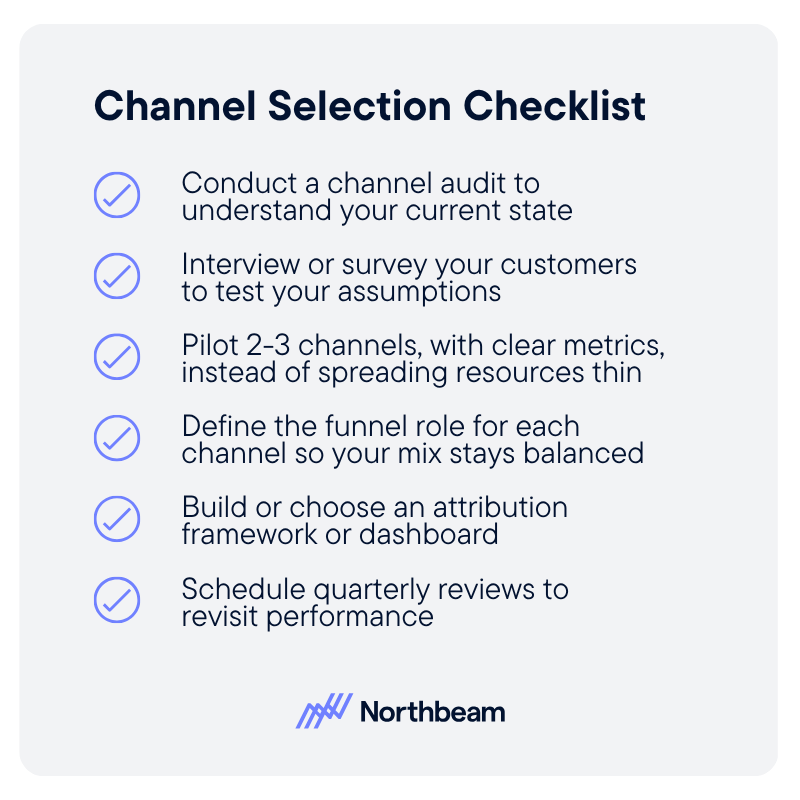
Use this checklist to turn your evaluation into an actionable plan that keeps your marketing mix sharp and accountable:
- Conduct a Channel Audit: Start with what’s already running. Review each channel’s spend, reach, and performance metrics to identify overlap, underperformance, and opportunities to consolidate.
- Interview or Survey Your Customers: Go straight to the source. Ask your audience where they actually spend time and what types of content influence them most. Even a small sample of customer feedback can reveal blind spots in your assumptions.
- Pilot 2-3 New Channels (with Clear Metrics): Instead of spreading thin, choose a few new channels to test deliberately. Define success metrics upfront (cost per lead, engagement rate, retention lift) and evaluate after a fixed test window.
- Define the Funnel Role for Each Channel: Every channel should have a specific job to do. Label it clearly (awareness, acquisition, retention) so your mix stays balanced and your performance data stays interpretable.
- Build or Choose an Attribution Framework/Dashboard: Select a measurement model (last-click, multi-touch, or MMM) that fits your scale and tech stack. Visualize data in a dashboard that lets you see trends, compare channels, and reallocate fast.
- Schedule Quarterly Reviews: Set a recurring cadence to revisit channel performance. Markets, audiences, and costs shift, and your mix should, too. Re-run prioritization each quarter to cut what’s stale and double down on what’s scaling.
A disciplined checklist like this keeps your marketing channels from running on autopilot. Strategy isn’t about doing more; it’s about doing the right things consistently.
Build Smarter, Not Broader
A strong channel strategy isn’t about being everywhere at once. It’s about showing up where it counts with intention, focus, and measurable impact.
Start by auditing what’s working. Then test a few new channels with purpose, and use data to guide every adjustment.
Over time, the result isn’t just better ROI, it’s a marketing engine that compounds insight, efficiency, and trust.
Don’t wait for perfect information. Pick two actions from the checklist above and start this week.
Ad Fatigue in Digital Marketing: How to Recognize & Remedy It
If your ads used to crush performance but now barely get clicks, it’s probably not the algorithm’s fault: it’s ad fatigue.
Even the best creative gets old fast when audiences see it over and over again. Engagement drops, costs rise, and before you know it, you’re spending more to achieve less.
Ad fatigue happens when your audience becomes so familiar with a campaign that they stop noticing it altogether.
The result? Declining CTR, rising CPC, and wasted media spend.
Here’s what you’ll learn in this guide:
- How to recognize ad fatigue: the key signals and metrics that reveal when performance is slipping
- Why it happens: the most common creative, targeting, and algorithmic culprits
- How to fix it fast: proven remedies and prevention tactics to keep campaigns performing longer
In short, this article helps marketers recognize, diagnose, and fix ad fatigue before it drains ROI. You’ll walk away with a clear playbook to keep your creative fresh, your audience engaged, and your campaigns cost-efficient.
What Is Ad Fatigue?
Ad fatigue (sometimes called creative fatigue or ad wear-out) happens when audiences are exposed to the same creative too often.
Over time, what was once engaging starts to feel repetitive or irrelevant, and viewers begin to scroll past, ignore, or even react negatively to your ads.
It’s important to distinguish ad fatigue from general underperformance. A campaign might underperform for reasons like poor targeting, weak messaging, or seasonality, but ad fatigue specifically refers to performance decline over time as a result of overexposure.
In other words, it’s not that your ad never worked. It just stopped working once people had seen it too many times.
This phenomenon can occur across nearly every digital channel: social media feeds, display networks, video platforms, and even retargeting campaigns.
The more often a user sees the same creative in these spaces, the less likely they are to engage with it, and the faster your results begin to drop.
Why Ad Fatigue Matters
Ad fatigue isn’t just a creative nuisance. It has real business consequences: your engagement drops, costs climb, efficiencies erode, and brand perception can take a hit.
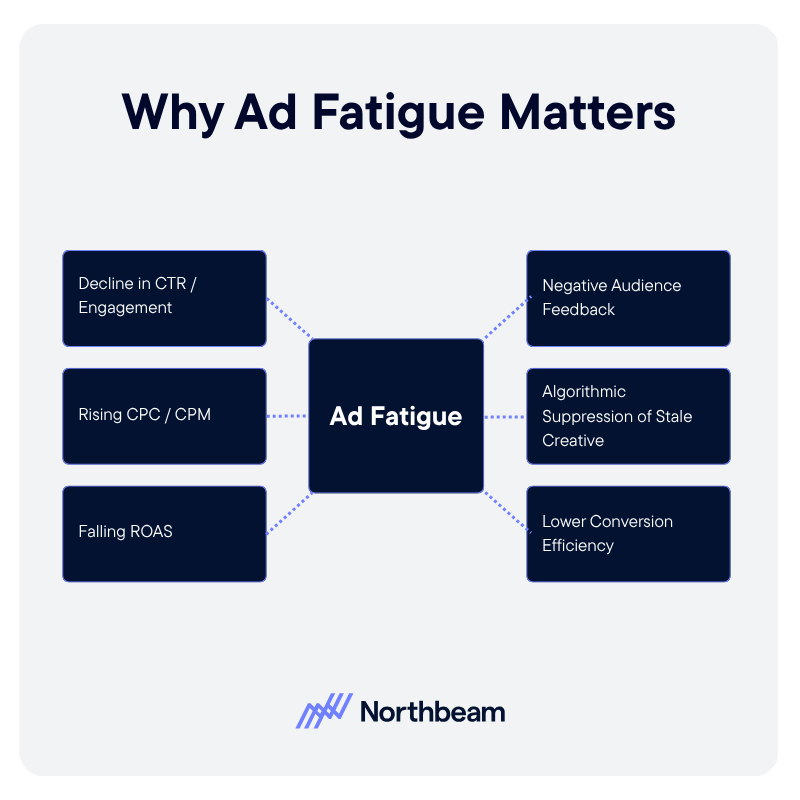
Key risks include:
Decline in CTR / Engagement
When an audience sees the same ad too often, they stop clicking, reacting, or paying attention.
For example, a study by Meta Platforms found that after just four repetitions of the exact same creative, the likelihood of a click dropped by about 45%.
Rising CPC / CPM
When engagement falls, the advertising platforms’ algorithms recognize your creative as less relevant and inefficient, so the cost to reach or get action from users goes up.
Falling ROAS / Conversion Efficiency
With fewer clicks and higher costs, the return on your ad spend drops. Essentially, you spend more to get less.
Negative Audience Feedback
Repetition can annoy or alienate users. Comments like “I’ve seen this already”, ad hides, or users choosing “not interested” all signal damage. That in turn can harm how users feel about your brand.
Algorithmic Suppression of Stale Creative
Digging deeper, when your creative becomes stale (low engagement, negative feedback, high frequency), ad platforms will serve it less or bid it up in cost, reducing reach and efficiency further.
It’s tempting to think “we’ll refresh eventually,” but the data shows that damage accumulates fast.
The higher you let costs rise and engagement fall, the harder (and more expensive) it’ll be to recover from the slide.
In short: ignoring creative fatigue puts your campaign health, budget efficiency and brand standing at risk.
Recognizing Ad Fatigue (Signals & Metrics)
Ad fatigue doesn’t always announce itself loudly. It can creep in gradually through subtle performance shifts.
To catch it early, marketers should monitor both quantitative and qualitative signals that reveal when an audience has seen too much of the same creative.
Quantitative Indicators
- Consistent drop in CTR or engagement rate: A steady decline in click-throughs or interactions is one of the clearest signs your audience is tuning out.
- Rising CPC or CPM with a stable budget: When your costs climb but impressions or clicks don’t, platforms may be penalizing your ad for poor relevance or repetitive delivery.
- Falling conversion rates or ROAS despite stable traffic: If your traffic remains steady but sales, sign-ups, or return on ad spend drop, fatigue may be eroding effectiveness.
- High ad frequency: Seeing the same ad too many times leads to boredom and frustration. As a general rule, frequency above 3-4 impressions per user often signals it’s time to refresh.
- Plateauing reach: When you’re no longer expanding to new audiences, it can indicate saturation within your target segment.
Qualitative Indicators
- Negative audience feedback: Comments like “I’ve seen this ad too much” or increased use of “Hide this ad” options suggest irritation and declining sentiment.
- Internal performance reviews: Feedback from creative, media, or account teams noting repeated visuals or stale messaging often correlates with performance dips.
- Audience sentiment monitoring: Social listening tools or manual reviews can reveal when tone shifts from neutral to negative, an early warning that perception is slipping.
Together, these metrics and insights create an early detection system.
By watching for even small shifts in engagement or sentiment, teams can refresh creatives before fatigue causes serious performance loss.
Root Causes & Risk Factors of Ad Fatigue
Understanding the root causes of ad and creative fatigue helps prevent the problem before it drains your budget.
Overuse Of The Same Creative
Running a single ad or a limited set of variations for too long is the most common driver of fatigue. Even high-performing creative will eventually lose impact once it’s seen too many times.
Narrow Or Saturated Targeting
When your audience pool is too small, the same users are repeatedly served your ads, especially if you’re also retargeting them across platforms.
Expanding or rotating segments can help distribute impressions more evenly.
Infrequent Creative Refresh Cycles
Without a consistent refresh schedule for visuals, copy, or calls-to-action, fatigue is inevitable.
Regularly rotating creative assets keeps campaigns feeling fresh and prevents diminishing returns.
Rigid Frequency Settings Without Caps
Overly aggressive bidding or missing frequency limits can lead to excessive impressions per user.
Implementing caps ensures users see your message enough to remember it, but not enough to get tired of it.
Cross-Channel Overlap
Delivering identical or similar creatives across multiple channels (e.g., Meta, YouTube, Google Display) can overwhelm the same audience.
Differentiating creative formats or sequencing them across channels helps prevent oversaturation.
Algorithmic Downranking
Ad platforms deprioritize creatives that get low engagement or negative feedback. Once this happens, reach declines and costs rise, creating a cycle of underperformance that’s hard to recover from.
Weak Creative Strategy Or Lack Of Testing
Without structured experimentation (like A/B testing, message rotation, or creative benchmarking) teams miss the early warning signs that an ad is wearing out.
A strong creative testing framework ensures you catch fatigue before performance drops.
How to Overcome Ad Fatigue: Remedies & Prevention Strategies
Once you’ve identified signs of fatigue, the next step is to act fast.
The key to preventing ad performance decline is proactive management: regularly refreshing creatives, rotating audiences, and automating monitoring to catch early dips before they hurt ROI.
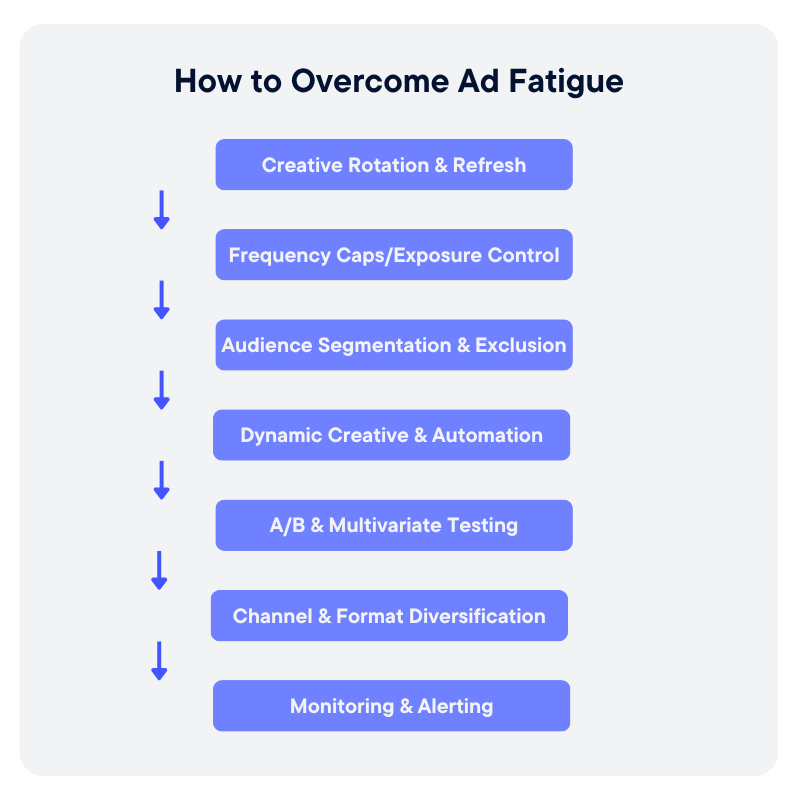
Here are seven steps to prevent ad campaign fatigue across Facebook (Meta), Google, and other channels.
Creative Rotation & Refresh
- Maintain multiple creative variants and refresh visuals, headlines, and CTAs on a regular schedule (every few weeks for always-on campaigns).
- Use seasonal hooks, trending topics, or new product angles to keep messaging timely and relevant.
- Experiment with alternate formats, such as short-form video, carousel, or interactive ads, to re-engage users who have grown tired of static visuals.
Frequency Capping / Exposure Control
- Set limits on how many times an individual user sees your ad within a set period (e.g., 3–5 impressions per week).
- Use platform-level frequency caps or automated rules to manage exposure across campaigns
- Pause or rotate creatives once thresholds are reached to prevent overexposure and preserve brand sentiment.
Audience Segmentation & Exclusion
- Break audiences into smaller, more precise segments and tailor creatives to each group’s interests or behaviors.
- Exclude users who have already converted or have seen your ad multiple times
- Gradually expand reach with lookalike or similar audiences to discover new engagement pockets.
Dynamic Creative & Automation
- Use Dynamic Creative Optimization (DCO) tools to automatically mix and match creative elements for optimal performance.
- Apply automation rules to pause or refresh underperforming creatives based on metrics like CTR, frequency, or cost per conversion.
- Let algorithms handle routine adjustments while your team focuses on strategy and creative innovation.
A/B & Multivariate Testing
- Continuously test variations of visuals, headlines, copy, and formats to understand what resonates.
- Retire versions as soon as engagement starts to drop, before fatigue fully sets in.
- Maintain a structured testing cadence to ensure ongoing learning and optimization.
Channel & Format Diversification
- Spread exposure across multiple platforms (social, display, video, search) to prevent oversaturation of any single audience.
- Sequence creative delivery (e.g., teaser video -> carousel -> static reminder ad) to maintain interest and storytelling momentum.
- Adjust creative formats by channel to make each placement feel fresh and contextual.
Monitoring & Alerting
- Build dashboards that track CTR, CPC, frequency, conversions, and audience sentiment over time.
- Set up automated alerts for sudden drops in engagement or unexpected cost spikes.
- Consider advanced detection techniques (e.g., change-point or anomaly analysis) to catch early fatigue in large-scale campaigns.
Ad Fatigue Case Study
Even the best-performing campaigns eventually hit a wall.
The key difference between teams that sustain success and those that burn through budget is how quickly they recognize and respond to fatigue.
Problem
A direct-to-consumer skincare brand noticed engagement on its Meta ads drop by nearly 30% over two weeks.
Click-through rates were falling, CPMs were creeping up, and customer comments increasingly mentioned seeing “the same ad again.”
The team realized that while their creative had once been a top performer, it hadn’t been updated in nearly two months, and the same video was running across Meta, YouTube, and Google Display.
Solution
The marketing team conducted a quick diagnostic: they compared audience frequency data, analyzed feedback sentiment, and confirmed fatigue as the culprit.
Within a week, they rolled out refreshed creatives featuring new visuals, reworded CTAs, and UGC-style testimonials.
They also implemented frequency caps and expanded to a broader lookalike audience to dilute overexposure.
Impact
CTR rebounded by 22% within ten days, CPMs fell back to their pre-fatigue baseline, and positive engagement returned.
More importantly, the team built an automated refresh schedule and dashboard alerts to detect similar dips in the future, turning a reactive fix into an ongoing preventive system.
This simple cycle of detect, refresh, and automate demonstrates how even small adjustments can revive fatigued campaigns and protect long-term ad performance.
Ad Fatigue Best Practices Checklist
To keep creative fatigue from eroding performance, build these principles into your campaign workflow from day one.
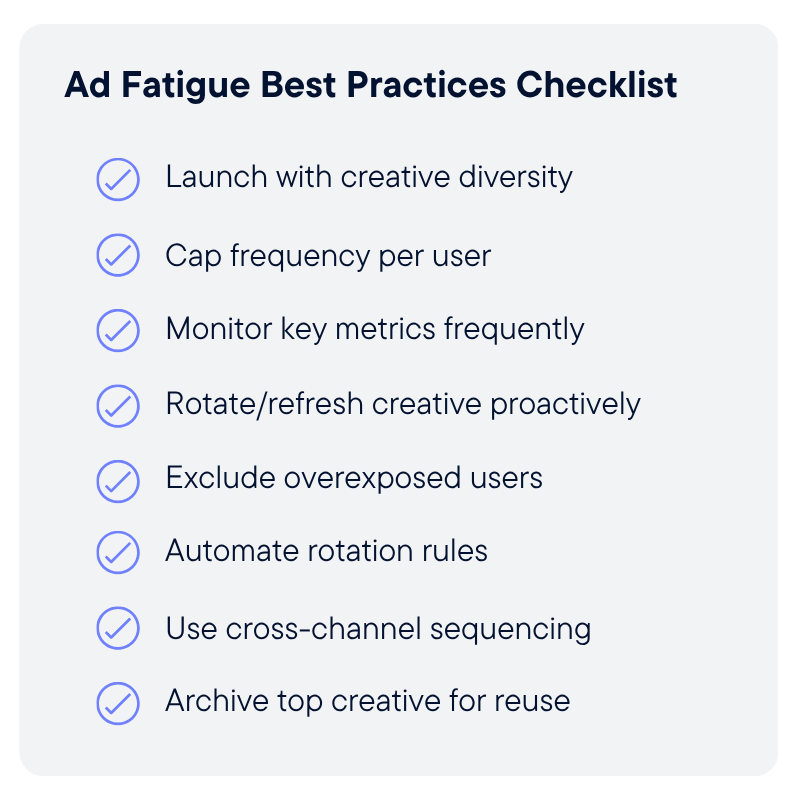
Launch With Creative Diversity
Start every campaign with multiple visuals, headlines, and CTAs to reduce early repetition and provide a strong foundation for testing and optimization.
Cap Frequency Per User
Limit how often each user sees your ad to avoid overexposure and irritation. This helps maintain engagement and keeps brand sentiment positive.
Monitor Key Metrics Frequently
Track CTR, CPC, CPM, ROAS, and frequency together. Sudden shifts or cost spikes often signal the first signs of ad fatigue in campaigns.
Rotate Or Refresh Creative Proactively
Don’t wait for performance to collapse. Schedule creative updates based on engagement trends, campaign length, or key seasonality shifts.
Exclude Overexposed Users
Use audience exclusions to remove people who’ve already converted or seen your ad too many times. This helps reset your exposure balance and keeps targeting efficient.
Automate Rotation Rules
Apply automated triggers or platform rules to pause stale creatives and prioritize high-performing variants. Automation keeps campaigns agile without constant manual oversight.
Use Cross-Channel Sequencing
Guide users through a story across channels. For example, build awareness with video, drive engagement on socials, and convert through display retargeting.
Archive Top Creatives For Reuse (With Variation)
Keep a library of proven creatives to repurpose later with refreshed visuals or copy. This saves production time while maintaining the proven performance of earlier assets.
Keep Your Campaigns Fresh & Your ROI Strong
Ad campaign fatigue doesn’t always look dramatic. It creeps in slowly, quietly draining performance and budget.
But with early detection and consistent creative refreshes, you can turn it from a hidden liability into an opportunity for smarter, more adaptive marketing.
Start by auditing your current campaigns. Look for early warning signs like declining engagement, rising costs, or growing audience frequency.
Then, act fast: implement at least two remedial tactics this week, whether it’s refreshing your creative, capping frequency, or testing a new audience segment.
For long-term resilience, build a fatigue-monitoring system. Use dashboards and automated alerts to catch drops early, schedule regular creative rotations, and make ad reviews a standing part of your campaign process.
Your best campaigns don’t have to fade quietly. Intervene early, stay creative, and keep testing. Freshness isn’t just about new ideas, it’s about maintaining momentum.


Product

RESOURCES
Support
Legal
Follow us
.svg)
