Comparison
Northbeam vs Prescient AI
At a glance
Northbeam is best for
Brands whose DTC site is the core of the business and that want observed, order-level attribution for daily buying, with MMM as a second lens.
The alternative is best for
Prescient AI is best for brands where more than half of revenue comes through Amazon or retailers such as Target and Walmart, and that need a model tying paid media to those sales.
Side-by-side comparison
| Capability | Northbeam | Prescient AI |
|---|---|---|
| Core method | Multi-touch attribution on observed clicks and verified views tied to real orders | Media mix model; campaign results are statistical estimates from aggregate data |
| How views are measured | Deterministic: views matched to orders by order ID, hashed email and phone | Modeled as halo effects |
| Order-level proof | Every credited touchpoint traces to an order | None; no user-level data by design |
| Daily output | Observed, ad-level attribution refreshed through the day | Daily, campaign-level model estimates |
| Attribution windows and accounting modes | Selectable windows; Cash Snapshot and Accrual Performance | Not applicable to an MMM |
| Amazon and in-store retail | DTC-first | Amazon halo and Multi-Retail Connectors for Target, Walmart, Ulta, Sephora |
| Incrementality testing | Automated lift tests that calibrate MTA and MMM+ | No native tests; accepts uploaded test results to calibrate the model |
| Signal sent back to ad platforms | Apex sends attributed credit per ad to Meta and AppLovin | None found |
Facts on this page are current as of November 2026 and are rechecked quarterly.
What is Prescient AI?
Prescient AI is a media mix modeling platform for omnichannel ecommerce. It connects without a pixel, shows first insights within days to two weeks, and produces daily campaign-level recommendations for brands spending $100K or more per month on advertising. Its models estimate halo effects, including the impact of off-Amazon media on Amazon sales, and its Multi-Retail Connectors, launched March 2026, measure paid media impact on in-store sales at retailers such as Target, Walmart, Ulta, Sephora and Nordstrom.
Where Prescient AI is strong
- Fast setup with no pixel and campaign-level output in days.
- Daily, campaign-level recommendations, unusual for an MMM.
- Amazon and retail halo measurement; a 2024 Prescient release cited customer Catalina Crunch attributing 15% of Amazon gross sales to off-Amazon paid media.
- Forecasting for future spend scenarios.
- No dependence on user-level tracking, so privacy changes do not degrade it.
Where Northbeam wins: observed versus modeled
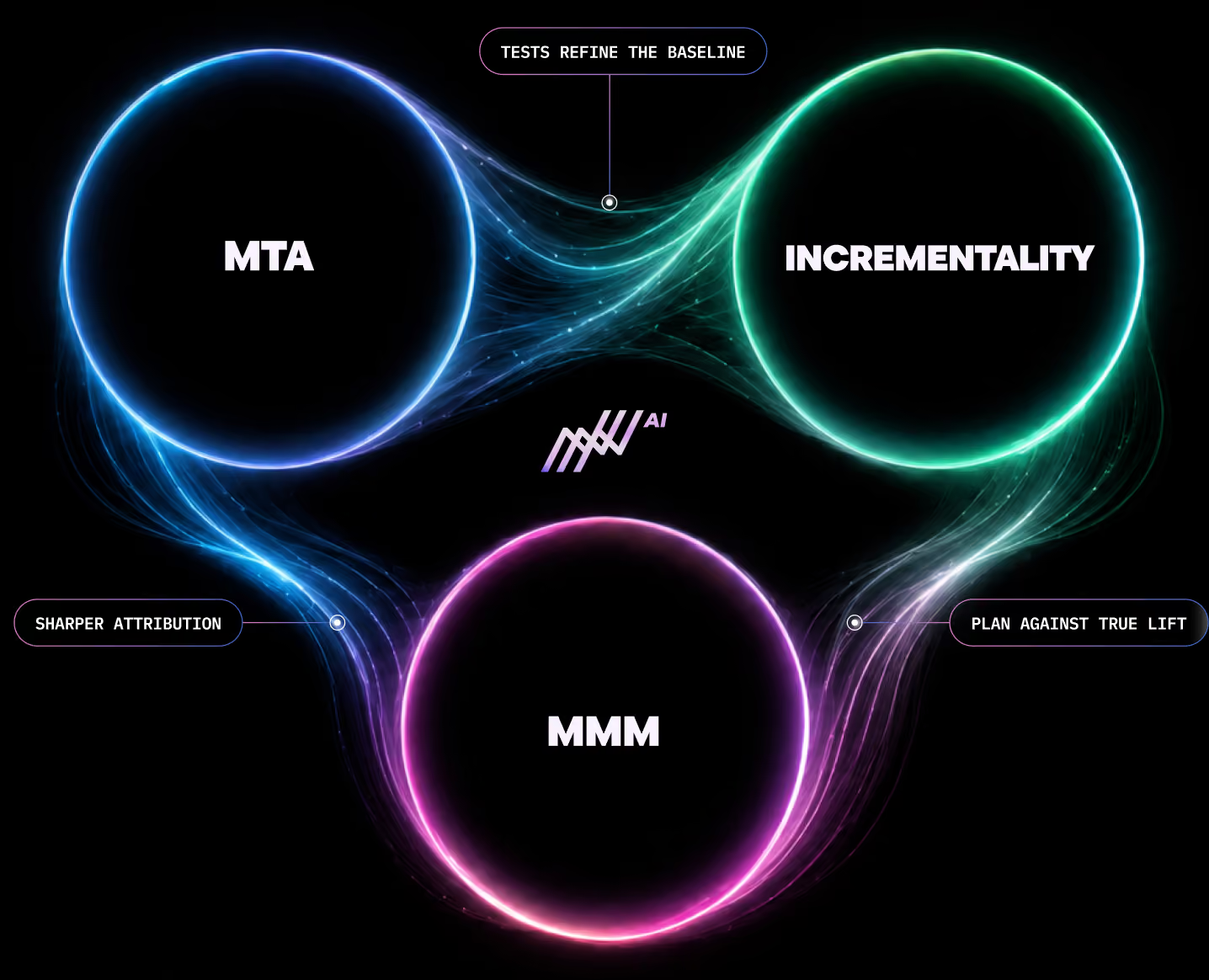
Prescient's daily numbers are model estimates from aggregate data. Northbeam's are observed: every click and every verified view from 16 platforms is matched to a real order by exact identifiers such as order ID, hashed email or phone, and every credited touchpoint traces back to that order. Both tools produce a daily read; only one can show you the orders behind it. Northbeam adds MMM+ and automated incrementality tests on the same data, so the modeled view and the observed view reconcile.
If Amazon and retail are more than half of your revenue, Prescient's halo and retail measurement is the better fit today, and some brands run an MMM alongside Northbeam for that reason.
Apex: only observed attribution can feed the ad platform
Northbeam Apex is a direct integration between Northbeam and ad platforms. Instead of sending the raw conversion the way a pixel or Conversions API does, Apex sends Northbeam's attributed credit for each ad, calculated with the multi-touch model, window and accrual accounting you choose. On Meta it runs through Custom Attribution, refreshing as often as hourly, and Northbeam's A/B testing has shown up to 25% higher ROAS. Apex is live on Meta and AppLovin, with Snap in closed beta, and it adds to your existing pixel and CAPI setup rather than replacing it.
A model estimate cannot be sent to Meta as a per-ad signal. Apex works because Northbeam's credit is tied to real orders and real touchpoints.
Verdict
Choose Prescient AI if more than half of your revenue comes through Amazon or retail and you need a model that ties paid media to those sales. Choose Northbeam if your DTC site is the core of the business and you want observed, order-level attribution for daily buying, with MMM as a second lens and Apex feeding Meta.
Frequently asked questions
Is Prescient AI an attribution tool or an MMM?
Prescient AI is a media mix modeling platform. It estimates channel and campaign impact, including halo effects, from aggregate data and does not track individual customer journeys. Northbeam is a multi-touch attribution platform that matches clicks and verified ad views to real orders, and also offers MMM+, incrementality testing and Apex.
What is the difference between halo effects and deterministic views?
Halo effects, as used by Prescient AI, are a model's estimate of sales influenced by ads people saw but did not click. Deterministic views, as used in Northbeam's Clicks + Deterministic Views model, are verified ad impressions matched to specific orders using exact identifiers.
Can I use Prescient AI and Northbeam together?
Yes. Some brands run a media mix model such as Prescient AI alongside Northbeam, using Northbeam for observed, order-level attribution and daily buying decisions and the MMM for Amazon and retail halo planning. Northbeam also includes its own MMM+ calibrated with incrementality tests.
Get the tool designed for profitable growth.


Product

RESOURCES
Support
Legal
Follow us

