




Customer acquisition is rarely a straight line. Prospects move across channels, touchpoints, and moments of intent, making it difficult to understand what actually drives conversion.
This customer acquisition funnel guide for marketers breaks down how to build a system so you can align channels, tracking, and attribution and turn growth into a repeatable, measurable system.
What a Customer Acquisition Funnel Is & Why It’s Critical
A funnel for customer acquisition is a structured way to map how potential customers move from first awareness of your brand to conversion, and in many cases beyond that initial purchase.
Instead of treating acquisition as a single moment or channel, the funnel breaks the journey into stages, each with a clear goal, message, and action.
Common stages include awareness, interest, consideration or evaluation, intent, and conversion. The exact labels may vary, but the purpose is the same: to make an otherwise messy, multi-touch journey understandable and actionable.
This structure matters because it brings alignment and focus to growth efforts. When teams agree on funnel stages, marketing and sales can align on what a qualified prospect looks like at each point and what should happen next.
It then becomes easier to spot where prospects drop off, where messaging is unclear, or where friction is slowing momentum.
Instead of optimizing in isolation, teams can improve funnel efficiency stage by stage, measuring conversion rates, drop-off, and cost at each step. That clarity is what turns acquisition from a guessing game into a repeatable system.
Invest in purpose-building your customer acquisition funnel for paid traffic and attribution. Every funnel stage implies specific touchpoints and behaviors, such as ad clicks, landing page views, form submissions, demo requests, or purchases.
When you map the funnel, you also define which events need to be tracked and how they connect across channels and systems. This makes it possible to understand not just which channel generated traffic, but which interactions actually contributed to revenue.
In practice, that leads to clearer ROI measurement, better budget allocation, and more confident optimization decisions across the entire acquisition motion.
How to Build a Customer Acquisition Funnel (Step-by-Step)
The steps below break the process of customer acquisition funnel building into practical, repeatable actions.
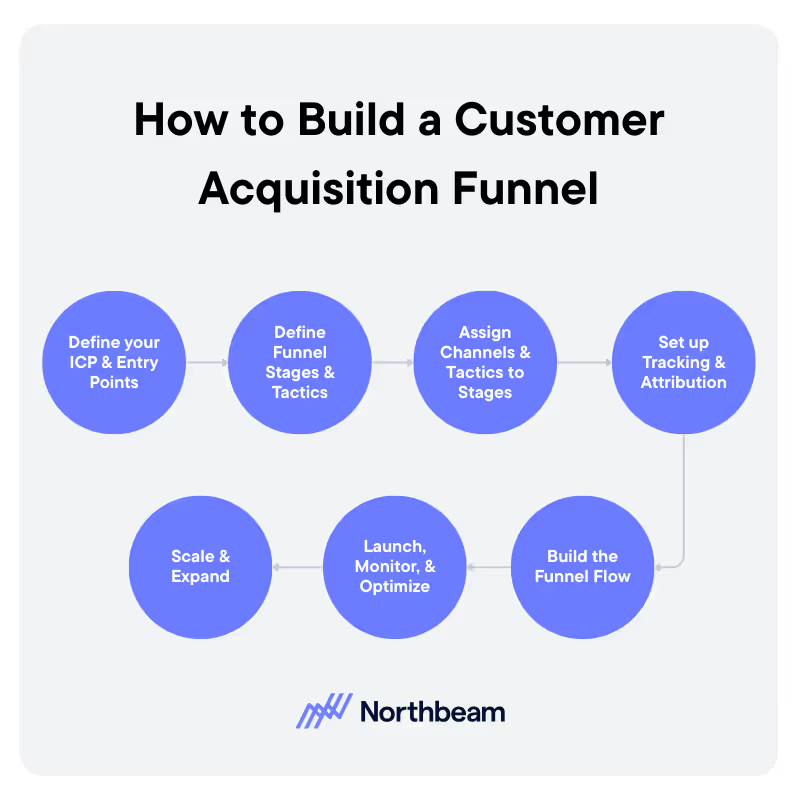
Define Your Ideal Customer & Journey Entry Points
- Develop clear buyer personas, including demographics, firmographics where relevant, pain points, motivations, behaviors, and preferred channels.
- Identify how and where prospects first encounter your brand, such as paid ads, search, referrals, social content, or partnerships.
- Map initial entry points visually to understand how different audiences enter the funnel and where they should go next.
Define Funnel Stages & Corresponding Tactics
- Establish your funnel stages, typically Awareness, Interest, Consideration or Evaluation, Intent, and Conversion.
- For each stage, define the prospect’s goal, the action you want them to take, and the message or value proposition that supports it.
- Align tactics to stage, for example paid search or display at Awareness, content or email nurture at Interest, and optimized checkout or signup flows at Conversion.
Select Channels & Tactics for Each Stage
- Map which channels and tactics feed each funnel stage, including paid media, organic search, retargeting, referrals, and email.
- Align creative format and messaging to stage, recognizing that early-stage education differs from late-stage decision support.
- Consider how attribution will capture each channel’s contribution across stages, not just at the final conversion.
Set Up Tracking & Attribution for the Funnel
- Define key events and micro-conversions at each stage, such as ad clicks, landing page views, form submissions, demo requests, or purchases.
- Ensure proper instrumentation, including UTMs, unique identifiers, and integration between ad platforms, analytics tools, and CRM systems.
- Align funnel events with your attribution model, whether first touch, last touch, or multi-touch, and establish baseline metrics like stage conversion rate, drop-off, CPA, and CAC.
Build the Funnel Flow & Experience
- Design the end-to-end user path, such as ad to landing page, landing page to nurture, nurture to offer, and offer to conversion.
- Optimize transitions between steps by reducing friction, clarifying value propositions, and using consistent messaging and CTAs.
- Use automation and segmentation to tailor the experience based on funnel stage, behavior, or acquisition source.
Launch, Monitor & Optimize
- Launch the funnel using a mix of paid and organic traffic to generate early data.
- Monitor performance by stage, focusing on conversion rates, drop-off points, CPA, CAC, and time to conversion.
- Identify bottlenecks and iterate through testing, including creative, landing pages, retargeting logic, offers, and segmentation.
Scale and Expand
- Scale spend and effort on high-performing channels and tactics while refining or reducing lower-performing ones.
- Extend the funnel beyond acquisition by adding retention, expansion, or upsell paths where appropriate.
- Revisit tracking and attribution regularly to ensure measurement stays accurate as channels, tactics, and customer behavior evolve.
Metrics, Attribution, & Dashboarding
Once your acquisition funnel is defined and live, measurement is what turns it into a system you can actually manage.
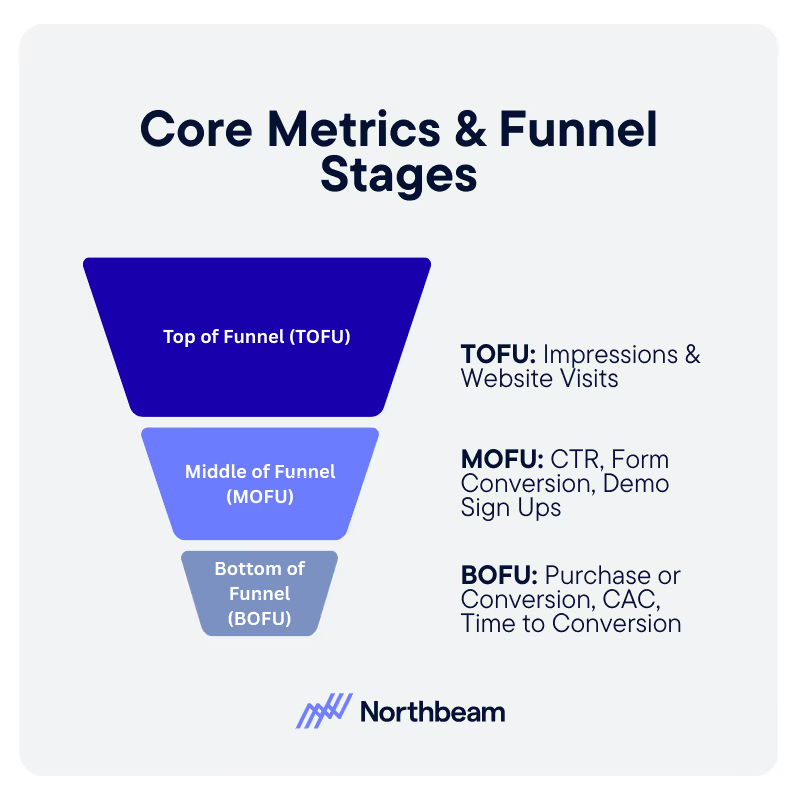
The goal is not to track everything, but to track the metrics that show how prospects move through each stage, where value is created, and where friction or waste exists. At a minimum, this means monitoring top-of-funnel volume, mid-funnel progression, and bottom-of-funnel efficiency in a way that connects activity to outcomes.
Core metrics should map directly to funnel stages.
- At the top of the funnel, track impressions and website visits to understand reach and demand generation.
- As prospects move forward, monitor click-through rate, lead form or content conversion, and demo or trial sign-ups to measure engagement and intent.
- At the bottom of the funnel, focus on purchase or activation conversion, customer acquisition cost, and time to conversion.
Looking at these metrics stage by stage makes it easier to isolate problems and avoid over-optimizing for traffic at the expense of revenue.
Because acquisition funnels span multiple channels and touchpoints, attribution is critical. Event tracking should be implemented consistently across stages so you can see the full conversion path, not just the final interaction.
Multi-touch attribution models are often better suited to this reality, as they help surface which channels introduce demand, which nurture it, and which close it. The objective is to understand contribution, not just credit, so budget and strategy decisions reflect real impact.
Dashboards should make these insights visible and actionable. Common views include a stage-by-stage lead-to-customer funnel conversion cascade, a drop-off heatmap to highlight friction points, and channel performance broken out by funnel stage.
Cost metrics layered against conversion rate and time to convert are especially useful for identifying efficiency gains. Where possible, use hold-out or control groups to test new channels, messages, or funnel changes, allowing you to measure incremental lift rather than assuming correlation equals impact.
Common Pitfalls & What to Avoid
The pitfalls below are some of the most common reasons funnels fail to deliver measurable, scalable results.
Vague or Undefined Funnel Stages
When funnel stages are loosely defined or inconsistently named, measurement quickly breaks down. Teams struggle to agree on what success looks like at each stage, which leads to unclear reporting and unreliable attribution.
Clear stage definitions are essential for understanding progression, drop-off, and performance.
Missing or Incomplete Tracking
If key events are not instrumented, especially at transitions between stages, you lose visibility into where prospects drop off. Gaps in tracking make it impossible to diagnose issues or prove impact.
Every meaningful action in the funnel should be tracked and connected across systems.
Over-Focusing on Top-of-Funnel Traffic
Driving traffic without equal attention to conversion and retention often leads to rising costs and disappointing returns. A healthy funnel optimizes volume and efficiency together.
Ignoring mid- and bottom-of-funnel performance creates the illusion of growth without sustainable results.
Misaligned Channels and Funnel Stages
Using the wrong tactic at the wrong stage creates friction and wastes budget. Messaging geared at awareness at the conversion stage, or aggressive sales CTAs too early in the journey, can push prospects away.
Channels, creative, and offers should always match the intent of the funnel stage.
Launching Without Attribution Logic
Launching a funnel before defining attribution rules makes optimization guesswork. Without a clear model in place, teams cannot reliably connect spend to outcomes or understand which tactics are driving value.
Attribution should be considered part of funnel design, not an afterthought.
Ignoring Funnel Drop-Off
Assuming that all traffic will eventually convert hides real performance issues. Drop-off is inevitable, but it should be measured and managed. Each stage deserves attention to reduce friction and improve progression.
Failing to Revisit and Evolve the Funnel
Customer behavior, channels, and platforms change over time. Funnels that are not revisited and adjusted gradually lose effectiveness. Regular review and iteration are necessary to keep acquisition strategies aligned with how people actually buy.
Case Study: Turning Funnel Visibility Into Lower CAC
A SaaS company selling a subscription product to small business owners wants to bring structure to its acquisition efforts. The team starts by defining a clear primary persona: owners who are cost-conscious, time-limited, and actively searching for tools to improve efficiency. From there, they design a funnel that reflects how this audience actually evaluates software.
At the top of the funnel, the company runs paid search and paid social campaigns to drive awareness and capture initial interest. Prospects who click through are offered a free downloadable guide, which serves as the primary interest-stage conversion.
For consideration, the funnel directs engaged users to case studies and a demo request. At the bottom of the funnel, qualified prospects are invited to start a free trial, with the goal of converting them into paid subscribers.
To measure performance, the team instruments key events across the funnel, including guide downloads, demo requests, trial starts, and paid conversions.
Early reporting reveals a significant drop-off between the guide download and demo request stages. While top-of-funnel traffic is strong, too few prospects are progressing into active evaluation.
In response, the team adjusts its messaging to better bridge the gap between education and product value. They introduce a targeted email nurture sequence that follows the guide download, reinforces the use case, and clearly positions the demo as the next logical step.
Within weeks, the conversion rate from guide download to demo request improves meaningfully.
Attribution analysis shows that paid search continues to drive the majority of trial starts, while paid social plays a stronger role in early discovery. Armed with this insight, the company reallocates budget to emphasize high-intent search while refining social retargeting.
As a result, cost per acquisition drops and overall customer acquisition cost improves, without sacrificing volume.
Actionable Next Steps & Implementation Checklist
Use the checklist below to translate your acquisition funnel strategy into action, ensuring each stage is clearly defined, measurable, and built for iteration and scale.
1. Define Your Customer and Entry Points
Map your ideal customer profile or profiles and list the primary channels where those audiences first encounter your brand, such as paid search, social, referrals, or content.
2. Establish Clear Funnel Stages
Define the funnel stages that reflect your buying journey, for example Awareness, Interest, Consideration, and Conversion. Ensure each stage has a clear purpose and outcome.
3. Assign Tactics and Success Metrics
For each stage, select one or two core tactics or channels and define a primary success metric, such as CTR, form completion, demo requests, or purchases.
4. Set Up Tracking and Attribution
List the key events and micro-conversions for each stage and confirm that UTMs, unique identifiers, analytics tools, and CRM systems are properly connected.
5. Launch a Pilot Funnel
Start with a modest budget and drive traffic through the full funnel. Monitor performance by stage to identify early bottlenecks or drop-off points.
6. Build a Practical Dashboard
Create a dashboard that shows stage conversion rates, channel performance by funnel stage, drop-off analysis, and cost metrics like CPA.
7. Optimize and Scale
Focus on improving one bottleneck at a time, measuring impact before moving on. Once performance stabilizes, scale budget on the strongest tactics and revisit your attribution model to ensure accurate measurement of acquisition cost and value.
By clearly defining each funnel stage, instrumenting the right metrics, and iterating based on real attribution data, teams can turn customer acquisition from a collection of disconnected tactics into a scalable, measurable growth engine.









































.avif)






















%25201.avif)


.avif)













.svg)
