
Blog

Points of Parity vs. Points of Difference: Finding Your Brand’s Competitive Sweet Spot

Meet Category Expectations While Standing Out in Meaningful Ways
Points of Parity vs. Points of Difference: Finding Your Brand’s Competitive Sweet Spot

TL;DR

  • POPs are the baseline features customers expect from any brand in your category, and PODs are your reason to be chosen.
  • Balancing POPs and PODs is essential. Too much sameness makes you forgettable; too much difference makes you confusing or irrelevant.
  • Audit your POPs, define strong PODs, craft clear messaging, and revisit your positioning regularly as markets evolve.
  • Positioning is never “done.” What’s unique today becomes tomorrow’s baseline. Consistent refinement keeps your brand defensible and distinctive.

The tension of fitting in enough to be trusted, while standing out enough to be chosen is at the heart of building a strong brand position in any market.

This guide breaks down the two pillars of modern positioning: Points of Parity (POPs), the essential attributes your brand must share with competitors, and Points of Difference (PODs), the meaningful advantages that set you apart.

You’ll learn what they are, why they matter, how to balance them, and how to convert the framework into a clear, defensible strategy.

Whether you’re refining a mature brand or defining a new one, this article will help you find your competitive sweet spot: the space where credibility meets differentiation and customers feel confident choosing you.

What are Points of Parity (POPs) and Points of Difference (PODs)
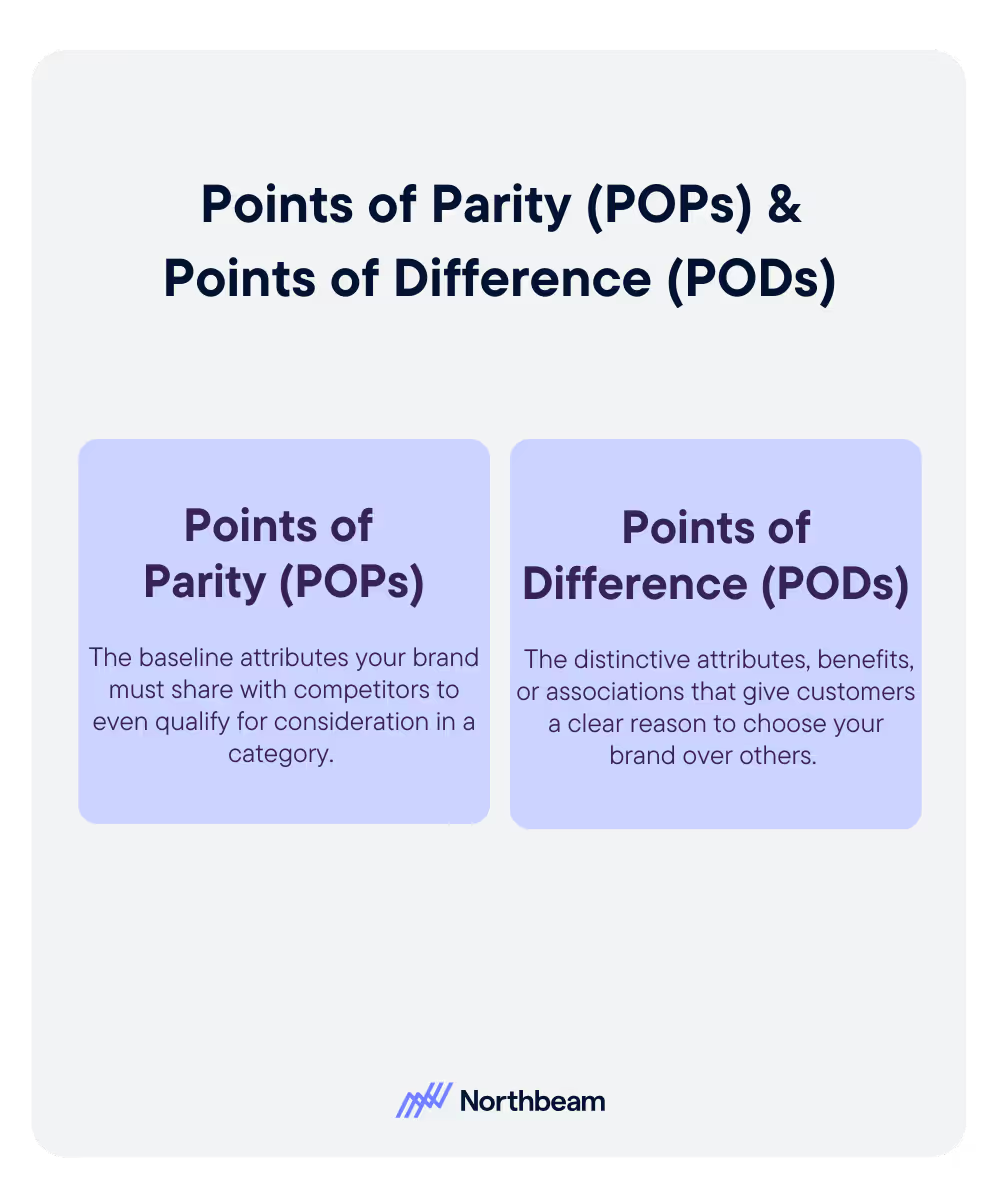
Here’s how to define points of parity and points of difference for your brand:

Points of Parity (POPs) & Why They Matter

Points of Parity, or POPs, are the baseline attributes your brand must share with competitors to even qualify for consideration in a category.

These are the features customers assume you offer. POPs don’t make you unique, and they’re not meant to. They simply signal that your brand belongs in the competitive set and can deliver the core value the category promises.

POPs establish credibility. A brand that fails to meet category expectations doesn’t just underperform, it gets dismissed entirely. If you don’t meet the non-negotiables, your unique strengths never get a chance to matter.

Most categories have clear POPs:

  • For streaming services, the minimum expectations might include a wide selection of content, multi-device support, and an ad-free premium plan.
  • In banking, POPs might include mobile access, security standards, and customer support.
  • In fitness apps, users expect progress tracking, personalized workouts, and basic integration with wearables.

This baseline changes over time as standards evolve, but the idea remains: POPs are the price of entry. Without them, even strong differentiators can’t keep you from being filtered out early in the decision process.

Now let’s discuss brand parity vs differentiation:

Points of Difference (PODs) & Why They Matter

Points of Difference, or PODs, are the distinctive attributes, benefits, or associations that give customers a clear reason to choose your brand over others.

Where POPs establish that you belong in the category, PODs define why you deserve preference. They’re the elements that make your brand memorable, compelling, and worth talking about.

Effective PODs create meaningful differentiation that customers value. When they’re strong, relevant, and credible, PODs can drive higher conversion rates, support premium pricing, and deepen long-term loyalty.

Examples show how PODs work in practice:

  • A smartphone might position a revolutionary camera system or breakthrough battery life as its signature difference.
  • A budget airline might win by leaning into ultra-low pricing and radical simplicity, offering a stripped-back experience that aligns with what its specific customers care about most.

In both cases, the POD gives buyers a concrete reason to prefer one brand over another.

But if your brand doesn’t meet basic category expectations (POPs), even the strongest differentiator won’t save you. Differentiation only drives value when the foundation is already in place.

Finding the Sweet Spot Between POP and POD in Brand Strategy

Focus too much on POPs, and you become interchangeable, competing on price or convenience instead of value.

Focus too much on PODs without meeting the basics, and you risk confusing customers or falling outside the category frame entirely.

The goal is to find the balance: credible enough to belong, distinct enough to win.

Here’s how to find your brand’s competitive sweet spot when it comes to points of parity vs difference:

1. Audit Your Category’s Required POPs

Start by clarifying the non-negotiables in your category. What does every credible brand have to offer?

These expectations may come from customer research, competitor analysis, or emerging industry standards. Until your POPs are consistently met, differentiation won’t land.

2. Map Your Brand’s Existing PODs

Next, identify what genuinely sets your brand apart. Look for strengths that are not only unique, but also desirable and believable. A POD must be rooted in something real (product quality, a signature experience, a proprietary capability) or customers won’t adopt it as meaningful.

3. Check Overlap, Clarity, and Defensibility

Some PODs can unintentionally conflict with POP expectations or become too easy for competitors to copy.

Validate that your differentiators reinforce, rather than undermine, the baseline attributes customers expect. And pressure-test whether your PODs can hold up over time.

4. Communicate in the Right Order

Messaging should reassure first and differentiate second. Show that you meet category standards, then layer on the unique value only you provide. This sequencing makes your PODs more persuasive.

5. Monitor and Evolve

POPs shift as yesterday’s innovations become today’s baseline, and PODs erode as competitors imitate. Revisit your brand positioning regularly to stay ahead of those shifts and protect your advantage.

Applying This to Brand Strategy: Steps for Marketers

Turning POPs and PODs into a usable positioning strategy requires moving from analysis to execution.

These steps help teams translate insights into a narrative the market can understand and act on:

Start With a Category Reality Check

Before defining your own position, ground yourself in the category’s truth. Review competitors, study their claims, and catalog the expectations customers already hold.

This gives you a working map of the “must-haves:” the POPs your brand cannot afford to miss.

Listen for What Actually Matters

Next, gather the customer perspective. Look at reviews, interview users, and analyze behavioral data to learn which attributes drive trust, trial, and repeat use. This helps you separate superficial differences from the things people genuinely value.

Name Your Advantage

Once you understand both the market and the customer, articulate the strengths your brand can uniquely and credibly claim.

Focus on differentiators you can back up consistently; not aspirational qualities, but real advantages that can serve as durable PODs.

Build the Positioning Narrative

This is where strategy becomes story. Craft messaging that first establishes credibility through your POPs, then sharpens into your differentiators. This should cascade across website copy, product pages, sales materials, and campaigns.

Create a System for Ongoing Refinement

Build a quarterly or biannual checkpoint to reassess what has become baseline, what still differentiates you, and where new opportunities are emerging.

Common Pitfalls & Strategic Traps
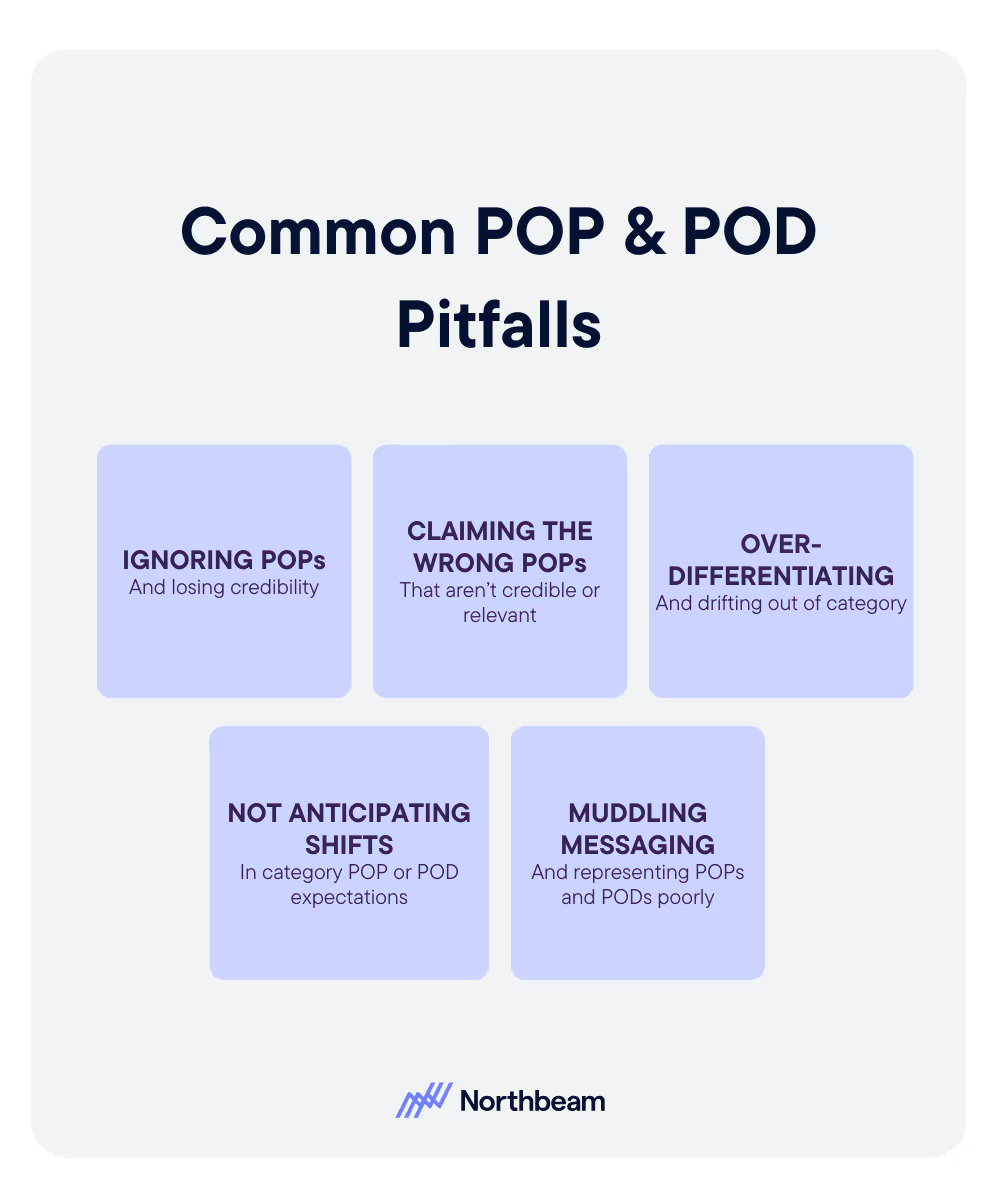
Even well-positioned brands can lose their footing if they mismanage the balance between POPs and PODs.

These are the mistakes that most often undermine otherwise solid strategies:

Ignoring POPs and Losing Credibility

Some brands focus so heavily on innovation that they overlook the basics. When you fail to meet core category standards, customers won’t consider you, even if your differentiators are strong.

Claiming PODs That Aren’t Credible or Relevant

A POD only works if customers believe it and value it. Differentiators that are exaggerated, niche, or internally beloved but externally meaningless won’t create preference.

Over-Differentiating and Drifting Out of the Category

Brands sometimes push uniqueness so far that customers can’t tell what category they’re in. When you fall outside the expected frame of reference, the market doesn’t see you as innovative, it sees you as confusing.

Not Anticipating Shifts in Category Expectations

What starts as a compelling POD often becomes a baseline expectation over time. If you don’t update your positioning when competitors catch up, your once-unique advantage turns into table stakes.

Muddled Messaging That Blends POPs and PODs Poorly

Trying to communicate everything at once is a quick route to brand confusion. When POPs and PODs aren’t clearly separated, or are presented in the wrong order, your message can sound contradictory.

How POPs and PODs Play Out in the Real World

To see how POPs and PODs work in practice, it helps to look at two very different categories; one saturated with global competition, the other hyper-local.

Brand A: Standing Out in the Smartphone Market

Brand A starts by meeting every baseline expectation in its category.

It delivers the standard hardware package customers assume: a responsive touchscreen, reliable internet access, and a competitive camera. These POPs ensure the brand feels credible next to better-known competitors.

From there, Brand A defines its POD: an industry-leading battery life paired with an AI-driven camera system.

These differentiators are both desirable and believable, grounded in real product performance. In its messaging, the brand first reassures customers it checks every essential box, then highlights the advantages that make it a smarter choice for power users and mobile photographers.

Brand B: Differentiating a Local Coffee Shop

A neighborhood coffee shop begins with familiar POPs: quality coffee, seating, and free WiFi. These basics signal that it provides the experience customers expect from any modern café.

Its PODs come from what makes it uniquely local: house-roasted beans, community-driven events, and sustainability certifications.

These differentiators resonate with customers who value craft, connection, and ethical sourcing. The shop’s communication emphasizes warmth, transparency, and neighborhood identity, creating distinction in a crowded market of similar offerings.

Both brands succeed by auditing their POPs, defining credible PODs, and communicating in a way that reinforces category fit while showcasing what makes them stand out.

Actionable Next Steps for Your Team: POPs and PODs

Here are practical steps your team can take to put POPs and PODs into action:

Map Your Top 5 POPs

List the key category expectations every credible competitor meets. Then, mark where your brand stands: met, partially met, or not met. This reveals any foundational gaps that could undermine your positioning.

Pinpoint 1-2 Strong POD Candidates

Identify the unique benefits or features your brand can credibly claim. Focus on differentiators that align with customer insight and are desirable, believable, and hard to replicate.

Write a Clear Positioning Statement

Craft or refine a positioning statement that explicitly pairs your POP baseline with your POD value proposition. This helps unify internal teams and anchors future messaging.

Refresh Your Messaging and Assets

Audit your website, sales collateral, ad campaigns, and social presence. Ensure each channel first establishes category credibility, then reinforces your differentiators with clarity and consistency.

Review and Adjust Quarterly

Revisit your POPs and PODs regularly. Ask whether any existing PODs have become category norms, and whether emerging strengths could replace them. This cadence keeps your advantage fresh and defensible.

Bringing Your Positioning Into Focus

Effective brand positioning is about understanding how POPs and PODs work together to create a foundation your audience trusts, and a reason they prefer you.

When you meet category expectations and layer on meaningful differentiation, you give customers both confidence and clarity: the two ingredients that drive real choice.

As your market evolves, so will the line between what’s expected and what’s unique. Revisit your POPs, refine your PODs, and keep your messaging disciplined and intentional.

The sweet spot is always shifting, but with a structured approach, your brand can stay grounded, distinctive, and unmistakably itself.

Continue Reading

Ad Operations 101: How Digital Ads Get Delivered

Ad Operations 101: How Digital Ads Get Delivered

Ad Ops Systems, Workflows, and Delivery Mechanics
How to Build a Customer Acquisition Funnel (Step-by-Step Guide)

How to Build a Customer Acquisition Funnel (Step-by-Step Guide)

Designing, Measure, and Optimize Customer Acquisition
Mid-Funnel Strategies: Nurturing Prospects from Consideration to Intent

Mid-Funnel Strategies: Nurturing Prospects from Consideration to Intent

Don’t Lose Momentum Mid-Funnel
Measuring Brand Performance How To Track Awareness Loyalty And Perception

Measuring Brand Performance: How to Track Awareness, Loyalty, & Perception

Connect Brand Health to Real Business Impact
performance-marketing-channels-guide-to-ppc-affiliates Performance marketing Channels A Guide To PPC Affiliates And More

Performance Marketing Channels: A Guide to PPC, Affiliates, & More

Your end-to-end playbook for selecting the right performance channels
What Is the Meta Conversions API? Implementing Server-Side Tracking in a Privacy-First World

What Is the Meta Conversions API? Implementing Server-Side Tracking in a Privacy-First World

Pair Pixel with CAPI for Accurate Measurements
Gamification Marketing: Using Game Mechanics To Boost Ad Engagement & Attribution

Gamification Marketing: Using Game Mechanics to Boost Ad Engagement & Attribution

How can gamification help your marketing ads and attribution?
LinkedIn Segment Reporting How To Analyze Your Ad Audiences

LinkedIn Segment Reporting: How to Analyze Your Ad Audiences on LinkedIn

Use LinkedIn for Smarter Targeting, Creative, and Budget Decisions
Cyber Week 2025 A Data Driven Look At Performance And Strategy

Cyber Week 2025: A Data‑Driven Look at Performance and Strategy

A data-driven look at how DTC brands actually performed during Cyber Week 2025, and why you should adjust your channel mix, pacing, and benchmarks before next year.
Second Party Data Tapping Into Trusted Partner Data For Marketing

Second-Party Data: Tapping Into Trusted Partner Data for Marketing

A Practical Guide to Partner-Sourced Data
Is Your Company Data Mature Understanding Data Maturity Models For Marketing

Is Your Company Data-Mature? Understanding Data Maturity Models for Marketing

Is Your Team Really “Data Driven?”
Introducing Incrementality By Northbeam: Automated Lift Testing You Can Trust

Introducing Incrementality by Northbeam: Automated Lift Testing You Can Trust

Run incrementality tests end-to-end inside Northbeam—automated design, rigorous validation, and unified results alongside your MTA and MMM for confident, daily decision-making.
Reporting on Marketing Automation Performance: Proving the ROI of Your Drip Campaigns

Reporting on Marketing Automation Performance: Proving the ROI of Your Drip Campaigns

Measure, Attribute, and Prove Business Value
Marketing Funnel Automation Scaling Engagement On Autopilot

Marketing Funnel Automation: Scaling Engagement on Autopilot

Build, Automate, and Measure
Why New Customer ROAS Matters More Than Blended Metrics

Why New Customer ROAS Matters More Than Blended Metrics

Why optimizing to New Customer ROAS (nROAS) — not blended ROAS — is the only way to scale net‑new growth, with a simple daily workflow to make it operational.
Channel Strategy How To Choose The Right Marketing Channels For Your Business

Channel Strategy: How to Choose the Right Marketing Channels for Your Business

Evaluate, Test, and Optimize Your Marketing Channels
Ad Fatigue In Digital Marketing How To Recognize And Remedy It

Ad Fatigue in Digital Marketing: How to Recognize & Remedy It

How to Know When Your Audience Has Seen Enough
Churn Analysis Identifying Why Customers Leave And How To Win Them Back

Churn Analysis: Identifying Why Customers Leave (And How to Win Them Back)

Uncover Churn Drivers and Build Stronger Retention Strategies
Funnel Creation Made Simple How To Map Out Your Marketing Funnel

Funnel Creation Made Simple: How to Map Out Your Marketing Funnel

Map, Measure, and Optimize the Customer Journey
Kill Last Click Bias A Simple Playbook For Read During BFCM

Kill Last‑Click Bias: A Simple Playbook for Reads During BFCM

A practical, windowed-read playbook—short for capture, longer for prospecting—to avoid last‑click bias during Cyber Five.
The Cyber Five Pattern What To Expect Heading Into BFCM

The Cyber Five Pattern: What to expect Heading Into BFCM

Planning Cyber Five with pattern‑based pacing and clear measurement reads.
What Is MAU Tracking Monthly Active Users To Gauge Growth

What Is MAU? Tracking Monthly Active Users to Gauge Growth

Learn what Monthly Active Users (MAU) means, how to measure it accurately, and how to use MAU trends to improve product engagement, retention, and growth.
User Segmentation Strategies How To Personalize Marketing For Every Audience

User Segmentation Strategies: How to Personalize Marketing for Every Audience

Learn how to build and activate user segments that power personalized marketing, boost engagement, and drive long-term customer loyalty.
Which Campaigns Benefit Most From CDV

Which Campaigns Benefit Most from C+DV? Prospecting, Reach/Traffic, and Retention by the Numbers

Learning How C+DV Evens the Playing Field
Fogg Behavior Model: Motivation, Ability, and Prompts

Fogg Behavior Model: Motivation, Ability, and Prompts

Apply Behavior Design Principles to Your Marketing Strategy
Lifecycle Marketing 101 For Every Stage Of The Customer Journey

Lifecycle Marketing 101: Engaging Customers at Every Stage of the Journey

Build Customer Relationships That Last

Benchmarks & Stoplights: Turning Data Into Daily Decisions for Ad Optimization

Turn your best performance days into a live decision system with clear green, yellow, and red signals—so your team knows exactly when to scale, pause, or pivot.
Behavioral Data In Marketing How User Behavior Drives Growth

Behavioral Data In Marketing: How User Behavior Drives Growth

Optimize journeys and personalize experiences
Cohort Analysis For Marketers Uncovering Trends In Customer Behavior

Cohort Analysis for Marketers: Uncovering Trends In Customer Behavior

Learn how to use cohort analysis to track retention, forecast LTV, and drive sustainable growth.
User Stickiness How To Measure Customer Engagement Metric

User Stickiness: The Metric to Measure Customer Engagement (and How to Improve It)

Discover how to calculate and improve user stickiness (DAU/MAU) — the key metric for measuring customer engagement and loyalty.

The PESO Model: Integrating Paid, Earned, Shared, and Owned Media

Learn how the PESO model unifies Paid, Earned, Shared, and Owned media into one powerful strategy.
reasons your awarness campaigns arent driving revenue

7 Reasons Your Awareness Campaigns Aren’t Driving Revenue

How evolving attribution models, creative strategy, and platform dynamics are redefining top-of-funnel success this BFCM season.

How Omnilux Drove a 659% ROAS Lift on Pinterest with Northbeam’s Clicks + Deterministic Views

A case study with Northbeam's newest attribution model.
Clicks + Deterministic Views, by Northbeam.

Introducing Clicks + Deterministic Views by Northbeam

A revolutionary new viewthrough model, now available in Northbeam.

Contextual Targeting In Advertising: Reaching Audiences Without Cookies

Discover how contextual targeting delivers privacy-first, high-performing ads without cookies.

First vs Second vs Third-Party Data: What Are They and Why They Matter

Learn the differences between first-, second-, and third-party data.

Zero-Party Data: The New Gold Standard in Privacy-First Marketing

Learn best practices for collection, activation, and governance to drive trust and ROI.
The Explore Exploit Cycle Of Meta's Algorithm

The Explore–Exploit Cycle of Meta’s Algorithm

Why Meta’s algorithm makes performance swing — and how to ride the cycle instead of panicking through the dips.
what-is-gclid-complete-guide-to-google-click-identifier

What Is GCLID? Complete Guide to Google Click Identifier

Learn what GCLID is, how it works, and why it’s essential for accurate Google Ads tracking.
beyond roas fundamentals of advertising hero

Beyond ROAS: Fundamentals of Advertising In 2025

Why relying on ROAS alone can stunt growth—and the metrics that reveal if your ads are truly building a brand.

iOS 26 Won’t Kill Your UTMs – Here’s Proof

Despite headlines warning of doom, our testing shows iOS 26 leaves Northbeam’s UTMs untouched.
what-is-fcblid-guide-to-facebook-click-identifiers-and-tracking-ad-performance

What is fbclid? A Complete Guide to Facebook Click Identifiers and Tracking Ad Performance

This small URL parameter powers big improvements in Meta ad attribution

What Is Data-Driven Marketing? A Complete Guide to Transforming Your Marketing Strategy with Data

Leverage data to improve your marketing strategies

Why You Should Care About MTA, MMM, and Incrementality

Transform Your Marketing Performance
A futuristic cityscape with a glowing digital figure and a person studying analytics, symbolizing insights into Return on Ad Spend and mastering return on ad spend, with the Northbeam logo and text overlay.

What Is ROAS? A Beginner’s Guide to Return on Ad Spend

Learn why ROAS matters and how to maximize your returns
What makes Northbeam data different

What Makes Northbeam Data Different?

Not All Data is Created Equally

What to Expect When Switching to Northbeam

Everything You Need to Know When You Try Out Northbeam
Illustration of pixel tracking concept with magnifying glass over mechanical gears, symbolizing data analysis, and Northbeam logo in the top corner. Text reads: 'What is Pixel Tracking?

What is Pixel Tracking?

Unlock the Power of Pixel Tracking for Better Marketing Insights
What is Multi-Touch Attribution (MTA)?

Multi-Touch Attribution Models: A Complete Guide to Measuring Every Marketing Touchpoint

Understand, compare, and implement MTA for smarter marketing measurement

What is Media Mix Modeling (MMM)?

Wondering what exactly comprises Media Mix Modeling? Get a comprehensive overview of MMM

What is Marketing ROI and How Can You Improve It?

Understand and enhance your marketing ROI
Image of a man utilizing applovin on his phone and measuring the impact of his adds using Northbeam, the multi touch attribution solution for profitable growth

What is AppLovin and How to Leverage it For Marketing Success

Why DTC brands are flocking to AppLovin, and how to make it work for you

What is Marketing Intelligence Software?

Capture the right data for informed marketing decisions
This highlights key marketing metrics with a creative scene of a strategist building a futuristic ship, symbolizing innovation and long-term success strategies, with the Northbeam logo and text overlay.

Top Marketing Metrics to Track for Long-Term Success

Track these essential metrics to drive sustainable growth

What Is Incrementality In Marketing? A Guide to Measuring True Campaign Impact

The Critical Role of Attribution Models in Unlocking Growth
Northbeam presents a marketer’s guide to customer journey mapping, featuring a relaxed professional at a desk, symbolizing strategic planning and marketing success.

The Marketer’s Guide to Customer Journey Mapping

Turn messy customer paths into data-driven strategies for growth

The Future with YouTube Advertising

Navigating rising digital ad costs with Northbeam

The Marketer’s Guide to AI

How modern marketers can best harness the power of AI
Super Bowl Football Field with the Super Bowl logo and Northbeam logo sitting on the 50 yard line

Super Bowl 2025 Advertising Trends & Performance Analysis

The Big Game, Big Spends, and Even Bigger Marketing Moves

Performance Benchmarks: Black Friday Cyber Monday 2023

A look into this year's performance compared to last year.

Serious Data For Serious Growth: How Northbeam Enables HexClad To Stay Efficient with Scale

Leveraging Northbeam for scalable efficiency

The 2024 Guide to Incrementality

A guide to measuring marketing impact

Northbeam's Definitive Guide to Q5 2025

A Northbeam guide to the "hidden" fifth quarter
Abstract illustration showcasing individuals standing on interconnected platforms with glowing gears, representing probabilistic and deterministic approaches in a cookieless future, with the Northbeam logo and text overlay.

Probabilistic vs. Deterministic Attribution Approaches In a Cookieless Future

Combine probabilistic and deterministic models for future-proof attribution

How Will Cookie Deprecation Affect Northbeam? An Explainer

Northbeam's resilience amid third-party cookie deprecation
Northbeam showcases a futuristic city with holographic figures, drones, and digital interfaces, guiding ecommerce brands on Meta's new sensitivity category restrictions.

Meta’s Sensitivity Category Restrictions: A Guide for Ecommerce Brands

How to get to grips with Meta's privacy restrictions

Beyond Walled Gardens: How Marketers Can Thrive in a Fragmented Digital Landscape

Embrace open web strategies in the evolving digital ad landscape
How to Not Get Fired: A 5-Step Guide for CMOs

How To Not Get Fired: A 5-Step Guide for CMOs

Secure your role amid a shifting marketing landscape

Media Mix Modeling (MMM): Build or Buy?

Evaluating the best approach to implementing MMM

Marketing Efficiency Ratio (MER): Definition, Benchmarks, and How it Differs from ROAS

Use MER and ROAS Together for Smarter Decisions
Northbeam is powered by AI, and so will you.

How does Northbeam use AI?

Northbeam's advanced ML models enhance marketing performance
Cost per clicks

Do Cost Per Clicks Matter?

Evaluating the significance of CPC in performance marketing

Google Chrome Won’t be Deprecating Cookies — Yet

Google's decision to retain third-party cookies, and what it means for you
Utm Tracking 101 How To Use Utm Parameters To Measure Campaigns

UTM Tracking 101: How to Use UTM Parameters to Measure and Improve Campaign Performance

Learn how to use UTM parameters to track campaign performance, improve attribution, and optimize ROI with this step-by-step guide for marketers.
Northbeam presents Black Friday and Cyber Monday 2024 predictions and performance with a futuristic digital sphere, symbolizing data-driven insights and analysis.

BFCM 2024 Predictions: How Did We Do?

Wins, surprises, and lessons for 2025
Northbeam presents a seamless omnichannel marketing strategy with a historical meeting room and futuristic digital elements, symbolizing innovation and best practices.

Creating a Seamless Omnichannel Marketing Strategy: Tips & Best Practices

Mastering Omnichannel Marketing by creating a Seamless, Data-Driven Customer Journey
Northbeam highlights customer retention with an elegant historical setting, symbolizing long-term relationships and why retention should be every marketer’s priority.

Beyond Acquisition: Why Retention Should Be Every Marketer’s Priority

Shifting Focus: Why Retention Is the Key to Sustainable Growth and Profitability
Company Northbeam creates an ad spend optimization with a vintage airplane in a high-tech workshop, symbolizing innovation and maximizing Return on Investment from every marketing dollar.

Ad Spend Optimization: How to Get More ROI from Every Marketing Dollar

Stop Wasting Ad Spend: How Smarter Strategies and Tools Can Maximize ROI
Futuristic laboratory scene with advanced technology screens, DNA graphics, and a scientist analyzing data, representing innovation strategies for return on investment with Northbeam during economic uncertainty, with the Northbeam logo and text overlay.

5 Strategies to Maximize ROI During Economic Uncertainty

Use data-driven techniques to thrive during challenging times
a vibrant digital marketing control room with gears, graphs, and data screens, illustrating insights from a beginner's guide to marketing attribution, with a Northbeam logo and overlay.

A Beginner’s Guide to Marketing Attribution: Understanding the Fundamentals

Learn what marketing attribution is and how to harness its power in an ever-changing digital landscape
Northbeam is the perfect tool for performance marketing agencies.

5 Reasons Why Northbeam is the Perfect Tool for Performance Marketing Agencies

The Last Thing You Should Worry About Is Accurate Data

Accounting Modes 101: What Marketers Need to Know

Understanding cash snapshot and accrual performance modes

2025 Marketing Trends to Watch Out For: Part 2

CTV growth, evolving search, nano-influencers, and data privacy

2025 Marketing Trends to Watch Out For: Part 1

Navigating a Shifting Landscape of Generative AI, Social Media, and Data Privacy

It's time to take your marketing

to the next level.

Chat with our team and discover how Northbeam can transform your business.
book a demo