





At the market level, 2025 looked like a comeback year for DTC. Across Northbeam’s dataset, businesses increased ad spend and revenue by the mid‑teens on average, confirming that growth “returned” after a choppy few years.
But that story did not apply evenly. When you cut the data by company size, the sub‑$5M cohort emerges as the group that struggled most.
Our whitepaper findings are blunt: sub‑$5M businesses were hit hardest, with revenue declining YoY, despite posting the smallest increase in spend and seeing declines in both total and first‑time revenue. For these businesses, 2025 wasn’t a victory lap. It was a survival year.
Download the full Northbeam 2025 data report.
What the numbers actually say for sub‑$5M businesses
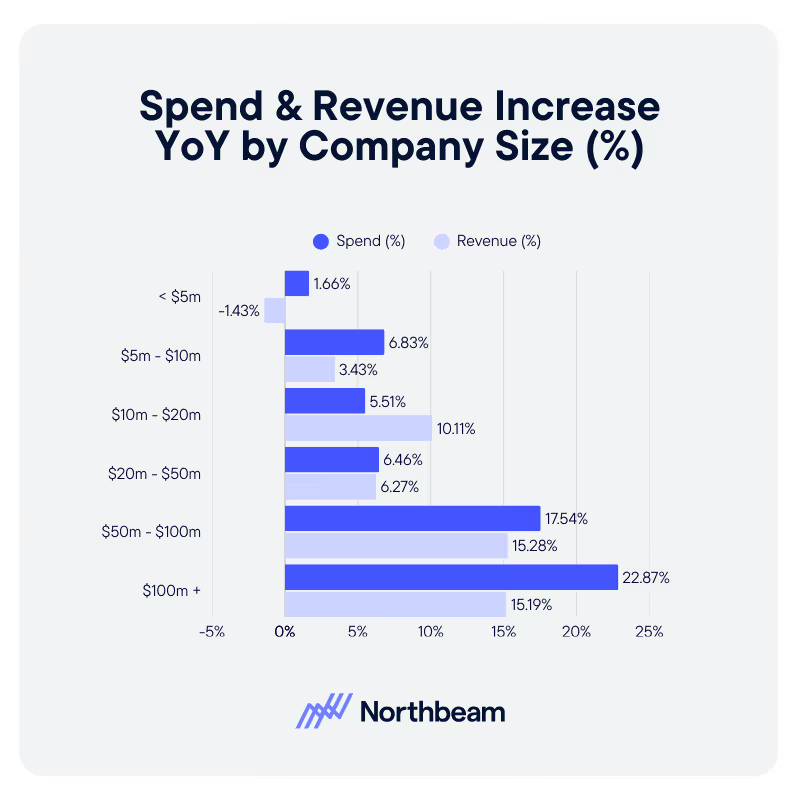
On a median basis, sub‑$5M businesses nudged spend up just +1.66%, but revenue fell –1.43% year over year. That alone tells a clear story: even modest attempts to grow were met with softer performance.
Underneath that:
- First‑time revenue declined more steeply than total revenue, confirming that acquisition was the main pressure point, not just one‑off volatility in returning buyers.
- MER and first‑time MER both fell, with median MER down meaningfully and first‑time MER deteriorating even faster.
- First‑time CAC rose, and both conversion rate and new‑visit share declined, signaling that traffic was more expensive, lower intent, and less likely to convert than in 2024.
In other words: early‑stage businesses paid more, brought in weaker traffic, and earned less on each incremental dollar of new revenue. The whitepaper summarizes this cohort as having a year “focused on cash preservation and margin protection rather than aggressive growth”, and the data backs that up.
Why early-stage businesses were most exposed
The same macro forces hit everyone, but they landed hardest under $5M.
1. Growth skewed toward businesses with more budget and maturity
Across the customer base, growth in 2025 was unevenly distributed by size. Smaller businesses largely played defense, mid‑market advertisers pushed for disciplined expansion, and upper‑mid/enterprise cohorts drove most of the topline gains.
As you move up the revenue ladder, the pattern is consistent: more spend, more revenue, and higher first‑time CAC. Larger businesses could afford to trade efficiency for market share. Sub‑$5M businesses didn’t have that option; they faced the same auction pressure without the balance sheet or measurement maturity to lean in safely.
2. Acquisition got structurally harder
At the business‑performance level, 2025 was defined by:
- First‑time MER dropping much faster than blended MER,
- First‑time CAC rising, and
- Conversion rate and new‑visit share falling across the dataset.
That’s exactly the environment in which small businesses struggle most. When auctions are crowded, traffic is less intent‑rich, and new‑customer efficiency deteriorates, early‑stage operators can’t simply outbid competitors or wait for long payback windows. They’re forced into shorter‑runway decisions: pull back, protect cash, and accept slower top‑line progress.
3. “Average” strategies were calibrated to larger operators
Our whitepaper found that upper‑mid and enterprise businesses turned 2025 into a true step‑change year by using better measurement, creative, and channel strategy, even as acquisition costs rose.
The risk for sub‑$5M businesses is copying the shape of those strategies without the same infrastructure:
- Running more channels than the team can really manage
- Scaling budgets into tougher months because “the category is growing”
- Chasing topline targets while the underlying unit economics (especially first‑time MER and CAC) quietly erode
The result is exactly what the data shows: tiny spend increases, real revenue declines, and a year dominated by defensive moves.

2025 as a survival year, and what changes in 2026
If your revenue is under $5M and your 2025 feels like this picture, the good news is: you were not alone, and you were not imagining it. The bad news is that 2026 can’t just be “try again, but harder.”
The strategic recommendations section of the whitepaper is effectively a playbook for early‑stage businesses to turn survival into disciplined growth.
1. Put hard guardrails around efficiency
The first step is to get explicit:
- Set MER floors and CAC ceilings that reflect your reality under $5M, not market‑wide averages.
- Make those thresholds visible in your weekly operating cadence so you know when a test or scale attempt is violating the rules in real time, not in a post‑mortem.
For this cohort, that usually means prioritizing survival math first: protecting payback, contribution margin, and runway before chasing aggressive growth curves.
2. Separate blended and new-customer performance
Because returning customers carried so much of 2025’s performance, we recommend evaluating first‑time MER and CAC independently from blended results.
For sub‑$5M businesses, this is non‑negotiable:
- Track first‑time MER, first‑time CAC, and first‑time revenue alongside blended MER.
- Treat any period where revenue is up but first‑time MER is down as a red flag: you’re likely leaning too hard on your base and loading in fragile cohorts when you do acquire.
3. Benchmark against the right peers
Based on our findings, I recommend benchmarking by size and industry cohort, rather than against the entire market.
If you’re under $5M:
- Use the sub‑$5M and $5–10M curves as your reference points, not the $50M+ charts.
- Layer on your category’s month‑by‑month shape (for example, the heavy seasonality and promo dependence in Baby & Kids or Food & Beverage) to decide when you can afford to test scale and when you should purely protect cash.
The goal isn’t to match the biggest players; it’s to move from the left tail of your own cohort toward the healthy middle.
4. Scale creative systems before budgets, even at small spend
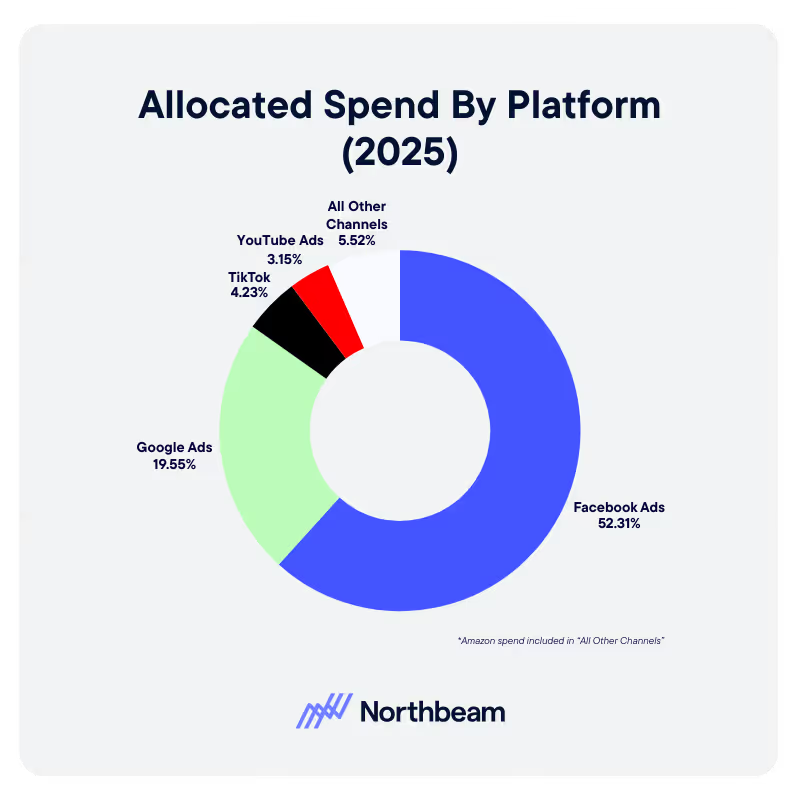
Finally, the platform‑level data makes one more thing clear: as businesses spend more, they are forced to launch more ads, particularly on Meta, TikTok, Axon, Snap, and even Pinterest.
For sub‑$5M businesses, that doesn’t mean hundreds of creatives per month, but it does mean:
- Treating creative throughput as a constraint; don’t raise budgets beyond what your team (or partners) can realistically support.
- Building a lightweight but consistent testing loop so you’re not relying on a single “hero” ad to carry months of spend in a fast‑decay environment.
The whitepaper’s findings here are simple: scale creative systems before budgets. That’s doubly true when you’re under $5M and every mis‑spent dollar hurts.
From survival to disciplined growth
Our 2025 Year in Review doesn’t sugarcoat things for early‑stage businesses: sub‑$5M operators saw revenue decline, MER compress, and acquisition costs rise, all while making only the smallest increases in spend. It was a year defined by cash preservation and margin protection, not hypergrowth.
But it also hands you a framework for what to do next:
- Anchor 2026 in clear guardrails.
- Judge yourself on new‑customer economics, not just blended results.
- Compare your trajectory to businesses your own size, in your own category.
- And only scale budgets when your creative, measurement, and channel mix are ready to support that spend.
For sub‑$5M businesses, that’s what moving from survival to disciplined, compounding growth actually looks like.

































































.avif)



























%25201.avif)



.avif)













.svg)
