





Most B2B website traffic never fills out a form on your website, yet their online activity still signals intent.
Anonymous website visitor intelligence promises visibility into that hidden demand, but it is often misunderstood or oversold. This guide explains what anonymous identification actually means, how it works, where it creates real value, and how to apply it responsibly.
Keep in mind that we’re aiming for directional clarity, not guaranteed accuracy: anonymous B2B website visitor identification is not a replacement for consent-based data or verified leads. But it can be a strong tool to make the most of intent signals hiding in plain sight.
What Anonymous Website Visitor Identification Is (and Is Not)
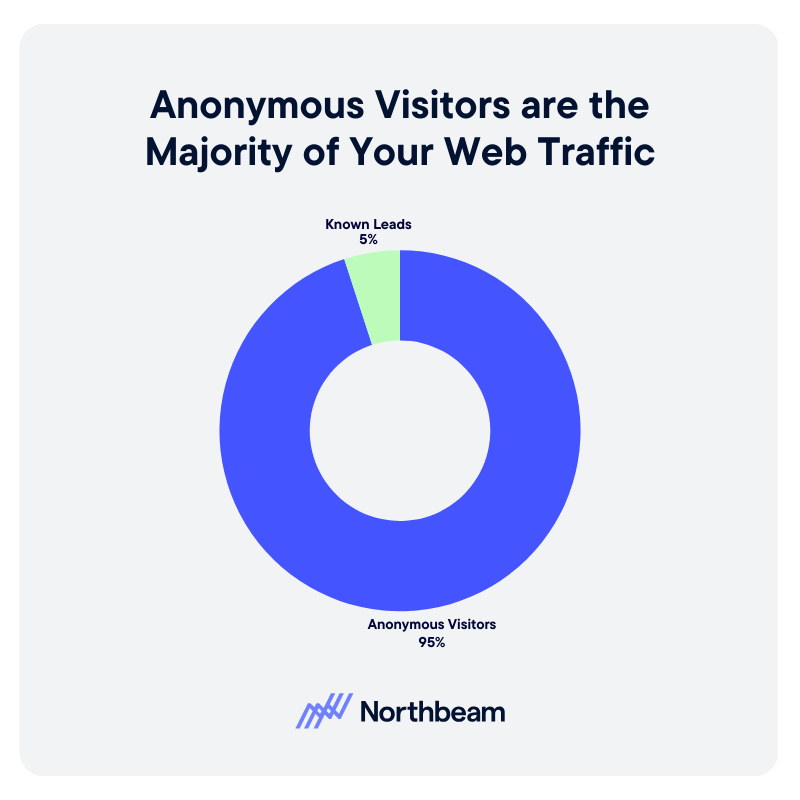
Anonymous website visitor identification for lead generation is the process of inferring which company is behind an otherwise unknown website visit.
Instead of waiting for someone to fill out a form, it uses technical and firmographic signals to suggest which account may be researching your site.
In B2B contexts, “anonymous” does not mean invisible. It means the individual has not self-identified. Most solutions focus on account-level inference, not naming a specific person.
The goal is to recognize that a company, such as a target account, is showing activity, even if you cannot see exactly who at that company is browsing.
It is important to distinguish identification from related concepts:
- Enrichment adds data to known leads
- Intent data aggregates behavioral signals across properties to indicate buying interest
- Anonymous visitor identification sits earlier in the funnel and connects website activity to likely accounts.
It is also important to dispel common misconceptions. Anonymous visit identification does not:
- Reveal personal identities
- Guarantee accuracy
- Replace consent-based data collection
In reality, it provides directional insight and surfaces probable accounts to inform prioritization, not verified individuals to contact blindly.
Why Anonymous Visitors Matter in B2B Marketing
B2B buying rarely starts with a demo request; buying groups conduct extensive independent research before ever speaking to sales. Multiple stakeholders visit websites, compare vendors, download resources, and revisit pricing pages, often without filling out a single form.
When teams rely only on form submissions, a large portion of early demand remains invisible. Website analytics may show traffic volume, but not which high-value accounts are evaluating your solution.
That creates a blind spot between awareness and declared intent.
Anonymous visitor identification highlights which target accounts are engaging with your content, and surfaces repeat visits or product-page activity. It can inform account-based marketing campaigns and sales prioritization.
However, these signals must be interpreted carefully. Not every visit indicates buying readiness. Overreacting to weak signals can overwhelm sales teams or lead to poorly timed outreach.
But used thoughtfully, anonymous insights improve resource allocation and outreach efficiency.
How Anonymous Visitor Identification Works
Anonymous visitor identification combines technical signals with data matching to infer which company is behind a website session. The process is probabilistic and connects patterns, not personal identities.
Technical Signals: IP Address, Device, and Firmographic Matching
Most systems start with IP-based detection. When someone visits your website, their IP address can sometimes be matched to a corporate network. That IP is then cross-referenced with firmographic databases to suggest a likely company.
Device data, browsing behavior, and session metadata may also contribute context, but the foundation is typically IP-to-company mapping.
Account-Level Inference vs Person-Level Claims
Reliable solutions focus on identifying accounts, not individuals. They indicate that a company is active, not that a specific buyer named Sarah is researching your pricing page.
Person-level claims are often overstated and far less accurate. Account-level inference is more defensible and more useful for B2B workflows.
Matching Logic and Confidence Thresholds
Identification relies on matching logic and confidence scoring. Not every IP resolves cleanly; shared networks, VPNs, and remote work environments complicate attribution. Strong systems apply thresholds to determine when a match is credible enough to surface.
Coverage Gaps and Accuracy Limitations
Coverage also varies by geography, traffic mix, and company size. Enterprise organizations with static corporate IP ranges are easier to match than small companies using residential or cloud networks.
Why Results Vary by Industry and Traffic Mix
Industries with concentrated target accounts often see stronger results. High volumes of consumer traffic, international visitors, or mobile users can reduce match rates and overall signal clarity.
Practical Use Cases for Boosting B2B Leads with Anonymous Visitor Identification
Anonymous visitor identification becomes valuable when insights are tied to clear actions. The goal is not visibility on its own, but smarter prioritization and activation.
Account-Based Marketing (ABM) Targeting and Prioritization
Marketing teams can compare identified website activity against target account lists. If priority accounts are engaging with product pages or high-value content, those accounts can be elevated within ABM campaigns. This allows budget and messaging to concentrate where engagement is already emerging.
Sales Alerts for High-Intent Account Activity
When an identified account shows repeat visits, pricing-page views, or deep product exploration, sales teams can receive alerts. These signals support better timing, not cold outreach based on a single visit. Clear activation rules help ensure alerts reflect meaningful engagement.
Content and Messaging Optimization
Aggregate patterns across identified accounts can reveal which industries engage with specific topics. That insight informs content strategy, landing page refinement, and vertical-specific messaging.
Retargeting and Nurture Entry Points
Identified accounts can be added to account-based advertising audiences or personalized nurture flows. This allows marketing to reinforce messaging without requiring immediate form completion.
Connecting Insights to Downstream Actions
To create impact, teams must define clear workflows. Detect the account, assess engagement strength, prioritize based on fit, activate through ABM or sales, and review outcomes to refine thresholds over time.
Common Pitfalls and How to Avoid Them
Anonymous visitor identification can improve focus and timing. It can also create noise and friction if applied without discipline.
Treating Identification as Lead Qualification
An identified account is not a qualified lead. Website activity signals interest, not buying readiness. Treating identification as equivalent to an MQL inflates pipeline expectations and damages credibility with sales.
Fix: Keep anonymous signals in a separate category from qualification. Use them to prioritize accounts for observation or light-touch marketing, not immediate sales conversion metrics.
Overloading Sales with Weak Signals
Sending alerts for every single visit quickly leads to alert fatigue. Sales teams need signal strength, not raw activity.
Fix: Define activation thresholds in advance. For example, require multiple visits, product page depth, or alignment with target account lists before triggering outreach.
Ignoring False Positives and Negatives
Matching is probabilistic: some accounts will be misidentified, while others will never be detected. Assuming perfect accuracy leads to poor decisions.
Fix: Regularly sample identified accounts and compare them to downstream outcomes. Review win rates, engagement lift, and false match patterns to recalibrate confidence levels.
Failing to Measure Downstream Impact
Anonymous visibility can feel powerful, but without impact measurement it becomes a vanity metric.
Fix: Tie identified account activity to concrete KPIs such as account engagement lift, time-to-first-contact, and pipeline influenced.
Privacy, Compliance, and Ethical Guardrails
Account-level inference differs from personal data collection, but misuse can still erode trust.
Fix: Document internal rules for activation, involve legal in policy reviews, and avoid invasive outreach that implies personal surveillance. Governance protects both performance and reputation.
Tools to Identify Anonymous Website Visitors
Anonymous visitor identification is not a single tool, but a workflow supported by multiple systems working together. Understanding the categories of tools helps teams evaluate solutions without over-indexing on any one vendor.
Data Sources
- Website analytics platforms capture session data, page views, and engagement patterns. This forms the behavioral foundation.
- IP intelligence providers map IP addresses to likely corporate networks. These tools attempt to resolve anonymous traffic to company domains.
- Firmographic databases enrich matched accounts with company size, industry, revenue, and other attributes. This helps assess fit against your ICP.
Processing
- Processing tools apply matching logic to connect technical signals with firmographic records. They assign confidence scores based on match strength and data quality.
- Website visitor identification tools allow teams to set threshold rules, determining when a match is strong enough to surface. Strong processing layers prioritize accuracy over volume and make assumptions transparent.
Activation
Once accounts are inferred, insights must flow into downstream systems. This includes:
- CRM platforms for account tagging and tracking
- ABM platforms for targeted advertising and orchestration
- Sales alert systems to notify reps of high-engagement accounts
- Personalization engines for dynamic website or email experiences
With the tooling landscape understood, the next step is designing a structured implementation plan that defines goals, guardrails, and ownership.
Anonymous Website Visitor Identification Implementation Plan
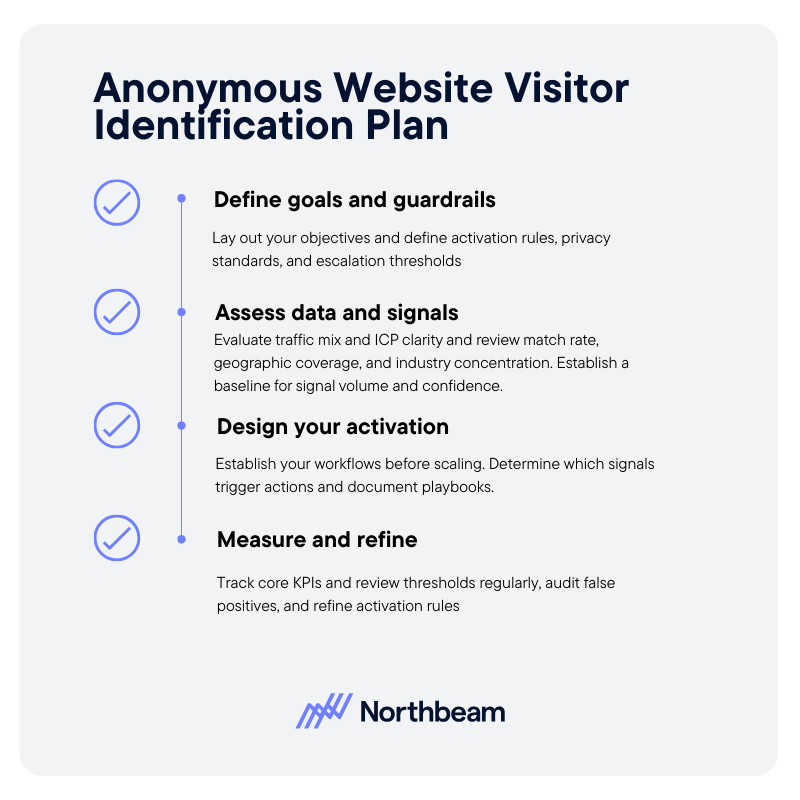
Anonymous visitor tracking delivers value when introduced with clear structure and ownership. A phased approach prevents signal overload and ensures alignment across marketing, sales, RevOps, and legal.
Step 1: Define Goals and Guardrails
- Start by clarifying why you are implementing identification. Is the objective to improve ABM prioritization, accelerate sales timing, or increase engagement within target accounts?
- Define activation rules, privacy standards, and escalation thresholds before any alerts are turned on. Clear guardrails prevent misuse and protect trust.
Step 2: Data and Signal Assessment
- Evaluate your traffic mix, ICP clarity, and existing systems.
- Review match rates, geographic coverage, and industry concentration.
- Establish a baseline for signal volume and confidence levels.
- This assessment helps set realistic expectations about coverage and accuracy.
Step 3: Activation Design
- Design workflows before scaling.
- Determine which signals trigger marketing actions, which reach sales, and which remain observational.
- Integrate identified accounts into CRM and ABM systems with documented playbooks.
- Activation should be deliberate, not reactive.
Step 4: Measure and Refine
- Track core KPIs tied to business impact.
- Monitor account engagement lift, MQL and SQL conversion rates, and pipeline influenced by identified accounts.
- Review thresholds regularly, audit false positives, and refine activation rules.
- Continuous iteration turns probabilistic signals into sustained performance gains.
From Anonymous Traffic to Actionable Focus
Anonymous visitor identification does not deliver guaranteed leads, but it does surface early demand signals that would otherwise remain hidden.
Account-level insight is more reliable, and more defensible, than bold person-level claims. The value lies in recognizing that a company is researching, not pretending to know exactly who.
But governance and restraint are essential. Clear activation rules, realistic expectations, and privacy guardrails protect trust across teams and with prospects.
Used thoughtfully, anonymous identification sharpens focus, improves timing, and supports higher-quality engagement across the B2B funnel.

























































.avif)





















%25201.avif)



.avif)














.svg)
