





High-performing teams do not win simply because they collect data, they win because they interpret it in time, with clarity, and act on it responsibly.
As marketing stacks grow more complex and markets shift faster, teams face a stark reality: the risks of doing intelligence poorly often outweigh the risks of not doing it at all.
This article focuses less on definitions and pillars and more on common failures that trip teams up, the hidden risks of weak intelligence practice, and practical steps teams can take to avoid those failures. It is meant as a reality check, because intelligence is powerful only when it is done well.
What Is Marketing Intelligence and What It Is Not
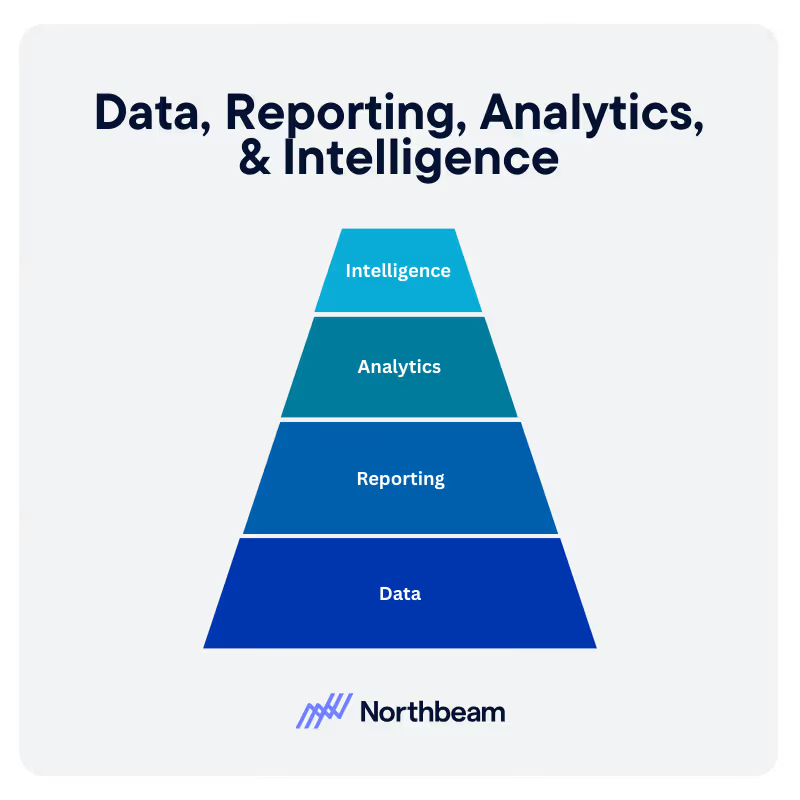
By definition, marketing intelligence is the practice of turning marketing data into informed decisions. It answers questions like: What is changing in our market? Why is performance shifting? What should we do next?
It is not the same as data, reporting, or analytics:
- Data is the raw input
- Reporting organizes data into charts and dashboards
- Analytics explains what happened and sometimes why
Marketing intelligence goes a step further: it synthesizes multiple signals, adds context, and produces insight that supports a decision or recommendation.
Marketing intelligence is also distinct from business intelligence. Business intelligence typically focuses on company-wide performance such as finance, operations, or supply chain metrics.
Marketing intelligence is more outward- and forward-looking. It combines internal performance data with external signals like customer behavior, competitive moves, market trends, and platform changes.
Importantly, marketing intelligence tools do not tell the whole story. Tools support intelligence, but they are not intelligence on their own. A dashboard without interpretation does not guide action. A report that is reviewed but never used does not create value.
Marketing intelligence only exists when insights are translated into decisions, priorities, and changes in execution.
The Hidden Costs of Bad Intelligence
When marketing intelligence fails, the impact is not just sloppy reporting, it can lead to misallocated budgets, missed opportunities, and strategic paralysis. Here are the most common failure modes teams face.
1. Insight Overload Without Prioritization
Many teams make the mistake of surfacing every anomaly, trend, and metric variation, assuming volume equals insight. When decision-makers are drowned in signals, nothing actually gets acted on.
Risk: Leaders delay decisions because they cannot distinguish noise from what truly matters.
Fix: Curate insights by asking these questions: Does this support a clear decision, and what action would this trigger. Rank intelligence outputs by strategic impact and urgency before sharing them.
2. Lagging Intelligence That Arrives Too Late
Intelligence that lands after decisions have already been made is not intelligence, it is reporting. Too often, teams rely on slow, backward-looking analyses that are outdated by the time they reach stakeholders.
Risk: Teams react to outcomes rather than shaping them.
Fix: Build faster data pipelines and review cadences timed to planning cycles. Use streaming signals and forward-looking market indicators where feasible, and automate alerts for critical changes, such as shifts in competitor activity or platform policies.
3. Overconfidence in Incomplete Signals
Partial data, vanity metrics, or short timeframes can create false confidence. Acting on incomplete or ambiguous signals can be worse than acting slowly, because it can embed poor strategy into your execution.
Risk: False positives lead to wasted budget and poor strategic decisions.
Fix: Treat uncertainty as part of intelligence. Cross-validate signals across multiple data sources, such as performance, customer behavior, and market trends. If you do not have sufficient data for confidence, surface that uncertainty rather than masking it.
4. Siloed Ownership and Misaligned Incentives
When intelligence lives in analytics teams without a clear handoff to planners and operators, it becomes noise. If incentives differ across teams, intelligence fails its primary purpose.
Risk: Insights die in dashboards and never influence decisions.
Fix: Define clear roles and responsibilities, including who owns data integrity, who interprets signals, and who makes decisions. Establish shared KPIs that align intelligence outputs with business outcomes.
Core Inputs That Power Marketing Intelligence
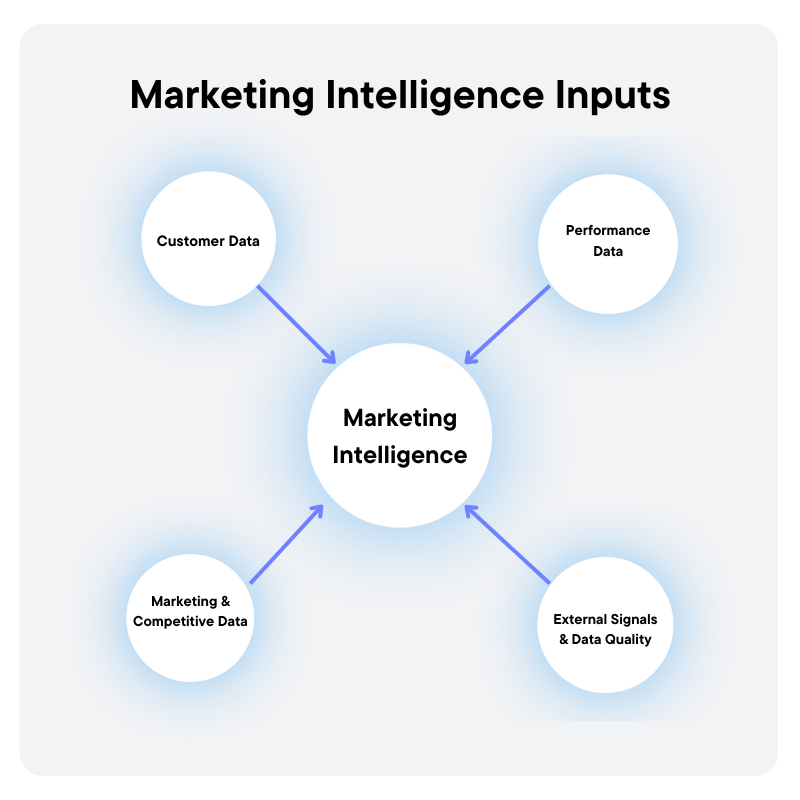
Effective examples of marketing intelligence depend on combining multiple data sources into a coherent view of performance, customers, and the competitive landscape.
Performance Data
Performance data shows how your marketing efforts are working today.
- Channel-level performance across paid, owned, and earned media
- Campaign results, including creative, targeting, and sequencing
- Funnel metrics such as conversion rates, velocity, and drop-off points
Customer Data
Customer data provides insight into who your audience is and how they behave over time.
- Behavioral signals across touchpoints and channels
- Cohort analysis to understand retention, value, and engagement patterns
- Lifecycle stage indicators, from first touch to expansion or churn
Market and Competitive Data
Market and competitive data adds essential external context to internal performance.
- Market trends, benchmarks, and seasonal patterns
- Competitor messaging, positioning, and pricing changes
- Channel presence and shifts in media strategy
External Signals and Data Quality
External signals help teams anticipate change before it impacts performance.
- Macro and economic indicators
- Regulatory developments and policy changes
- Platform updates, algorithm changes, and ecosystem shifts
Across all inputs, data quality matters. Consistent definitions, reliable sources, and proper context are critical to ensuring insights are trustworthy and actionable.
Why Good Intelligence Still Fails
Even with tools and data, intelligence can fall short if it does not integrate meaningfully into daily execution and strategic planning.
Failure: Treating Tools as a Silver Bullet
Dashboards, competitor intelligence platforms, and automated reports create the illusion of intelligence without interpretation and decision frameworks.
Truth: Tools enable intelligence, they do not create it.
Best Practice: Tie every dashboard or alert to a decision workflow. If a signal will not trigger a decision or hypothesis test, reconsider its place in your stack.
Failure: Ignoring Data Quality
No amount of analysis can rescue flawed data. Inconsistent definitions, fragmented sources, and unclear timeframes create noise that misguides teams.
Truth: Bad data is worse than no data because it creates false paths.
Best Practice: Invest early in data governance with standardized definitions, consistent time periods, and centralized data sources. Create a simple data quality scorecard for key intelligence feeds.
Emerging Risk Areas in Marketing Intelligence
As intelligence matures across organizations, deeper systemic risks emerge that leaders must anticipate and manage.
The Risk of Bias in Data Interpretation
Even large and rich datasets can mislead when analysts do not account for bias in data selection or analysis methodologies. Bias can arise because of overreliance on certain sources or because the context behind the data is not well understood.
Risk: Decisions based on biased insights can undermine strategy and obscure true market dynamics.
Fix: Encourage diverse source selection, use blind analysis techniques where possible, and involve cross-functional perspectives to challenge assumptions. Encourage teams to ask what the data might be missing as part of the analysis conversation.
The Risk of Overdependence on Secondary Data
Some organizations mistakenly rely heavily on secondary or syndicated data sources such as industry reports, press releases, or generic market dashboards.
Risk: Secondary sources can omit nuance and real-time shifts, leading to stale or superficial intelligence.
Fix: Balance secondary sources with primary research and unique data signals such as survey results, customer feedback, or real-time behavioral tracking. Investing in primary data collection allows teams to fill gaps that generic sources cannot address.
The Risk of Misalignment With Business Context
Intelligence that is disconnected from actual business priorities or decision contexts loses impact. Analysts must have an accurate understanding of the organization’s strategic goals to ensure insights are relevant.
Risk: Intelligence may deliver insight that is interesting but not actionable.
Fix: Start each cycle of analysis with a conversation about strategic objectives. Document business goals related to the intelligence questions and ensure alignment with planning.
Common Marketing Intelligence Failures and How to Avoid Them
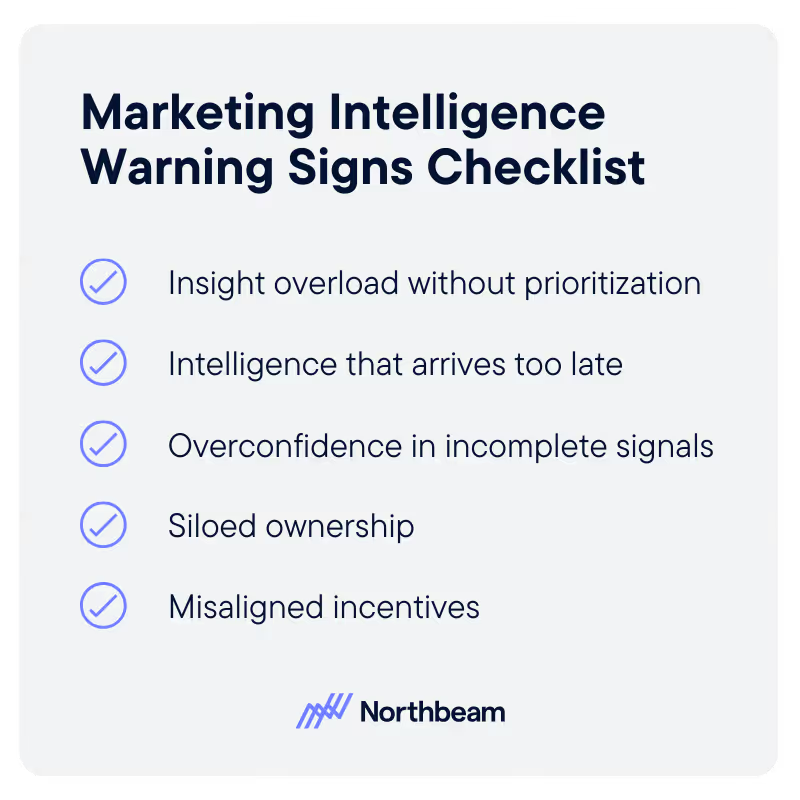
Most marketing intelligence failures are not caused by lack of data, but by how intelligence is generated, shared, and used.
Insight Overload Without Prioritization
One of the most common failures is producing too many insights without clear prioritization. When teams surface every anomaly or trend, decision-makers struggle to determine what actually matters.
Effective marketing intelligence filters signals, frames trade-offs, and highlights the few insights that warrant action.
Lagging Intelligence That Arrives Too Late
Intelligence loses value when it arrives after decisions have already been made. If insights are tied to slow reporting cycles or retrospective analysis, teams end up reacting rather than shaping outcomes.
Successful programs focus on timeliness, ensuring intelligence is delivered in time to influence planning and execution.
Overconfidence in Incomplete Signals
Another risk is acting on partial or misleading data. Single metrics, short time frames, or unvalidated assumptions can create false confidence.
Strong intelligence practices emphasize context, triangulation, and uncertainty, helping teams understand what the data does and does not support.
Siloed Ownership and Misaligned Incentives
When intelligence ownership is unclear, insights often live in silos and fail to influence decisions. Clear accountability, shared goals, and alignment with decision-makers are essential to turning insight into action.
Conclusion: Intelligence That Works Is Intentional and Integrated
Marketing intelligence is not just about producing more reports or dashboards, it is about creating clarity, reducing uncertainty, and guiding better decisions. The biggest failures are not technical, they are organizational and process-based.
By prioritizing timely, actionable insights, aligning teams around strategic goals, and governing intelligence with purpose, organizations can avoid the common pitfalls that turn good data into bad decisions.
With the right culture, cadence, and discipline, marketing intelligence does not just inform, it transforms how teams think, act, and win in competitive markets.
















































.avif)























%25201.avif)


.avif)













.svg)
