




Many marketing teams talk about being “data-driven,” but data maturity is a spectrum.
Some teams rely on basic reports pulled at the end of the month. Others operate with real-time insights, automated decisioning, and predictive models shaping strategy.
Understanding where your team falls on that spectrum, and how to move forward, is the core purpose of a marketing data maturity model.
In this guide, we’ll break down what “data maturity” means, the key dimensions that shape it, and the five stages most teams move through when moving from an ad-hoc to a data-mature marketing organization.
What “Data Maturity” Means for Marketing
In a marketing context, data maturity reflects how effectively your team uses data to guide strategy, personalize outreach, optimize campaigns, and tie activity to measurable business outcomes.
Mature organizations don’t treat data as a reporting function. They use it as the connective tissue of their entire growth engine, from segmentation and creative testing to budgeting and lifecycle strategy.
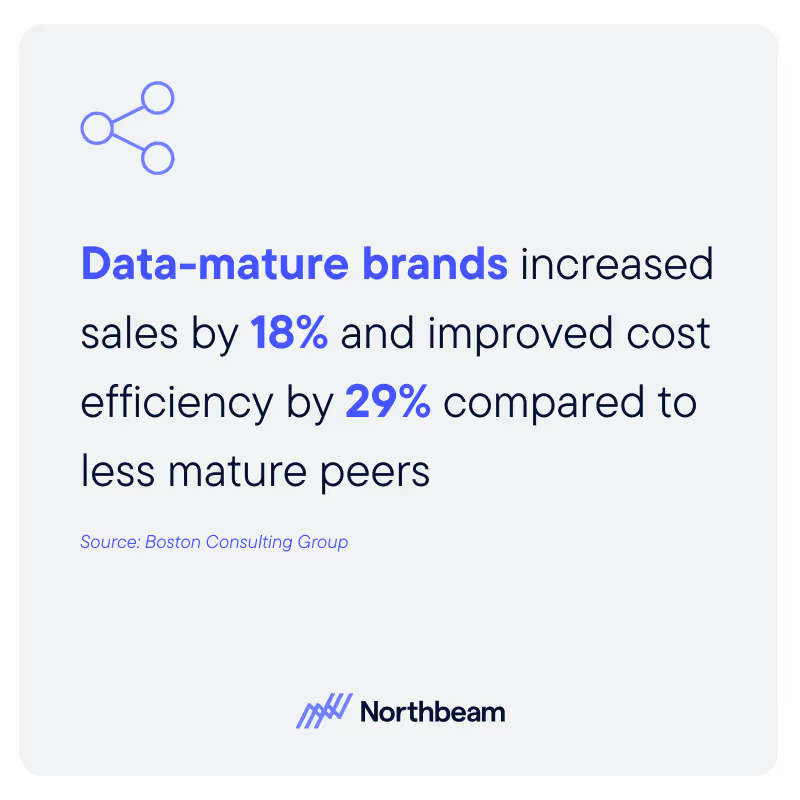
The impact is tangible. Research from Boston Consulting Group (BCG) found that more digitally mature brands increased sales by 18% and improved cost efficiency by 29% compared to less mature peers.
In other words, data maturity is one of the clearest competitive advantages a marketing team can build.
Most teams can also recognize the early warning signs that they aren’t as data-mature as they’d like to be:
- Data lives in disconnected tools and channels
- Dashboards are isolated, inconsistent, or manually maintained
- Reporting depends on spreadsheets and heroic effort rather than repeatable systems
- Campaigns rely on gut instinct because insights are incomplete or hard to access
- Instead of measuring the full customer journey, teams focus only on surface-level metrics like clicks or impressions.
These patterns aren’t failures. They’re indicators of where you are today, and a starting point for building a more integrated, data-mature marketing organization.
Key Dimensions of a Data Maturity Model for Marketing Teams
To understand your level of data maturity, it helps to break the concept into core dimensions:
Strategy & Alignment
Data maturity starts with strategy and alignment. This means marketing KPIs are explicitly tied to business objectives, not created in isolation.
Mature teams work within a culture where data-informed decision-making is expected, shared, and reinforced, from leadership priorities to campaign planning.
Without this alignment, even the most sophisticated tools fail to drive meaningful outcomes.
Data Governance & Quality
Governance covers how your data is collected, cleaned, standardized, and maintained. High-maturity teams invest in master data management, ensure data accuracy and accessibility, and define processes that keep customer data trustworthy over time.
Data & Technology Architecture
Your marketing tech stack is only as powerful as the connections between its components.
Modern architecture enables cross-channel data flow, unifies event and customer data, and supports real-time analytics.
If tools operate in silos or require heavy manual intervention, insights will lag and opportunities will be missed.
Analytics Capability
Analytics maturity evolves in stages:
- Descriptive (what happened)
- Diagnostic (why it happened)
- Predictive (what will happen)
- Prescriptive (what to do next)
As teams progress, data becomes less about reporting and more about foresight. Mature organizations incorporate modeling, forecasting, and experimentation into everyday workflows.
People & Culture
Technology can only take an organization so far. Data-mature teams cultivate literacy across their marketing organization and beyond, encouraging experimentation, and promoting tight collaboration among marketing, analytics, product, and engineering.
On these types of teams, curiosity and cross-functional problem-solving become cultural norms.
Execution & Activation
Ultimately, maturity shows up in how well data fuels daily marketing activity.
This includes smarter segmentation, personalization at scale, rigorous measurement, consistent optimization, and campaigns that adapt in real time.
The most mature teams close the loop between insight and action quickly and repeatedly.
These six dimensions form the framework for assessing your current state and identifying where maturity improvements will have the highest impact.
Typical Stages of Marketing Data Maturity
Every marketing team sits somewhere on the data-maturity spectrum. Understanding your stage helps you benchmark your current capabilities and set realistic expectations for growth.
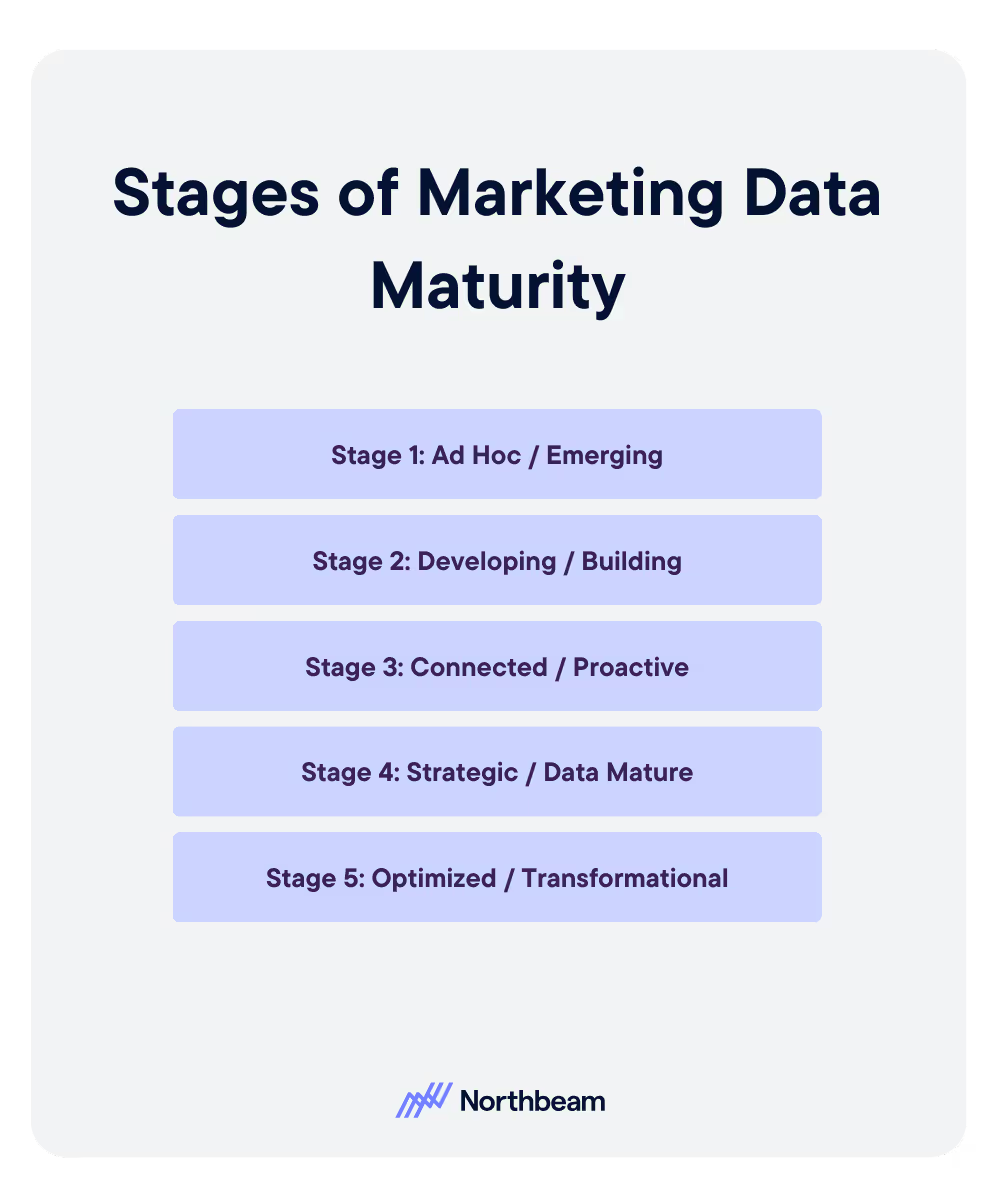
Most organizations fall into one of five broad categories:
Stage 1: Ad Hoc / Emerging
Teams at this stage rely on basic campaign metrics like impressions and clicks.
Data lives in channel-specific tools, reporting is inconsistent, and insights rarely influence strategy.
Most decision-making happens through intuition or past experience, making this the least scalable stage.
Stage 2: Developing / Building
Some unification begins to take shape in Stage 2. Teams might connect a few data sources or build early cross-channel dashboards.
Segmentation and personalization are possible but limited, often requiring manual effort. This is the stage where teams recognize the value of data but haven’t yet operationalized it.
Stage 3: Connected / Proactive
Data infrastructure becomes more robust and reliable in Stage 3. A shared customer view emerges, analytics begin driving decisions, and campaigns are optimized across channels rather than within silos.
Teams at this stage shift from reactive reporting to proactive insight generation.
Stage 4: Strategic / Data-Mature
In Stage 4, marketing becomes deeply integrated with predictive analytics, real-time optimization, and full-funnel measurement aligned to business outcomes.
Testing is systematic, insights flow quickly into activation, and data literacy is strong across the organization. This is where real competitive advantage becomes visible.
Stage 5: Optimized / Transformational
In Stage 5, marketing operates as a serious growth engine. AI, automation, and advanced modeling shape strategy at scale. Data is embedded into culture, not just tooling. Teams move with agility, adapting to customer behavior in real time and continuously learning from every interaction.
By identifying your stage, you can build a roadmap that’s ambitious but achievable. But how do you know exactly what stage you’re in now?
How to Assess Marketing Data Maturity
To assess your team’s data maturity, start by conducting a data-driven marketing maturity audit.
This involves scoring your team across each key dimension listed above:
- Strategy and alignment
- Data governance and quality
- Data and tech architecture
- Marketing analytics maturity
- People and culture
- Execution and activation
Give yourself a score for each dimension. The goal isn’t to produce a perfect number, it’s to reveal patterns and help you decide where to focus first.
Many teams pair this internal audit with external benchmarking. Frameworks from Gartner and other industry leaders offer structured questionnaires and maturity rubrics that help you calibrate your results against peers and best-in-class organizations.
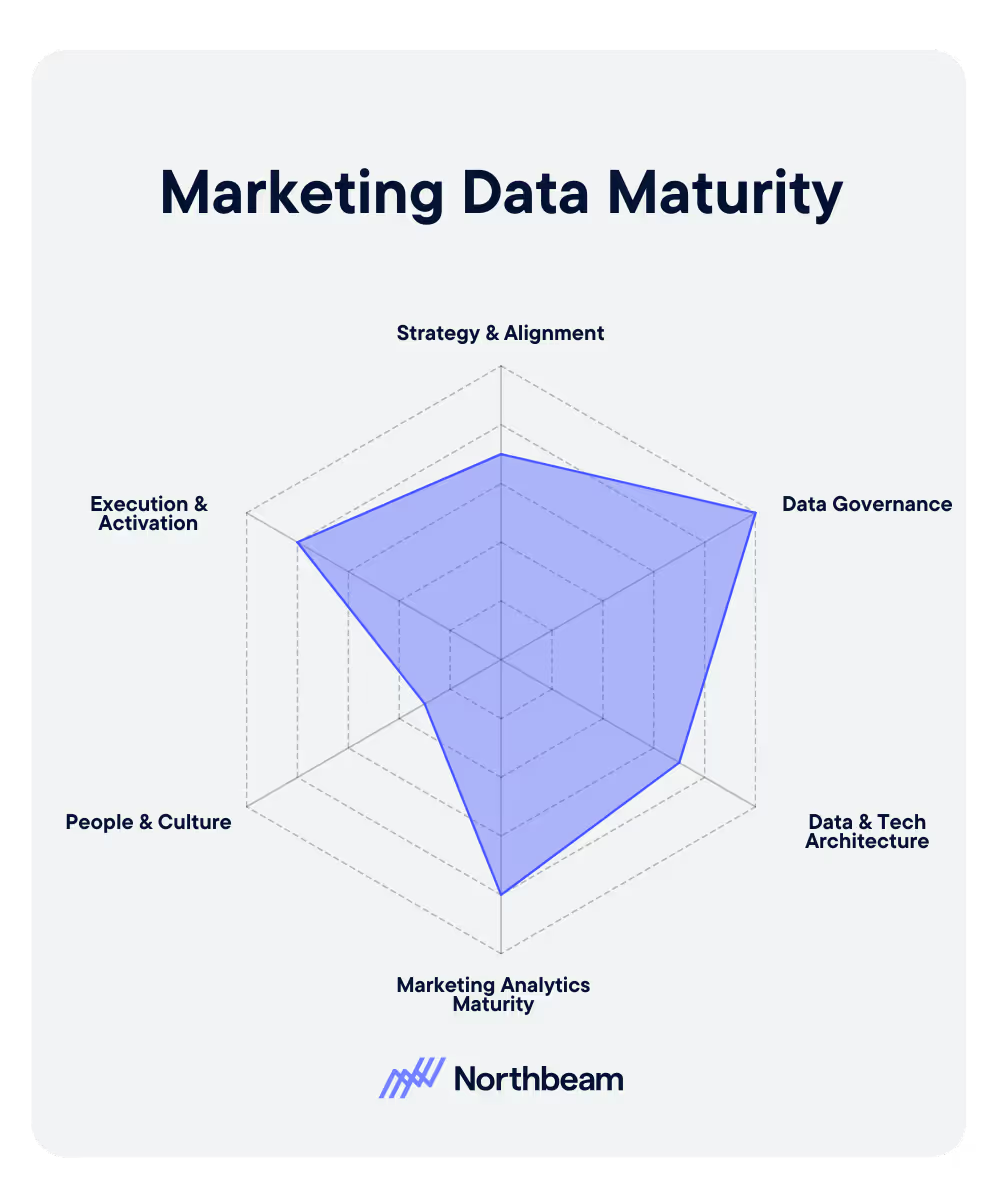
To bring your assessment to life, visualize your scores. A radar chart or similar diagnostic view makes maturity gaps immediately visible and highlights where investment will drive the biggest lift.
Often, you’ll see that one or two lagging dimensions disproportionately drag down your overall maturity level.
Most importantly, conduct the assessment collaboratively. Involving stakeholders from marketing, analytics, IT, data engineering, and even leadership ensures you’re capturing the full picture.
It also creates early buy-in for the roadmap you’ll build next, because maturity transformation is rarely a marketing-only project. It succeeds when the entire organization is aligned around the same goals, the same metrics, and the same definition of “data-driven.”
Building the Roadmap to Data-Mature Marketing
An assessment becomes meaningful once it turns into action.
After identifying your strengths and gaps, the next step is to build a phased roadmap that moves your organization toward greater data maturity in a realistic, sustainable way.
Start with Quick Wins
These are low-effort, high-impact improvements that unlock immediate value.
Examples include:
- Unifying a few high-value data sources
- Standardizing naming conventions or taxonomies
- Building or refreshing core dashboards
- Implementing basic segmentation or journey mapping
- Eliminating manual reporting bottlenecks
Move to Medium-Term Initiatives
These require more coordination and investment, but fundamentally upgrade your marketing operations.
Common examples:
- Expanding or modernizing your marketing tech stack
- Implementing a customer data platform (CDP)
- Enabling real-time analytics pipelines or event tracking
- Formalizing experimentation processes
- Upskilling teams and reinforcing a data-driven culture
- Improving collaboration between marketing, analytics, and engineering
Plan for the Long-Term
These initiatives help you reach full data maturity and create a scalable, self-optimizing marketing engine.
They often include:
- Predictive modeling and forecasting
- Advanced attribution and measurement
- Automated decision-making
- Personalization at scale across channels
- AI-driven optimization
Tie Initiatives to Business Outcomes
Align your roadmap with measurable company goals such as:
- Lower customer acquisition cost (CAC)
- Improved retention or customer lifetime value (LTV)
- Faster experimentation cycles
- Increased marketing-influenced revenue
Establish Governance and Operating Models
To ensure maturity isn’t a one-off project, define:
- Data ownership and stewardship
- Processes, documentation, and QA standards
- Recurring maturity audits and alignment rituals
Measure Maturity Improvements Over Time
Track indicators like:
- Percentage of campaigns using data-driven segmentation
- Time from insight to action
- Cost per test or experiment
- Percentage of decisions backed by data
Challenges & Considerations for Marketing Leaders
Even with a clear roadmap, progressing through the stages of data maturity isn’t always straightforward.
Most teams encounter predictable obstacles that can slow down momentum or create false signals of progress. Being aware of these challenges upfront helps leaders navigate them with more intention and fewer surprises.
Data Silos
When channels, tools, or business units operate in isolation, insights stay fragmented and teams lose the ability to understand the full customer journey.
Resource Constraints
Many organizations underestimate the talent required to operationalize data maturity. It’s not just the tools, it’s analysts, engineers, and marketers who can translate data into meaningful action.
Tech Before Culture
A shiny new tool can’t compensate for misaligned processes or a culture that doesn’t value experimentation and data-driven decision-making. Culture and operations must mature alongside the stack.
Misaligned Expectations
Moving from Stage 1 to Stage 4 isn’t a quick win. It requires sustained investment, organizational alignment, and a willingness to change how decisions are made.
Privacy & Ethical Considerations
As personalization becomes more sophisticated, compliance, consent, and responsible data use become non-negotiable components of maturity.
“Maturity Theater”
It’s easy to claim advanced capabilities without the underlying systems to support them. True data maturity is demonstrated through measurable impact, not labels.
With these challenges in mind, leaders can approach maturity work with clearer expectations and a more grounded path forward.
Case Study: How One eCommerce Brand Leveled Up Its Data Maturity
Consider a mid-size ecommerce brand operating squarely at Stage 2 of data maturity.
Their marketing efforts were spread across disconnected tools, each channel measured in isolation. Without a unified customer view, the team relied on surface-level metrics like clicks, opens, and last-touch attribution.
Their campaigns performed reasonably well, but growth had stalled; they couldn’t see what was working across the full customer journey.
To move forward, the team implemented a customer data platform (CDP) and consolidated cross-channel tracking.
They defined a shared set of KPIs, aligned stakeholders around a unified measurement framework, and rebuilt core dashboards to reflect customer-level behavior rather than channel-level outputs.
Within a quarter, the shift was clear.
Reporting evolved from “clicks only” to dark-funnel attribution and multi-touch insights. Campaigns moved from one-off initiatives to journey-based optimization, and tests scaled faster because the team could finally see which touchpoints drove incremental value.
These improvements lifted ROI, shortened the time from insight to action, and moved the organization firmly into Stage 3: Connected and Proactive.
Start Your Maturity Journey Today
Reaching higher levels of data maturity doesn’t require a massive transformation from day one. Small, structured steps can create meaningful momentum and help your team build confidence along the way.
Here is a quick checklist to help you get started:
- Host an internal workshop with stakeholders from marketing, analytics, IT, and data engineering. Use the maturity dimensions outlined in this guide to score your current state and surface gaps or inconsistencies.
- Identify three priority initiatives: one quick win, one medium-term improvement, and one long-term capability. Assign clear owners, timelines, and success metrics so each initiative has a path to execution.
- Build a maturity dashboard to track your progress. Useful indicators like the percentage of campaigns using insights, time from insight to activation, or the share of marketing spend influenced by data.
- Establish a quarterly review cadence to revisit your maturity score and evolve your roadmap.
Marketing data maturity isn’t static. It’s a continual process of strengthening foundations, refining processes, and expanding capabilities.
Every step forward compounds, and the brands that invest steadily unlock a clear advantage.























































.avif)

























%25201.avif)


.avif)














.svg)
