
Blog

Mid-Funnel Strategies: Nurturing Prospects from Consideration to Intent

Don’t Lose Momentum Mid-Funnel
Mid-Funnel Strategies: Nurturing Prospects from Consideration to Intent

TL;DR

  • The mid-funnel is where prospects actively evaluate options and build trust. It requires guidance, not pressure, to move from consideration to intent.
  • Effective mid-funnel strategies combine educational content, retargeting, social proof, segmented nurture, and clear lead scoring aligned with sales.
  • Success at this stage is measured through engagement, progression, and qualification metrics rather than top-funnel reach or last-click revenue alone.
  • Proper tracking, attribution, and dashboarding help teams understand mid-funnel impact and invest more efficiently.

After a prospect shows initial interest, they rarely convert right away. Instead, they research, compare options, and look for proof that a solution will actually deliver.

This mid-funnel consideration stage in marketing is where many teams lose momentum, not because demand isn’t there, but because nurturing, measurement, and attribution are unclear or underdeveloped.

This guide breaks down how to approach mid-funnel strategy with intention. You’ll learn what the mid-funnel really represents, why it plays such a critical role in driving intent, and which tactics help prospects move forward without being rushed.

We’ll also cover how to track and attribute mid-funnel performance, common pitfalls to avoid, and practical steps your team can take to improve progression from consideration to action.

What the Mid-Funnel Stage Represents & Why It’s Critical
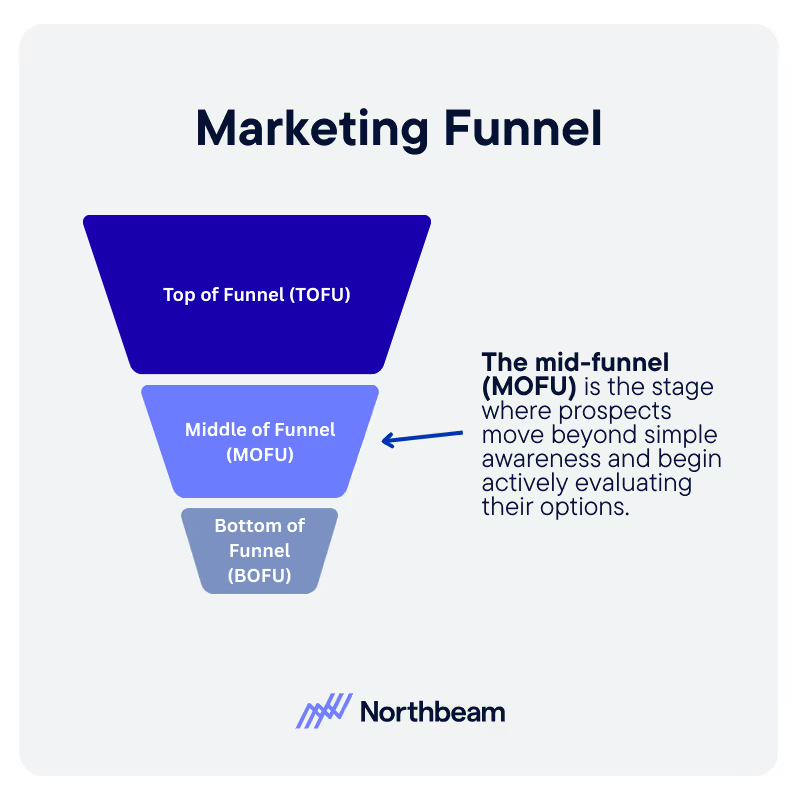
The mid-funnel (often referred to as MOFU) is the stage where prospects move beyond simple awareness and begin actively evaluating their options.

At this point, they know who you are and what you offer, but they are not yet ready to convert. Instead, they are comparing solutions, weighing trade-offs, validating claims, and looking for proof that your product or service is the right fit.

This is where interest becomes informed consideration, and where many buying decisions are quietly shaped.

Without thoughtfully nurturing leads mid-funnel, prospects often stall, disengage, or choose a competitor who does a better job answering their questions and earning trust.

Unlike top-of-funnel efforts, which focus on visibility, or bottom-of-funnel tactics, which push for action, the mid-funnel is defined by information-seeking and confidence-building.

Buyers want clarity, relevance, and reassurance, not pressure. Brands that rush this stage risk pushing prospects away before they are ready to act.

From an attribution and marketing operations perspective, the mid-funnel is also where complexity increases.

Progression typically involves multiple touchpoints across channels and over longer time frames, making it harder to connect activity directly to revenue.

When mid-funnel interactions are measured and attributed properly, teams can see where value is being created, invest more efficiently, and avoid underestimating one of the most critical phases of the buyer journey.

Key Strategies & Tactics to Nurture from Consideration -> Intent
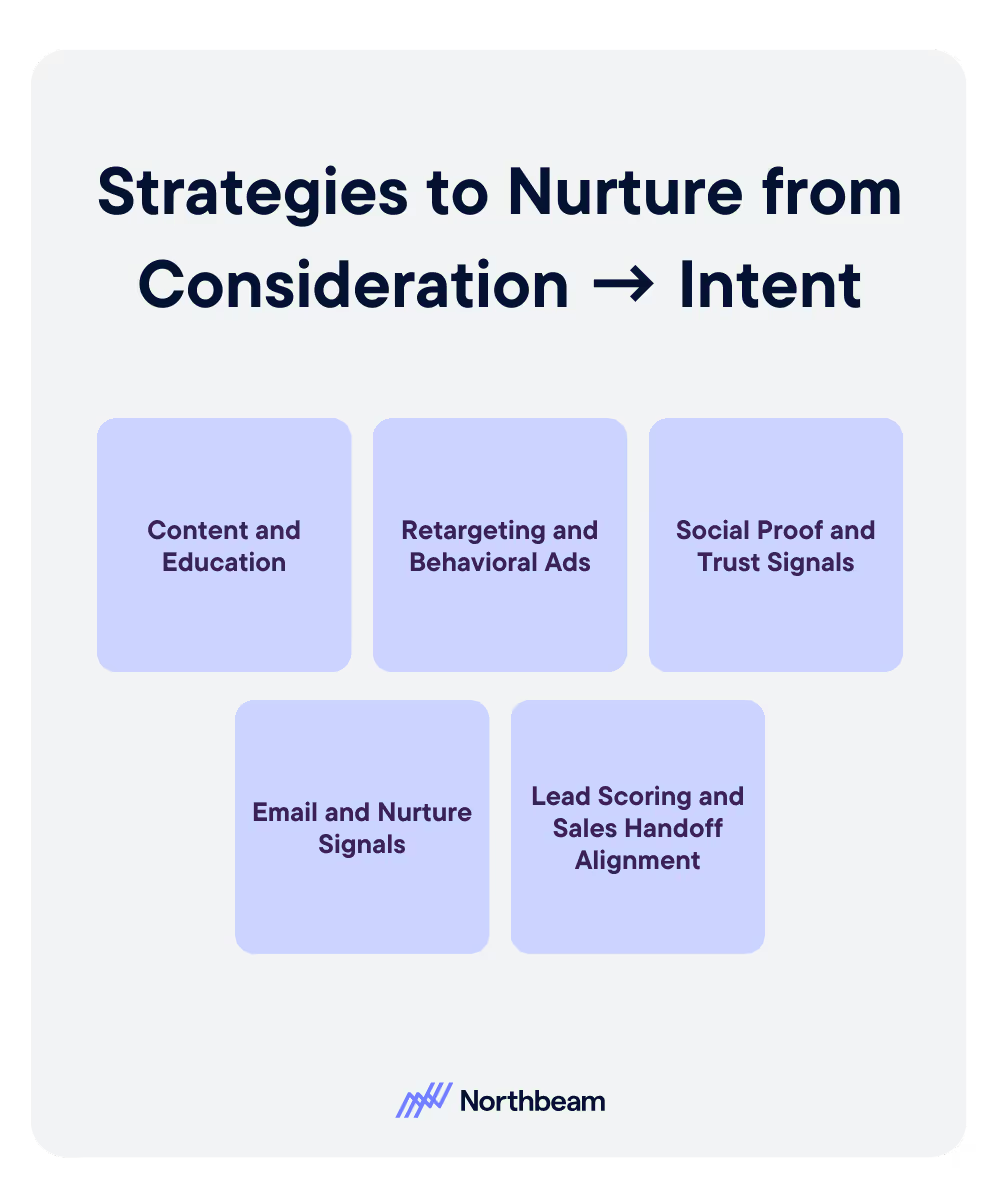
Moving prospects through the mid-funnel requires a coordinated set of tactics that educate, build trust, and respond to real buying signals.

Content and Education

Assets like case studies, comparison guides, product deep dives, and ROI or cost calculators address common questions and objections while clearly articulating value.

The goal is to support informed decision-making, not to force a conversion, by providing clarity at the moments buyers are actively seeking it.

Retargeting and Behavioral Ads

Retargeting reinforces relevance by building on prior engagement. By serving ads based on behaviors such as site visits, content consumption, or product views, teams can tailor messaging to what prospects already care about.

This approach keeps your brand top of mind while advancing the conversation in a way that feels contextual rather than repetitive.

Social Proof and Trust Signals

Trust is a key barrier at the mid-funnel stage. Reviews, testimonials, customer stories, and user-generated content help reduce perceived risk by showing real-world success.

Social proof validates your claims and reassures prospects that others like them have achieved meaningful outcomes, which can accelerate movement toward intent.

Email and Nurture Sequences

Email nurture programs help orchestrate the mid-funnel journey over time. Effective sequences are segmented and behavior-driven, delivering content that aligns with a prospect’s interests and level of readiness.

Instead of pushing for a sale too early, strong nurture flows guide prospects with helpful information that builds confidence and keeps engagement high.

Segmentation and Personalization

Not all mid-funnel leads are equal. Prospects vary by source, use case, product interest, and engagement level, and messaging should reflect those differences.

Segmentation and personalization allow teams to tailor content, format, and timing so that each interaction feels relevant and useful, increasing the likelihood of progression.

Lead Scoring and Sales Handoff Alignment

As prospects move closer to intent, it’s critical to recognize and act on the right signals. Lead scoring helps identify behaviors that indicate readiness, such as repeated high-value content engagement or demo requests.

Clear alignment between marketing and sales on these criteria ensures timely, informed handoffs and prevents momentum from stalling at a critical point.

Tracking, Metrics, & Attribution Considerations

Measuring mid-funnel performance requires signals that reflect progression, engagement, and readiness.

Because this stage sits between awareness and conversion, the right measurement approach focuses on movement and influence rather than immediate revenue.

Focus on Mid-Funnel-Relevant Metrics

Mid-funnel success is best measured through engagement and progression metrics.

This includes signals like time spent on content, number of meaningful interactions, content downloads, and movement from one action to the next, such as from a guide download to a demo request.

Qualification metrics like MQL to SQL conversion rates are also more informative than top-of-funnel reach or bottom-funnel sales alone, as they indicate whether nurturing is effectively advancing prospects toward intent.

Attribution Nuance Across Channels and Time

Mid-funnel touchpoints often occur weeks or months before a conversion and span multiple channels, which makes attribution more complex.

Capturing these interactions accurately requires consistent use of UTMs, tracking content consumption, and accounting for view-through and assisted engagements from paid media.

Multi-touch or time-decay attribution models are typically better suited to reflect mid-funnel influence than last-touch models, which tend to undervalue earlier interactions.

Dashboarding and Reporting Best Practices

Dashboards should be designed to visualize progression, not just volume.

Useful views include the percentage of leads moving from interest to intent, segment-level performance by source or campaign, cost per qualified lead, average time to conversion, and engagement rates across nurture programs.

These views help teams understand where momentum is building and where prospects are getting stuck.

Addressing Measurement Challenges

Because mid-funnel activity does not always tie directly to immediate revenue, teams should rely on proxy metrics to demonstrate impact.

Indicators like reduced sales cycle length, improved close rates, and higher conversion from MQL to SQL help show the downstream value of nurturing.

Framing mid-funnel measurement in terms of efficiency and acceleration makes its contribution clearer to stakeholders and supports smarter investment decisions.

Common Pitfalls & What to Avoid

Even teams with strong top- and bottom-funnel programs often struggle in the mid-funnel due to misaligned expectations or incomplete measurement.

Avoiding the following pitfalls can help preserve momentum and ensure effective marketing tactics for intent:

Pushing for Conversion Too Early

One of the most common mistakes is treating the mid-funnel like a lighter version of the bottom funnel. Prospects at this stage are still evaluating and building confidence, and aggressive sales messaging can feel premature.

Underinvesting Due to Measurement Challenges

Because mid-funnel impact is less immediately visible than top-funnel reach or closed revenue, it is often underfunded. This can lead to gaps in content, inconsistent nurture programs, and stalled prospects.

Relying on One-Size-Fits-All Messaging

Ignoring segmentation and personalization is another common issue. Mid-funnel leads vary widely in intent, use case, and engagement level, and generic messaging rarely addresses their specific concerns.

Poor Marketing and Sales Alignment

When marketing and sales are not aligned on what qualifies a lead or what signals intent, prospects can fall through the cracks. Marketing may pass leads too early, or sales may lack the context needed to follow up effectively.

Incomplete Tracking and Attribution

Failing to capture mid-funnel interactions properly leads to undervaluing the role this stage plays in driving conversions. Without visibility into content engagement, assisted touchpoints, and nurture performance, teams may misallocate spend or deprioritize strategies that are quietly driving progress.

Use Case: How a SaaS Nurtured Prospects from Consideration to Intent

To see how mid-funnel strategies work together in practice, consider a B2B SaaS brand focused on shortening its sales cycle and improving lead quality.

A prospect first enters the funnel through a top-of-funnel blog article addressing a common industry challenge. After consuming that content, they are identified as a mid-funnel lead and presented with a comparison guide that outlines different solution approaches and clearly positions the brand’s strengths.

This asset is designed to support evaluation, not push a sale, and becomes the prospect’s first deeper engagement signal.

Following this interaction, the brand activates retargeting ads tailored to the comparison content the prospect viewed. These ads highlight a relevant customer case study, reinforcing credibility and addressing common objections for that use case.

Rather than introducing new messaging, the ads build on what the prospect has already shown interest in.

In parallel, the prospect enters a segmented email nurture sequence triggered by the comparison guide download. The emails provide additional context, including short product explainers and a deeper customer success story, before eventually introducing a demo invitation once engagement crosses a predefined threshold.

Lead scoring tracks behaviors such as content downloads, retargeting ad engagement, and email clicks to identify rising intent.

All interactions are tracked across channels, with attribution models capturing how content, ads, and email contributed over time. As a result, when the prospect requests a demo, the handoff to sales is timely and informed.

Through this coordinated mid-funnel approach, the brand reduced time to conversion by 25% and increased MQL to SQL conversion rates by 15%, demonstrating the measurable impact of thoughtful mid-funnel nurturing.

Actionable Next Steps for Your Team

These steps can help teams start improving consideration-to-intent progression in a structured, measurable way:

1. Audit Your Current Funnel

Begin by reviewing where prospects tend to stall after initial interest. Look for high drop-off points in the mid-funnel, such as after a content download or product page visit, and identify where engagement slows or stops. This audit provides a baseline for prioritizing improvements.

2. Map a Mid-Funnel Nurture Strategy for One Segment

Rather than trying to fix everything at once, choose a single audience segment to focus on and then put in place mid-funnel marketing tactics for lead nurture.

Define the triggers that move prospects into mid-funnel nurture, the content types they should receive, the retargeting logic that reinforces messaging, the email sequence that guides them, and the lead scoring criteria that indicate rising intent.

3. Strengthen Tracking and Attribution

Confirm that your tracking infrastructure captures key mid-funnel interactions, including content downloads, ad impressions and clicks, and email engagement.

Ensure these signals are tied to lead progression metrics so you can understand how nurturing activities influence movement toward intent.

4. Build a Mid-Funnel Performance Dashboard

Create a dashboard that surfaces the metrics that matter most at this stage. Common KPIs include content engagement rates, retargeting click-through rates, lead score progression, average time to intent, and cost per qualified lead.

These views make it easier to spot trends and optimize over time.

5. Launch a Pilot and Iterate

Run a pilot campaign for your selected segment over 60-90 days. Measure progression to intent against your baseline, identify what is working, and refine content, sequencing, or targeting as needed.

Small, controlled tests help teams learn quickly without overcommitting resources.

6. Align with Sales on Intent Signals

Finally, meet with your sales team to align on what truly signifies intent in your category. Agree on MQL to SQL criteria, required context for handoff, and follow-up expectations.

Strong alignment ensures that when prospects are ready to engage, momentum is maintained through a smooth, measurable transition.

Bringing the Mid-Funnel Into Focus

Treating the mid-funnel as a distinct, measurable phase of the overall marketing funnel allows teams to move beyond surface-level engagement and focus on what actually drives progression from consideration to intent.

When content, nurture, and retargeting are aligned to buyer needs, and when performance is tracked across touchpoints and time, mid-funnel programs become a powerful driver of efficiency and growth.

By implementing best practice consideration to intent strategies for marketers in 2025, and connecting mid-funnel activity to attribution and outcomes, marketing teams can reduce friction, shorten sales cycles, and deliver more qualified opportunities to sales.

Continue Reading

Ad Operations 101: How Digital Ads Get Delivered

Ad Operations 101: How Digital Ads Get Delivered

Ad Ops Systems, Workflows, and Delivery Mechanics
How to Build a Customer Acquisition Funnel (Step-by-Step Guide)

How to Build a Customer Acquisition Funnel (Step-by-Step Guide)

Designing, Measure, and Optimize Customer Acquisition
Measuring Brand Performance How To Track Awareness Loyalty And Perception

Measuring Brand Performance: How to Track Awareness, Loyalty, & Perception

Connect Brand Health to Real Business Impact
Points of Parity vs. Points of Difference: Finding Your Brand’s Competitive Sweet Spot

Points of Parity vs. Points of Difference: Finding Your Brand’s Competitive Sweet Spot

Meet Category Expectations While Standing Out in Meaningful Ways
performance-marketing-channels-guide-to-ppc-affiliates Performance marketing Channels A Guide To PPC Affiliates And More

Performance Marketing Channels: A Guide to PPC, Affiliates, & More

Your end-to-end playbook for selecting the right performance channels
What Is the Meta Conversions API? Implementing Server-Side Tracking in a Privacy-First World

What Is the Meta Conversions API? Implementing Server-Side Tracking in a Privacy-First World

Pair Pixel with CAPI for Accurate Measurements
Gamification Marketing: Using Game Mechanics To Boost Ad Engagement & Attribution

Gamification Marketing: Using Game Mechanics to Boost Ad Engagement & Attribution

How can gamification help your marketing ads and attribution?
LinkedIn Segment Reporting How To Analyze Your Ad Audiences

LinkedIn Segment Reporting: How to Analyze Your Ad Audiences on LinkedIn

Use LinkedIn for Smarter Targeting, Creative, and Budget Decisions
Cyber Week 2025 A Data Driven Look At Performance And Strategy

Cyber Week 2025: A Data‑Driven Look at Performance and Strategy

A data-driven look at how DTC brands actually performed during Cyber Week 2025, and why you should adjust your channel mix, pacing, and benchmarks before next year.
Second Party Data Tapping Into Trusted Partner Data For Marketing

Second-Party Data: Tapping Into Trusted Partner Data for Marketing

A Practical Guide to Partner-Sourced Data
Is Your Company Data Mature Understanding Data Maturity Models For Marketing

Is Your Company Data-Mature? Understanding Data Maturity Models for Marketing

Is Your Team Really “Data Driven?”
Introducing Incrementality By Northbeam: Automated Lift Testing You Can Trust

Introducing Incrementality by Northbeam: Automated Lift Testing You Can Trust

Run incrementality tests end-to-end inside Northbeam—automated design, rigorous validation, and unified results alongside your MTA and MMM for confident, daily decision-making.
Reporting on Marketing Automation Performance: Proving the ROI of Your Drip Campaigns

Reporting on Marketing Automation Performance: Proving the ROI of Your Drip Campaigns

Measure, Attribute, and Prove Business Value
Marketing Funnel Automation Scaling Engagement On Autopilot

Marketing Funnel Automation: Scaling Engagement on Autopilot

Build, Automate, and Measure
Why New Customer ROAS Matters More Than Blended Metrics

Why New Customer ROAS Matters More Than Blended Metrics

Why optimizing to New Customer ROAS (nROAS) — not blended ROAS — is the only way to scale net‑new growth, with a simple daily workflow to make it operational.
Channel Strategy How To Choose The Right Marketing Channels For Your Business

Channel Strategy: How to Choose the Right Marketing Channels for Your Business

Evaluate, Test, and Optimize Your Marketing Channels
Ad Fatigue In Digital Marketing How To Recognize And Remedy It

Ad Fatigue in Digital Marketing: How to Recognize & Remedy It

How to Know When Your Audience Has Seen Enough
Churn Analysis Identifying Why Customers Leave And How To Win Them Back

Churn Analysis: Identifying Why Customers Leave (And How to Win Them Back)

Uncover Churn Drivers and Build Stronger Retention Strategies
Funnel Creation Made Simple How To Map Out Your Marketing Funnel

Funnel Creation Made Simple: How to Map Out Your Marketing Funnel

Map, Measure, and Optimize the Customer Journey
Kill Last Click Bias A Simple Playbook For Read During BFCM

Kill Last‑Click Bias: A Simple Playbook for Reads During BFCM

A practical, windowed-read playbook—short for capture, longer for prospecting—to avoid last‑click bias during Cyber Five.
The Cyber Five Pattern What To Expect Heading Into BFCM

The Cyber Five Pattern: What to expect Heading Into BFCM

Planning Cyber Five with pattern‑based pacing and clear measurement reads.
What Is MAU Tracking Monthly Active Users To Gauge Growth

What Is MAU? Tracking Monthly Active Users to Gauge Growth

Learn what Monthly Active Users (MAU) means, how to measure it accurately, and how to use MAU trends to improve product engagement, retention, and growth.
User Segmentation Strategies How To Personalize Marketing For Every Audience

User Segmentation Strategies: How to Personalize Marketing for Every Audience

Learn how to build and activate user segments that power personalized marketing, boost engagement, and drive long-term customer loyalty.
Which Campaigns Benefit Most From CDV

Which Campaigns Benefit Most from C+DV? Prospecting, Reach/Traffic, and Retention by the Numbers

Learning How C+DV Evens the Playing Field
Fogg Behavior Model: Motivation, Ability, and Prompts

Fogg Behavior Model: Motivation, Ability, and Prompts

Apply Behavior Design Principles to Your Marketing Strategy
Lifecycle Marketing 101 For Every Stage Of The Customer Journey

Lifecycle Marketing 101: Engaging Customers at Every Stage of the Journey

Build Customer Relationships That Last

Benchmarks & Stoplights: Turning Data Into Daily Decisions for Ad Optimization

Turn your best performance days into a live decision system with clear green, yellow, and red signals—so your team knows exactly when to scale, pause, or pivot.
Behavioral Data In Marketing How User Behavior Drives Growth

Behavioral Data In Marketing: How User Behavior Drives Growth

Optimize journeys and personalize experiences
Cohort Analysis For Marketers Uncovering Trends In Customer Behavior

Cohort Analysis for Marketers: Uncovering Trends In Customer Behavior

Learn how to use cohort analysis to track retention, forecast LTV, and drive sustainable growth.
User Stickiness How To Measure Customer Engagement Metric

User Stickiness: The Metric to Measure Customer Engagement (and How to Improve It)

Discover how to calculate and improve user stickiness (DAU/MAU) — the key metric for measuring customer engagement and loyalty.

The PESO Model: Integrating Paid, Earned, Shared, and Owned Media

Learn how the PESO model unifies Paid, Earned, Shared, and Owned media into one powerful strategy.
reasons your awarness campaigns arent driving revenue

7 Reasons Your Awareness Campaigns Aren’t Driving Revenue

How evolving attribution models, creative strategy, and platform dynamics are redefining top-of-funnel success this BFCM season.

How Omnilux Drove a 659% ROAS Lift on Pinterest with Northbeam’s Clicks + Deterministic Views

A case study with Northbeam's newest attribution model.
Clicks + Deterministic Views, by Northbeam.

Introducing Clicks + Deterministic Views by Northbeam

A revolutionary new viewthrough model, now available in Northbeam.

Contextual Targeting In Advertising: Reaching Audiences Without Cookies

Discover how contextual targeting delivers privacy-first, high-performing ads without cookies.
First vs Second vs Third-Party Data: What Are They and Why They Matter

Learn the differences between first-, second-, and third-party data.

Zero-Party Data: The New Gold Standard in Privacy-First Marketing

Learn best practices for collection, activation, and governance to drive trust and ROI.
The Explore Exploit Cycle Of Meta's Algorithm

The Explore–Exploit Cycle of Meta’s Algorithm

Why Meta’s algorithm makes performance swing — and how to ride the cycle instead of panicking through the dips.

what-is-gclid-complete-guide-to-google-click-identifier

What Is GCLID? Complete Guide to Google Click Identifier

Learn what GCLID is, how it works, and why it’s essential for accurate Google Ads tracking.
beyond roas fundamentals of advertising hero

Beyond ROAS: Fundamentals of Advertising In 2025

Why relying on ROAS alone can stunt growth—and the metrics that reveal if your ads are truly building a brand.

iOS 26 Won’t Kill Your UTMs – Here’s Proof

Despite headlines warning of doom, our testing shows iOS 26 leaves Northbeam’s UTMs untouched.
what-is-fcblid-guide-to-facebook-click-identifiers-and-tracking-ad-performance

What is fbclid? A Complete Guide to Facebook Click Identifiers and Tracking Ad Performance

This small URL parameter powers big improvements in Meta ad attribution

What Is Data-Driven Marketing? A Complete Guide to Transforming Your Marketing Strategy with Data

Leverage data to improve your marketing strategies

Why You Should Care About MTA, MMM, and Incrementality

Transform Your Marketing Performance
A futuristic cityscape with a glowing digital figure and a person studying analytics, symbolizing insights into Return on Ad Spend and mastering return on ad spend, with the Northbeam logo and text overlay.

What Is ROAS? A Beginner’s Guide to Return on Ad Spend

Learn why ROAS matters and how to maximize your returns
What makes Northbeam data different

What Makes Northbeam Data Different?

Not All Data is Created Equally

What to Expect When Switching to Northbeam

Everything You Need to Know When You Try Out Northbeam
Illustration of pixel tracking concept with magnifying glass over mechanical gears, symbolizing data analysis, and Northbeam logo in the top corner. Text reads: 'What is Pixel Tracking?

What is Pixel Tracking?

Unlock the Power of Pixel Tracking for Better Marketing Insights
What is Multi-Touch Attribution (MTA)?

Multi-Touch Attribution Models: A Complete Guide to Measuring Every Marketing Touchpoint

Understand, compare, and implement MTA for smarter marketing measurement

What is Media Mix Modeling (MMM)?

Wondering what exactly comprises Media Mix Modeling? Get a comprehensive overview of MMM

What is Marketing ROI and How Can You Improve It?

Understand and enhance your marketing ROI
Image of a man utilizing applovin on his phone and measuring the impact of his adds using Northbeam, the multi touch attribution solution for profitable growth

What is AppLovin and How to Leverage it For Marketing Success

Why DTC brands are flocking to AppLovin, and how to make it work for you

What is Marketing Intelligence Software?

Capture the right data for informed marketing decisions
This highlights key marketing metrics with a creative scene of a strategist building a futuristic ship, symbolizing innovation and long-term success strategies, with the Northbeam logo and text overlay.

Top Marketing Metrics to Track for Long-Term Success

Track these essential metrics to drive sustainable growth

What Is Incrementality In Marketing? A Guide to Measuring True Campaign Impact

The Critical Role of Attribution Models in Unlocking Growth
Northbeam presents a marketer’s guide to customer journey mapping, featuring a relaxed professional at a desk, symbolizing strategic planning and marketing success.

The Marketer’s Guide to Customer Journey Mapping

Turn messy customer paths into data-driven strategies for growth

The Future with YouTube Advertising

Navigating rising digital ad costs with Northbeam

The Marketer’s Guide to AI

How modern marketers can best harness the power of AI
Super Bowl Football Field with the Super Bowl logo and Northbeam logo sitting on the 50 yard line

Super Bowl 2025 Advertising Trends & Performance Analysis

The Big Game, Big Spends, and Even Bigger Marketing Moves

Performance Benchmarks: Black Friday Cyber Monday 2023

A look into this year's performance compared to last year.

Serious Data For Serious Growth: How Northbeam Enables HexClad To Stay Efficient with Scale

Leveraging Northbeam for scalable efficiency

The 2024 Guide to Incrementality

A guide to measuring marketing impact

Northbeam's Definitive Guide to Q5 2025

A Northbeam guide to the "hidden" fifth quarter
Abstract illustration showcasing individuals standing on interconnected platforms with glowing gears, representing probabilistic and deterministic approaches in a cookieless future, with the Northbeam logo and text overlay.

Probabilistic vs. Deterministic Attribution Approaches In a Cookieless Future

Combine probabilistic and deterministic models for future-proof attribution

How Will Cookie Deprecation Affect Northbeam? An Explainer

Northbeam's resilience amid third-party cookie deprecation
Northbeam showcases a futuristic city with holographic figures, drones, and digital interfaces, guiding ecommerce brands on Meta's new sensitivity category restrictions.

Meta’s Sensitivity Category Restrictions: A Guide for Ecommerce Brands

How to get to grips with Meta's privacy restrictions

Beyond Walled Gardens: How Marketers Can Thrive in a Fragmented Digital Landscape

Embrace open web strategies in the evolving digital ad landscape
How to Not Get Fired: A 5-Step Guide for CMOs

How To Not Get Fired: A 5-Step Guide for CMOs

Secure your role amid a shifting marketing landscape

Media Mix Modeling (MMM): Build or Buy?

Evaluating the best approach to implementing MMM

Marketing Efficiency Ratio (MER): Definition, Benchmarks, and How it Differs from ROAS

Use MER and ROAS Together for Smarter Decisions
Northbeam is powered by AI, and so will you.

How does Northbeam use AI?

Northbeam's advanced ML models enhance marketing performance
Cost per clicks

Do Cost Per Clicks Matter?

Evaluating the significance of CPC in performance marketing

Google Chrome Won’t be Deprecating Cookies — Yet

Google's decision to retain third-party cookies, and what it means for you
Utm Tracking 101 How To Use Utm Parameters To Measure Campaigns

UTM Tracking 101: How to Use UTM Parameters to Measure and Improve Campaign Performance

Learn how to use UTM parameters to track campaign performance, improve attribution, and optimize ROI with this step-by-step guide for marketers.
Northbeam presents Black Friday and Cyber Monday 2024 predictions and performance with a futuristic digital sphere, symbolizing data-driven insights and analysis.

BFCM 2024 Predictions: How Did We Do?

Wins, surprises, and lessons for 2025
Northbeam presents a seamless omnichannel marketing strategy with a historical meeting room and futuristic digital elements, symbolizing innovation and best practices.

Creating a Seamless Omnichannel Marketing Strategy: Tips & Best Practices

Mastering Omnichannel Marketing by creating a Seamless, Data-Driven Customer Journey
Northbeam highlights customer retention with an elegant historical setting, symbolizing long-term relationships and why retention should be every marketer’s priority.

Beyond Acquisition: Why Retention Should Be Every Marketer’s Priority

Shifting Focus: Why Retention Is the Key to Sustainable Growth and Profitability
Company Northbeam creates an ad spend optimization with a vintage airplane in a high-tech workshop, symbolizing innovation and maximizing Return on Investment from every marketing dollar.

Ad Spend Optimization: How to Get More ROI from Every Marketing Dollar

Stop Wasting Ad Spend: How Smarter Strategies and Tools Can Maximize ROI
Futuristic laboratory scene with advanced technology screens, DNA graphics, and a scientist analyzing data, representing innovation strategies for return on investment with Northbeam during economic uncertainty, with the Northbeam logo and text overlay.

5 Strategies to Maximize ROI During Economic Uncertainty

Use data-driven techniques to thrive during challenging times
a vibrant digital marketing control room with gears, graphs, and data screens, illustrating insights from a beginner's guide to marketing attribution, with a Northbeam logo and overlay.

A Beginner’s Guide to Marketing Attribution: Understanding the Fundamentals

Learn what marketing attribution is and how to harness its power in an ever-changing digital landscape
Northbeam is the perfect tool for performance marketing agencies.

5 Reasons Why Northbeam is the Perfect Tool for Performance Marketing Agencies

The Last Thing You Should Worry About Is Accurate Data

Accounting Modes 101: What Marketers Need to Know

Understanding cash snapshot and accrual performance modes

2025 Marketing Trends to Watch Out For: Part 2

CTV growth, evolving search, nano-influencers, and data privacy

2025 Marketing Trends to Watch Out For: Part 1

Navigating a Shifting Landscape of Generative AI, Social Media, and Data Privacy

It's time to take your marketing

to the next level.

Chat with our team and discover how Northbeam can transform your business.
book a demo