





Content is one of the most trusted marketing channels and one of the hardest to measure. It influences decisions over time, across channels, and rarely converts in a single step.
This article breaks down why content measurement falls short, what ROI actually means in a content context, and how teams can build a more credible measurement system.
What Content Marketing Measurement Really Means
Content marketing measurement is often confused with content reporting, but they are not the same thing. Reporting tells you what happened. Measurement helps you understand why it happened and what to do next.
Pageviews, clicks, and downloads are reports. Insight comes from connecting those signals to decisions, outcomes, and trade-offs.
One reason content marketing measurement ROI is so hard to pin down is that teams mix three different types of metrics:
- Activity metrics describe output, such as how much content was published
- Performance metrics show engagement, such as time on page, scroll depth, or return visits
- Business outcomes reflect downstream impact, like pipeline influence, conversion lift, or retention.
None of these layers is unimportant, but problems arise when activity or content performance metrics are treated as proof of ROI on their own.
Content rarely drives immediate conversion, especially in B2B or complex buying cycles. Its value compounds over time, shaping awareness, credibility, and consideration long before a buyer fills out a form or talks to sales.
Good content measurement accounts for both short-term and long-term value. A single asset may generate quick engagement, while also supporting future conversions weeks or months later. In this way, content works across the full funnel, from discovery to retention.
Measuring it well means evaluating contribution at each stage, not forcing it into a last-click box it was never meant to fit.
Why Marketers Struggle to Measure Content Marketing ROI
Content marketing measurement breaks down because content does not behave like most performance channels. Its impact is distributed, delayed, and shared across systems that were never designed to tell a single, simple story.
Content Rarely Drives Immediate Conversion
Most content is consumed long before a buyer is ready to act. Educational articles, guides, and thought leadership build familiarity and trust, but they are rarely the final step before conversion. When teams expect direct revenue attribution, content appears to underperform.
Multi-Touch Journeys Obscure Causality
Buyers encounter many pieces of content across channels. By the time a conversion happens, isolating the influence of any single asset becomes difficult. Attribution models struggle to reflect how content actually shapes decisions.
Inconsistent Tagging and Attribution Windows
Content measurement depends on clean taxonomy and consistent tracking. In reality, tagging varies by team, attribution windows are arbitrary, and historical data is often incomplete. This creates gaps that undermine confidence in the results.
Siloed Tools and Ownership Across Teams
Content lives in CMSs, content marketing analytics platforms, marketing automation tools, and CRMs. When ownership is fragmented, no one is responsible for connecting engagement to downstream outcomes.
Pressure to Prove Value Quickly
Leadership often wants fast proof of impact. This pushes teams toward shallow metrics that are easy to report but weak indicators of business value.
The Consequences of Poor Measurement
When content appears ineffective, teams either underinvest or optimize for the wrong signals. Both outcomes limit long-term growth and learning.
Core Metrics to Track at Each Stage of the Funnel
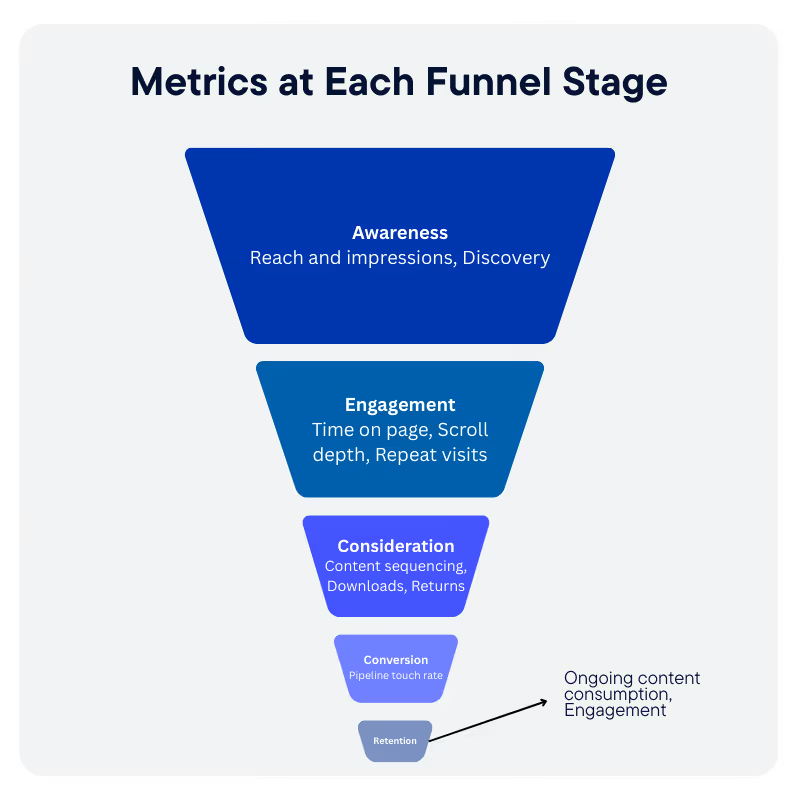
Effective content measurement starts with recognizing that no single metric tells the whole story. Content plays different roles at different stages of the funnel, and the metrics that matter should reflect those roles rather than forcing every asset to justify itself in revenue terms.
Awareness Metrics
At the top of the funnel, content supports discovery and visibility. Useful signals include:
- Reach and impressions, to understand how often content is surfaced.
- Assisted discovery, such as first-touch or early-touch appearances in buyer journeys.
Engagement Metrics
Engagement shows whether content is earning attention once discovered. Common indicators include:
- Time on page and scroll depth, to assess consumption quality.
- Repeat visits, which suggest sustained interest.
Consideration Metrics
As buyers evaluate options, content helps them progress and compare. Signals to track include:
- Content sequencing, or movement between related assets.
- Downloads and return frequency, which indicate deeper evaluation behavior.
Conversion Influence Metrics
Content often contributes indirectly to conversion. Helpful measures include:
- Assisted conversions, showing content presence in successful journeys.
- Pipeline touch rate, capturing how often content appears before revenue events.
Retention and Expansion Signals
Post-conversion content usage can support long-term value. Look for:
- Ongoing content consumption by existing customers.
- Engagement with educational or enablement assets tied to adoption.
The goal is not to eliminate leading indicators, but to interpret them in context and connect them to downstream outcomes over time.
Attribution and Contribution Models for Content
Attribution is where many content measurement efforts break down. Traditional models were designed for channels that drive immediate action, not for assets that influence decisions gradually and in combination with other touchpoints.
Why Last-Click Fails for Content
Last-click attribution assigns all credit to the final interaction before conversion. For content, this almost always misrepresents reality.
Educational articles, guides, and thought leadership tend to appear early or mid-journey, long before a buyer takes action. When last-click is the default, content appears ineffective even when it plays a meaningful role.
Multi-Touch Attribution for Content Influence
Multi-touch attribution distributes credit across multiple interactions in a buyer journey. For content, this approach better reflects how influence accumulates over time. It help teams see patterns in how content supports progression rather than expecting direct conversion.
Position-Based and Time-Decay Approaches
Position-based models assign more weight to early and late touches, acknowledging both discovery and conversion moments.
Time-decay models prioritize interactions closer to conversion while still recognizing earlier influence.
Both approaches are useful for content because they avoid the extremes of all-or-nothing credit.
Content Grouping and Asset-Level Rollups
Evaluating individual assets in isolation often produces noisy results. Grouping content by theme, audience, or funnel stage allows teams to assess performance at a level that supports decision-making.
When Directional Insight Is Sufficient
Content attribution rarely delivers precision. The goal is not perfect accounting, but informed direction.
When models consistently show which content types and themes contribute to successful journeys, teams have enough insight to prioritize investment and improve performance over time.
Building a Content Marketing Measurement Framework That Scales

A scalable content measurement framework focuses less on perfect data and more on consistency, clarity, and repeatable decision-making. The goal is to create a system teams can maintain over time as content volume and complexity grow.
1. Define Content Objectives by Audience and Stage
Measurement should start with clear objectives tied to who the content is for and where it fits in the funnel. Different audiences and stages require different success criteria, and alignment here prevents misinterpretation later.
2. Standardize Taxonomy, Tagging, and Naming
Consistent taxonomy is the foundation of reliable measurement. Standard naming conventions, tags, and metadata ensure content can be grouped, compared, and analyzed without manual cleanup.
3. Align Metrics to Decisions, Not Dashboards
Metrics should exist to inform action. Each tracked signal should map to a decision, such as where to invest, what to optimize, or what to retire, rather than filling space in a report.
4. Establish Review Cadence and Learning Loops
Regular reviews turn data into insight. A defined cadence helps teams identify patterns, test changes, and apply learnings across future content.
5. Document Assumptions and Limitations
No measurement system is perfect. Documenting assumptions, gaps, and known limitations for the next iteration builds trust and prevents overconfidence in the numbers.
Common Content Measurement Mistakes and How to Fix Them
The following content measurement mistakes are common, understandable, and fixable with a few structural changes.
Over-Optimizing for Clicks and Views
Mistake:
- Clicks and pageviews are easy to track and easy to report.
- They are often treated as success metrics, even when they do not reflect business impact.
- This pushes teams toward headline optimization rather than value creation.
Fix:
- Treat clicks and views as entry signals, not outcomes.
- Pair engagement metrics with downstream indicators such as assisted conversions or return visits.
- Evaluate performance trends over time instead of optimizing for single-asset spikes.
Treating All Content Equally
Mistake:
- All assets are measured against the same KPIs regardless of audience, purpose, or funnel stage.
- This makes high-value, early-stage content look weak and low-effort assets look successful.
Fix:
- Define success criteria by content type and funnel stage.
- Group assets by theme or objective before evaluating performance.
- Compare like with like rather than ranking everything on a single scale.
Content Marketing Attribution Challenges
Mistake:
- Content influence often appears weeks or months after publication.
- Short measurement windows miss compounding effects and long-tail value.
Fix:
- Extend attribution and evaluation windows for evergreen content.
- Track performance at multiple time horizons rather than single snapshots.
- Revisit older assets as part of regular reviews.
Failing to Connect Content to Downstream Systems
Mistake:
- Content engagement lives in web analytics, while revenue lives in CRM systems.
- Without integration, content impact remains anecdotal.
Fix:
- Connect content data to marketing automation and CRM platforms.
- Track content touches within buyer and customer journeys.
- Focus on influence patterns rather than perfect attribution.
Content Marketing Measurement Governance
Strong content measurement requires ongoing governance, not just one-time setup. Without guardrails, even well-designed frameworks degrade as content volume grows, teams change, and tools evolve.
Diagnostic checks help teams assess whether their measurement system is working as intended:
- Tracking time-to-impact by content type clarifies how long different assets typically take to influence outcomes
- Evaluating influence across multiple touches helps confirm that content is showing up throughout buyer journeys rather than clustering in a single stage
- Monitoring channel overlap and duplication prevents double counting and reveals where content may be competing with itself for credit.
Governance also requires clear ownership and shared rules. Teams should agree on who is responsible for content measurement, how attribution logic and windows are defined, and when those assumptions should be revisited.
Regular audits of tagging, taxonomy, and data quality help maintain confidence in the insights generated and prevent small inconsistencies from undermining long-term decision-making.
Content Marketing Measurement Tools
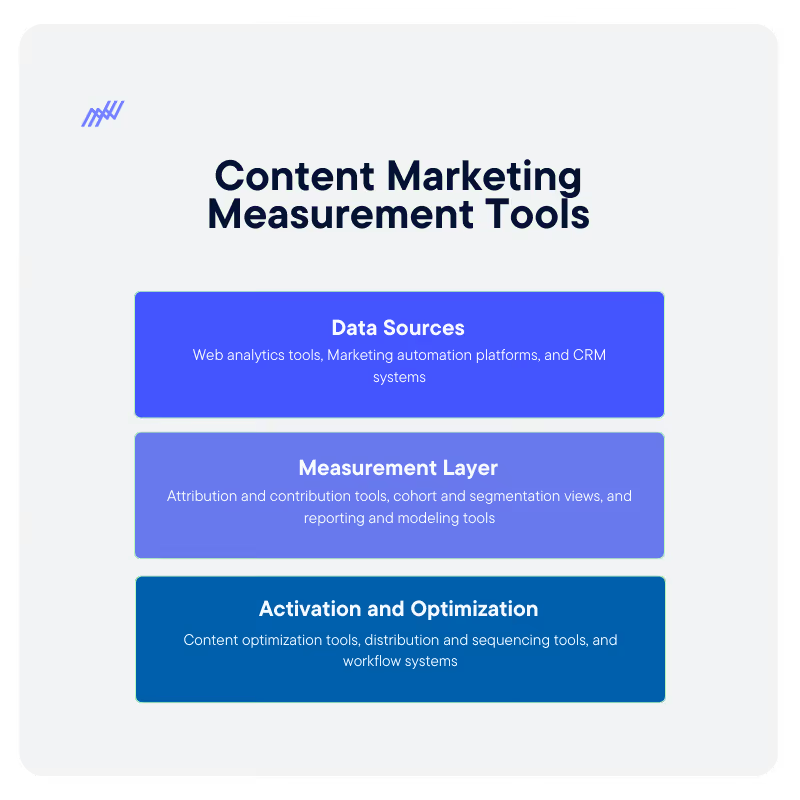
Effective content measurement does not depend on a single platform, but on how different tools work together across the measurement lifecycle.
Data Sources
These systems capture the raw signals that content measurement relies on:
- Web analytics tools to track pageviews, engagement, navigation paths, and on-site behavior.
- Marketing automation platforms to record content interactions tied to known leads and accounts.
- CRM systems to connect content exposure to pipeline, revenue, and customer outcomes.
Measurement Layer
This layer turns raw data into insight:
- Attribution and contribution tools to understand how content influences multi-touch journeys.
- Cohort and segmentation views to compare performance by audience, channel, or content type.
- Reporting and modeling tools that support trend analysis rather than one-off snapshots.
Activation and Optimization
Measurement is only valuable if it informs action:
- Content optimization tools for updating, consolidating, or retiring assets.
- Distribution and sequencing tools to test how content performs across channels and journeys.
- Workflow systems that help teams operationalize insights and iterate over time.
Measuring What Matters
Content marketing ROI is about influence, contribution, and cumulative impact across the buyer journey. Strong measurement starts with clear objectives, realistic expectations, and metrics tied to decisions rather than vanity.
Attribution will never deliver perfect answers, but it can provide enough direction to guide smarter investment. Teams that measure content ROI well gain clarity, confidence, and the ability to scale what works.






















































.avif)



























%25201.avif)


.avif)














.svg)
