





Most marketing teams can track leads. Far fewer can confidently explain how those leads turn into revenue.
Revenue attribution connects early marketing touchpoints to downstream sales outcomes, helping bridge the gap between marketing, sales, and RevOps.
This guide breaks down what revenue attribution is, how lead attribution fits in, common models, measurement challenges, and how to implement it responsibly. The goal is not perfect precision, but shared clarity and alignment around what actually drives growth.
What Revenue Attribution Is and How It Differs from Lead Attribution

Revenue attribution is the practice of connecting marketing activity to actual sales outcomes. Instead of stopping at leads or form fills, it looks at how early marketing touchpoints influence opportunities, deals, and closed revenue over time.
Lead attribution plays a role here, but it is an input, not the end goal. It helps explain where leads come from, while revenue attribution asks what happened next.
Did those leads turn into opportunities? Did they contribute to pipeline movement? Did they help close deals?
This distinction matters because attribution can be framed at different levels:
- Lead-based attribution assigns credit at the point of lead creation.
- Opportunity-based attribution focuses on what influenced pipeline creation or acceleration.
- Revenue-based attribution ties influence directly to closed deals.
For B2B teams, stopping at MQLs creates blind spots. Long sales cycles, multiple stakeholders, and sales activity all shape outcomes after the lead stage.
A common misconception is that revenue attribution exists to prove marketing “owns” revenue. In reality, its value lies in creating shared visibility into how growth actually happens.
Why Revenue Attribution Is Hard (and Why It Matters Anyway)
Revenue attribution breaks down in practice because B2B buying rarely follows a clean, linear path.
Sales cycles stretch across months or quarters, with prospects moving in and out of active evaluation. Along the way, multiple stakeholders engage with different messages, channels, and people, often at different times and for different reasons.
Not all of those interactions are captured digitally. Sales conversations, events, referrals, and partner activity frequently happen offline or outside standard marketing systems.
Even when data exists, CRM handoffs between marketing and sales are inconsistent. Leads may be reclassified, contacts merged, or opportunities created late, obscuring earlier influence.
Despite these challenges, weak revenue attribution carries real costs. When teams cannot credibly connect marketing effort to sales outcomes, budgeting becomes political, optimization stalls, and trust erodes across functions.
The goal is not perfect tracking, but a shared, defensible view of what influences revenue and where investment actually pays off.
Core Revenue Attribution Models Explained
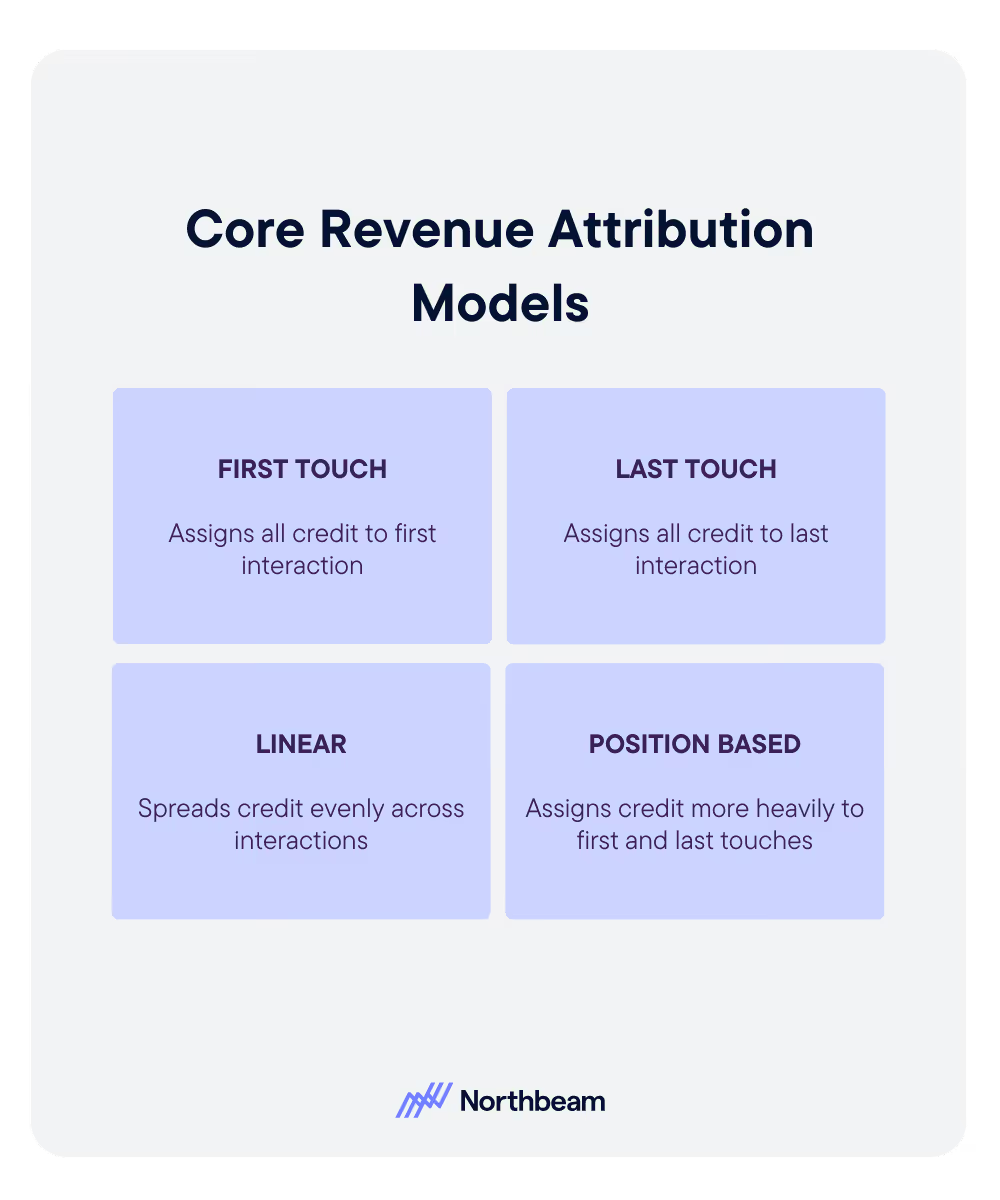
Revenue attribution models define how credit is assigned across marketing and sales touchpoints. Each model answers a different question, which is why no single approach works for every team or use case.
First-Touch Revenue Attribution
- Definition: Assigns all revenue credit to the first recorded marketing interaction.
- Use cases: Understanding which channels are effective at creating initial demand or awareness.
- Limitations: Ignores everything that happens after the first touch, including sales activity and deal acceleration.
Last-Touch Revenue Attribution
- Definition: Assigns all revenue credit to the final interaction before opportunity creation or close.
- Use cases: Evaluating conversion-focused programs and late-stage influence.
- Limitations: Overweights closing tactics and undervalues earlier marketing efforts that shaped the deal.
Linear and Multi-Touch Revenue Attribution
- Definition: Distributes credit across multiple interactions throughout the buyer journey.
- Use cases: Gaining a more holistic view of how marketing and sales jointly influence revenue.
- Limitations: Sensitive to data quality, model configuration, and interpretation. Results can vary widely.
Position-Based Revenue Models
- Definition: Position-based models weight key moments, often first and last touch, more heavily.
- Use cases: Teams seeking balanced visibility without heavy modeling complexity.
- Limitations: Still rely on assumptions about which moments matter most.
When Simpler Models Outperform Complex Ones
In practice, simpler models often outperform complex ones because they are easier to explain, validate, and apply consistently. Attribution only creates value when teams trust it enough to act on it. Stability and shared understanding matter more than mathematical precision.
Mapping Marketing Touchpoints to Sales Outcomes
Mapping marketing touchpoints to sales outcomes works best when it follows a deliberate, shared process rather than an attempt to capture everything at once.
1. Align Marketing, Sales, and RevOps Up Front
Attribution should be treated as a cross-functional agreement, not a marketing-only exercise. Clarify how sales activity fits into attribution, establish review cadences, and create feedback loops to surface issues early. Alignment at this stage helps avoid attribution-driven tension later.
2. Scope Attribution Responsibly
Define what questions attribution needs to answer. Focus on decisions you want to inform, such as budget allocation or program prioritization, and avoid overextending attribution beyond what data can support.
3. Define What Counts as a Marketing Touch
Not every interaction should be included. Clearly document which activities qualify as marketing touches, such as campaigns, content engagement, or events, and apply those rules consistently.
4. Align Touchpoints With Funnel Stages
Map touches to stages like awareness, opportunity creation, and deal progression. This helps distinguish between activities that open doors and those that move deals forward.
5. Understand Opportunity Creation vs Opportunity Acceleration
Some programs generate new opportunities. Others influence deal velocity, size, or win rate. Treating these as distinct outcomes improves interpretation.
6. Decide How to Handle Sales-Led and Partner-Led Deals
Define rules for deals initiated by sales or partners. Clear handling prevents over-attribution while still recognizing marketing’s supporting role.
Common Revenue Attribution Pitfalls and How to Avoid Them
Even well-intentioned attribution efforts can backfire when teams push models beyond their intended purpose or apply them inconsistently. The most common failures are avoidable with clear guardrails and shared expectations.
Over-Claiming Marketing Influence
- Pitfall: Attribution models are used to maximize marketing credit rather than reflect reality, eroding trust with sales and finance.
- Fix: Scope attribution to influence, not ownership. Document assumptions, acknowledge uncertainty, and present results as directional inputs for decision-making.
Ignoring Sales Activity or Timing
- Pitfall: Marketing touchpoints are analyzed in isolation, without accounting for sales outreach, deal stage, or timing.
- Fix: Incorporate sales activity into attribution views and separate early-stage influence from late-stage acceleration to preserve context.
Changing Models Mid-Quarter
- Pitfall: Teams tweak attribution models or windows in response to short-term performance, making trends impossible to interpret.
- Fix: Lock attribution definitions for a given period and review changes on a defined cadence, not reactively.
Treating Attribution as Compensation Logic
- Pitfall: Attribution is used to determine credit, quotas, or incentives, turning it into a political tool.
- Fix: Keep attribution focused on learning, planning, and optimization. Compensation decisions should rely on broader performance measures.
Revenue Attribution KPIs
Revenue attribution should inform a focused set of outcome-oriented metrics, not create a parallel reporting universe.
Core KPIs revenue attribution should support include:
- Marketing-influenced revenue, to show where marketing plays a meaningful role.
- Pipeline contribution, to understand impact earlier in the revenue cycle.
- Win rate by source, to assess deal quality, not just volume.
- Sales cycle length by touch pattern, to identify acceleration effects.
Equally important are diagnostic checks that test attribution health:
- Sensitivity to model or window changes.
- Consistency in lead-to-opportunity conversion.
- Overlap across channels that may indicate double-counting.
Together, these metrics help teams trust attribution as a decision-making input rather than a scorekeeping exercise.
Revenue Attribution Governance
Revenue attribution only works when it is governed as a shared system, not an ad hoc analysis.
Teams should lock attribution definitions, models, and windows for each reporting period to ensure results remain comparable over time. Frequent changes undermine confidence and make trends impossible to interpret.
Clear ownership is equally important. Establish who is responsible for maintaining attribution logic, who interprets results, and how questions or disputes are resolved.
Just as critical is documenting assumptions, known limitations, and data gaps. Transparent documentation sets realistic expectations, prevents misuse, and reinforces attribution’s role as a learning tool rather than a source of absolute truth.
Core Revenue Attribution Tools
Revenue attribution relies less on a single platform and more on how systems work together across the revenue stack.
Data Sources
Attribution starts with integrated data from marketing platforms, CRM systems, and sales activity logs. These sources capture campaign engagement, lead and opportunity records, and direct sales interactions that shape deal outcomes.
Identity and Linkage
Effective attribution depends on reliable identity resolution across leads, contacts, accounts, and opportunities. This layer connects early marketing engagement to downstream revenue, enabling analysis across long, multi-touch buying journeys.
Attribution Logic
Attribution tools apply defined models, windows, and weighting rules to determine how credit is assigned. This logic should be configurable, documented, and stable over time, allowing teams to compare performance consistently rather than chasing short-term signal shifts.
Outputs
The value of attribution appears in its outputs. Common outputs include revenue and pipeline reports, trend analyses by channel or touch pattern, and planning inputs that inform budget allocation and program strategy.
Attribution tools are most effective when outputs are easy to interpret and directly tied to decision-making workflows.
Revenue Attribution Implementation Plan
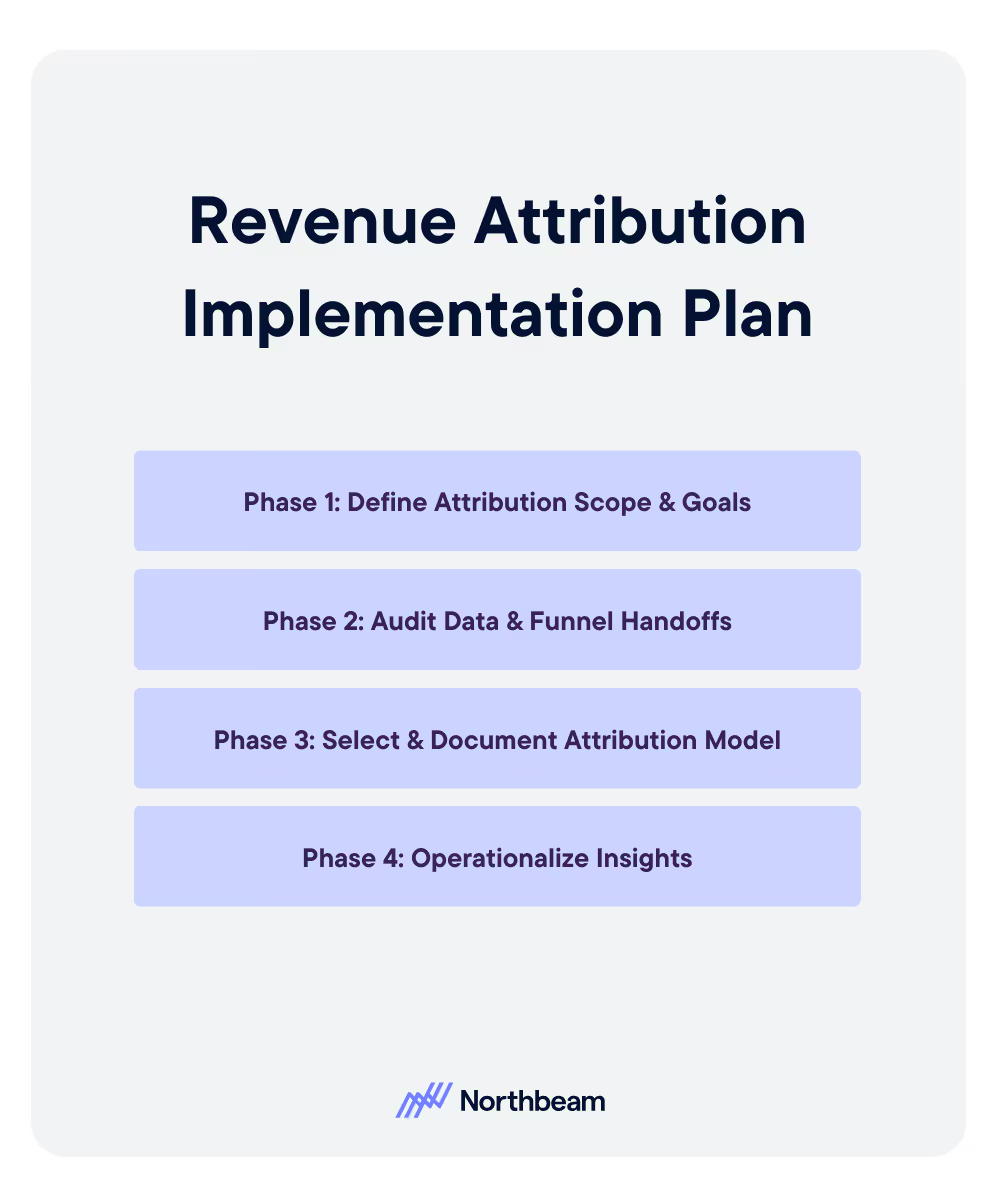
Revenue attribution works best when it is introduced deliberately, with clear intent and shared ownership, rather than treated as a technical configuration exercise.
Phase 1: Define Attribution Scope and Goals
Start by agreeing on what attribution is meant to support, such as budgeting, prioritization, or planning. Clear success definitions prevent misalignment and unrealistic expectations later.
Phase 2: Audit Data and Funnel Handoffs
Review marketing, sales, and CRM data to identify gaps, inconsistencies, and broken handoffs. Fixing foundational issues early improves confidence in downstream insights.
Phase 3: Select and Document Attribution Model
Choose a model and window that reflect your sales cycle and data maturity. Document assumptions and lock configurations to ensure consistency and comparability over time.
Phase 4: Operationalize Insights
Integrate attribution outputs into regular planning and review processes. Attribution delivers value only when insights influence investment decisions and strategic trade-offs.
From Revenue Attribution to Action
Revenue attribution connects marketing effort to real business outcomes by extending analysis beyond leads and into pipeline and revenue.
The real value of attribution comes when shared definitions, stable models, and cross-functional alignment are all in place. When governed well, attribution stops being a debate about credit and becomes a trusted input for planning, investment, and growth decisions.










































































.avif)






























%25201.avif)



.avif)
















.svg)
