





Attribution models determine how credit is assigned across the buyer journey, shaping budgets, priorities, and decisions.
This guide breaks down the most common attribution models, explains how attribution windows work and affect results, and shows how marketing attribution tools put these ideas into practice.
The verdict: no single model is “correct” in isolation. What matters most is choosing an approach that fits your business and applying it consistently over time.
What Marketing Attribution Is and Why It Matters
Marketing attribution is the practice of assigning credit to the marketing touchpoints that influence a conversion or revenue outcome.
In practical terms, it helps teams answer a simple but high-stakes question: which activities are contributing to results, and how much should each one matter in decision-making?
Attribution exists because modern marketing is a portfolio of bets. Budgets are spread across channels, campaigns, and time, and leaders need a way to allocate spend, prioritize effort, and learn what is actually moving the business forward.
Without attribution, decisions default to intuition, recency bias, or whoever makes the strongest argument in the room.
Attribution should be treated as a decision framework, not a reporting exercise. Its value is not in producing a perfectly accurate chart, but in creating a shared, repeatable way to compare options and test assumptions over time.
This is also where attribution breaks down. Buyer journeys are nonlinear, cross-device, and influenced by factors that are difficult or impossible to track. As a result, attribution provides directional insight, not exact causality.
The goal is not to prove what caused a conversion, but to understand patterns well enough to make better, more confident decisions.
Overview of Common Attribution Models
Attribution models differ in how they distribute credit across the buyer journey. Each model reflects a set of assumptions about what matters most, and those assumptions materially shape how channels and campaigns are valued.
First-Touch
First-touch attribution assigns all credit to the first interaction that introduces a buyer to your brand.
Its strength is clarity. It highlights top-of-funnel discovery and is useful for understanding which channels are effective at generating initial demand.
Its weakness is that it ignores everything that happens after awareness, often overstating the value of early touches while undervaluing nurturing and conversion-driving efforts.
Last-Touch
Last-touch attribution gives full credit to the final interaction before conversion.
It persists because it is simple and aligns neatly with conversion reporting. However, it often misleads by over-crediting lower-funnel channels and underestimating the cumulative influence of earlier marketing activity.
Linear/Multi-Touch
Linear attribution distributes credit evenly across all recorded touchpoints in a multi-touch attribution model.
This model is useful when the goal is to acknowledge the full journey without prioritizing any single stage. The trade-off is that it assumes all touches are equally influential, which is rarely true in practice.
Time-Decay
Time-decay attribution weights interactions closer to conversion more heavily. It reflects momentum and buying intent, making it useful for longer sales cycles. However, it can still minimize the strategic importance of early demand creation.
Position-Based
Position-based attribution emphasizes both entry and conversion points, typically assigning more credit to the first and last touches. This approach balances discovery and closure, but still relies on fixed assumptions about where value is created.
Ultimately, different models can dramatically change perceived channel value. Understanding those shifts is more important than selecting a single “correct” model.
Understanding Attribution Windows and Their Impact
Attribution windows define how far back in time a touchpoint can occur and still receive credit for a conversion. While often treated as a technical setting, window length plays a major role in shaping what attribution surfaces and what it quietly excludes.
Why Attribution Windows Matters
Attribution windows exist to create boundaries. They limit how much historical activity is considered relevant to a conversion, helping teams avoid assigning credit to interactions that are too distant to be meaningfully connected.
Typical Window Lengths by Channel
Paid search and social often use shorter windows, while content, email, and organic channels tend to require longer lookback periods to capture influence over time.
How Window Choice Affects Performance
Short windows favor lower-funnel channels and recent activity. They reduce noise but introduce recency bias.
Longer windows increase the apparent impact of awareness and nurturing efforts, often reshaping channel rankings. They capture more context but risk overstating weak or indirect influence.
How Marketing Attribution Tools Operationalize Models
The best marketing attribution tools translate abstract models into operational systems by collecting data, applying logic, and producing outputs teams can act on. Understanding how this process works helps clarify both the power and the limits of marketing attribution software.
Data Ingestion
Attribution tools ingest data from ad platforms, web analytics, CRM systems, and other sources. These inputs include events, identifiers, and recorded touchpoints that form the raw material for attribution analysis.
Identity Resolution and Cross-Device Challenges
To connect touchpoints into a single journey, tools rely on identity resolution. This process is imperfect, especially across devices, browsers, and anonymous sessions, and directly affects attribution accuracy.
Model Configuration and Customization
Tools allow teams to select attribution models, define windows, and apply weighting rules. These configurations encode assumptions about how value is created across the funnel.
Reporting Outputs
Outputs typically include dashboards, comparisons, and channel-level summaries that can be used to guide actions.
But even the most sophisticated tooling cannot compensate for incomplete inputs, unclear goals, mismatched models, or unrealistic expectations. Tools amplify assumptions; they do not correct them.
Choosing the Right Attribution Model for Your Team
The right attribution approach depends less on sophistication and more on fit. Models and windows should reflect how your funnel actually works, how long decisions take, and how your organization uses insights to make trade-offs.
Funnel complexity and sales cycle length are the first constraints. Short, transactional journeys can often rely on simpler models and tighter windows, while longer, multi-stakeholder sales cycles benefit from approaches that recognize sustained influence over time.
B2B and B2C programs also face different pressures. B2C teams often prioritize speed, volume, and channel efficiency, while B2B teams need attribution that supports account-based motion, longer consideration periods, and collaboration with sales.
These differences should shape both model choice and expectations.
Finally, consider program maturity. Early-stage teams are often better served by stable, easy-to-explain models that establish baselines. As programs mature and data quality improves, more nuanced approaches can add value.
Attribution Approach Decision Checklist
- Which decisions will attribution inform?
- How long is our typical buying cycle?
- How complex are our conversion paths?
- Who needs to trust and use our output?
- How stable is our data and identity resolution?
- How often can models realistically change?
Common Attribution Mistakes and How to Avoid Them
Most attribution failures come from how attribution is interpreted, operationalized, and governed inside an organization.
Treating Attribution as a Source of Truth
Attribution is often mistaken for a definitive answer to what caused a conversion. In reality, it offers directional insight. Treating it as ground truth leads to overconfidence and brittle decisions.
Changing Models Too Frequently
Frequent model changes make trends impossible to interpret. When the rules keep shifting, teams lose the ability to compare performance over time and confidence in the outputs erodes.
Ignoring Non-Digital Touchpoints
Many buyer journeys include offline or non-trackable interactions such as sales conversations, events, referrals, or word of mouth. Ignoring these touchpoints biases attribution toward what is easiest to measure, not what is most influential.
Optimizing Spend Without Guardrails
Attribution-driven optimization without constraints can lead to short-term efficiency at the expense of long-term growth. Channels that build demand or support conversion indirectly are often the first to be cut.
Practical Fixes
Clear documentation, locked model definitions, agreed interpretation rules, and a regular review cadence help keep attribution useful, trusted, and aligned with business outcomes.
Attribution Model Measurement, Tools, & Governance
Attribution only creates value when it is measured against the right outcomes, supported by reliable tooling, and governed with discipline.
Measurement
Attribution should inform a small set of business-relevant indicators, not an ever-expanding list of metrics. The most useful KPIs focus on trends and confidence rather than point-in-time precision.
Key indicators should include channel efficiency trends over time, confidence in budget reallocation decisions, consistency in observed conversion paths, and stability in forecasting.
When attribution outputs fluctuate dramatically without underlying business changes, that volatility is a signal to investigate assumptions rather than react to results.
Tools
Attribution tools operate as layered systems. The data layer ingests inputs from ad platforms, web analytics, and CRM systems. These inputs are then processed through event normalization and identity stitching to create a usable representation of the buyer journey.
At the core sits the attribution engine, where model logic, windowing rules, and weighting are applied. Outputs typically take the form of dashboards, model comparisons, and planning inputs that support budgeting and prioritization.
The goal is clarity and consistency, not exhaustive reporting.
Governance
Strong governance ensures attribution remains trustworthy and actionable. Diagnostic checks such as sensitivity to model changes, window-length impact analysis, and channel overlap or inflation help teams understand how fragile or robust their insights are.
Effective governance also requires locked model definitions on a regular cadence, documented assumptions and limitations, and cross-team agreement on how results should be interpreted and used.
Attribution Model Implementation Plan
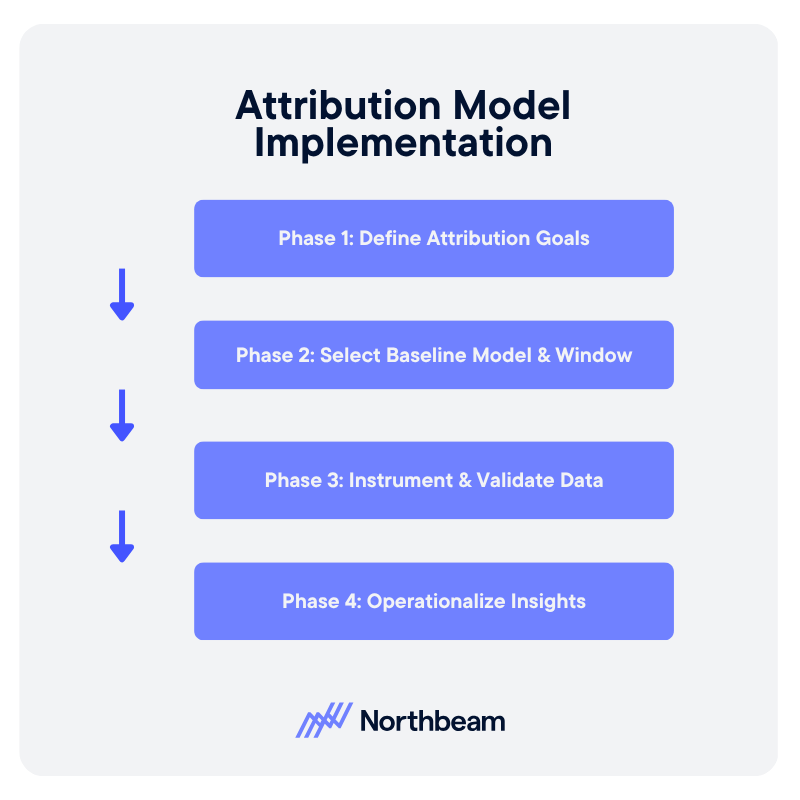
Implementing attribution effectively requires a phased approach that prioritizes clarity, data reliability, and organizational alignment before optimization. Each phase builds on the last, reducing risk while increasing confidence in the decisions attribution supports.
Phase 1: Define Attribution Goals
The first step is defining what attribution is meant to inform. Leadership should align on the decisions attribution will support, such as budget allocation, channel evaluation, or planning scenarios, and document clear success criteria.
Phase 2: Select Baseline Model and Window
Once goals are defined, marketing operations selects a baseline attribution model and window that match funnel structure and buying cycle length. This configuration should be simple, explicit, and stable.
Phase 3: Instrument and Validate Data
Analytics teams ensure events, identifiers, and integrations are correctly instrumented and validated. The focus is on completeness, consistency, and repeatability, not perfection.
Phase 4: Operationalize Insights
In the final phase, attribution insights are embedded into planning, budgeting, and performance reviews. When attribution consistently informs real decisions, it has moved from theory to practice.
Attribution Models as Decision Tools
Attribution models are tools for learning, not final verdicts, and window choice shapes results as much as model choice. In practice, simple and consistent approaches often outperform complex ones. And with strong governance, attribution can become a system for confident decision-making.




































































.avif)




























%25201.avif)


.avif)















.svg)
