





What customers say about themselves matters less than what they actually do.
Behavioral segmentation groups users based on real actions, such as purchases, browsing activity, engagement frequency, and product usage, rather than static attributes or stated preferences.
This guide covers what behavioral segmentation is, how it works in practice, and how to build and apply it across channels. When tied to lifecycle strategy and measurement discipline, behavioral segmentation becomes a reliable driver of performance and more efficient growth.
What is Behavioral Segmentation
Behavioral segmentation groups customers based on what they actually do, not what they say about themselves.
Instead of relying on static attributes like age, industry, or job title, it uses observed actions such as purchases, browsing behavior, product usage, and engagement frequency to define audiences.
This differs from demographic segmentation, which focuses on who a customer is, and psychographic segmentation, which focuses on attitudes or preferences. Behavioral segmentation centers instead on real interactions, making it more actionable for marketing and growth teams.
Common behavioral signals include:
- Purchase history
- Pages viewed
- Feature adoption
- Session frequency
- Response to past campaigns
These signals can be tracked across channels and updated continuously as customer behavior changes.
Because behavior reflects intent, it is often more predictive than stated attributes. A user who repeatedly visits a pricing page or abandons a cart shows clearer purchase intent than one who simply fits a target persona.
Core Behavioral Segmentation Models
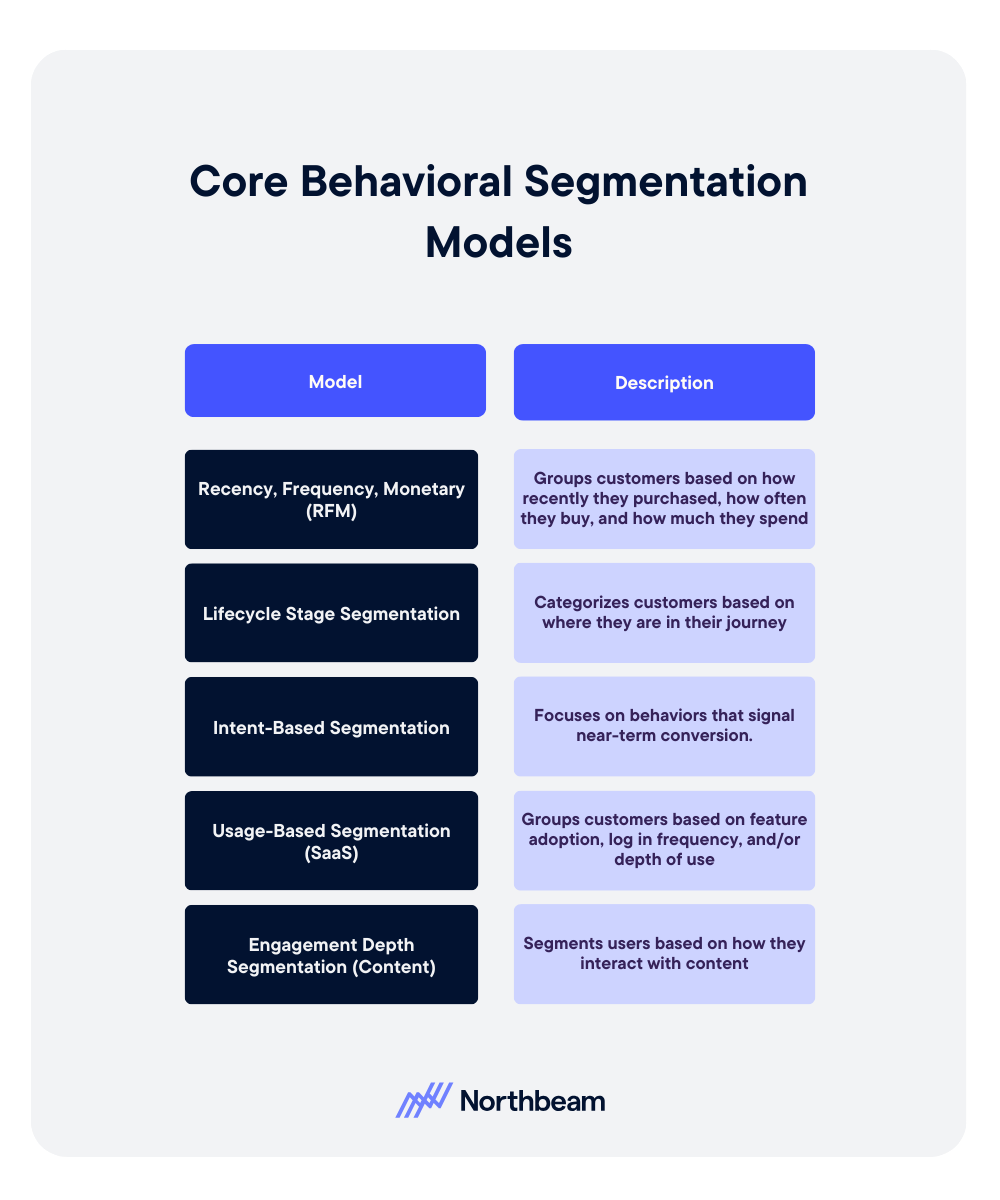
Different behavioral segmentation models organize customer actions in distinct ways. The right model depends on your business type, data availability, and the decisions you are trying to inform.
Recency, Frequency, Monetary (RFM)
RFM segmentation groups customers based on how recently they purchased, how often they buy, and how much they spend. It is widely used in e-commerce and retail to identify high-value customers, reactivation opportunities, and churn risk.
Lifecycle Stage Segmentation
Lifecycle segmentation categorizes customers based on where they are in their journey, such as new users, active customers, at-risk users, or churned accounts. This model helps align messaging and offers to customer maturity, ensuring that communication is timely and relevant.
Intent-Based Segmentation
Intent-based segmentation focuses on behaviors that signal near-term conversion, such as repeated product views, pricing page visits, or trial sign-ups. These segments are often used for performance marketing and sales prioritization, where timing and relevance are critical.
Usage-Based Segmentation (SaaS)
In SaaS environments, segmentation is often based on product usage. Customers can be grouped by feature adoption, login frequency, or depth of use. This helps identify power users, expansion opportunities, and accounts at risk of churn.
Engagement Depth Segmentation (Content)
For content-driven businesses, engagement depth segments users by how they interact with content, such as page views, time on site, or repeat visits. These segments inform personalization, subscription strategies, and audience development.
Behavioral Segmentation Examples & Use Cases Across Channels
Behavioral segmentation becomes most valuable when applied in context. The same underlying signals can be used differently depending on the channel, business model, and customer journey.
Ecommerce Product Recommendation Segments
Retailers commonly segment customers based on browsing and purchase behavior.
- Users who frequently view a category but have not purchased can receive targeted recommendations or limited-time offers.
- Repeat buyers may be grouped into loyalty segments and shown complementary products.
B2B Account Engagement Tiers
In B2B marketing, accounts are often segmented by engagement level.
- High-intent accounts that attend webinars, download resources, and revisit key pages can be prioritized for sales outreach.
- Lower-engagement accounts may remain in nurture campaigns until their activity increases.
SaaS Feature Adoption Cohorts
SaaS companies segment users based on feature usage and product adoption.
- Customers who have adopted core features may be candidates for upsell.
- Those who have not reached activation milestones can receive onboarding support or education campaigns.
Re-Engagement Campaigns for Inactive Users
Inactive users can be grouped by time since last interaction and prior behavior.
- Recently lapsed users may respond to reminders.
- Long-dormant users may require stronger incentives or win-back campaigns.
Cross-Sell Triggers Based on Purchase Behavior
Purchase history can be used to trigger cross-sell opportunities.
- Customers who buy one product category can be targeted with related items, bundles, or upgrades based on observed buying patterns.
How to Build and Use Behavioral Segments
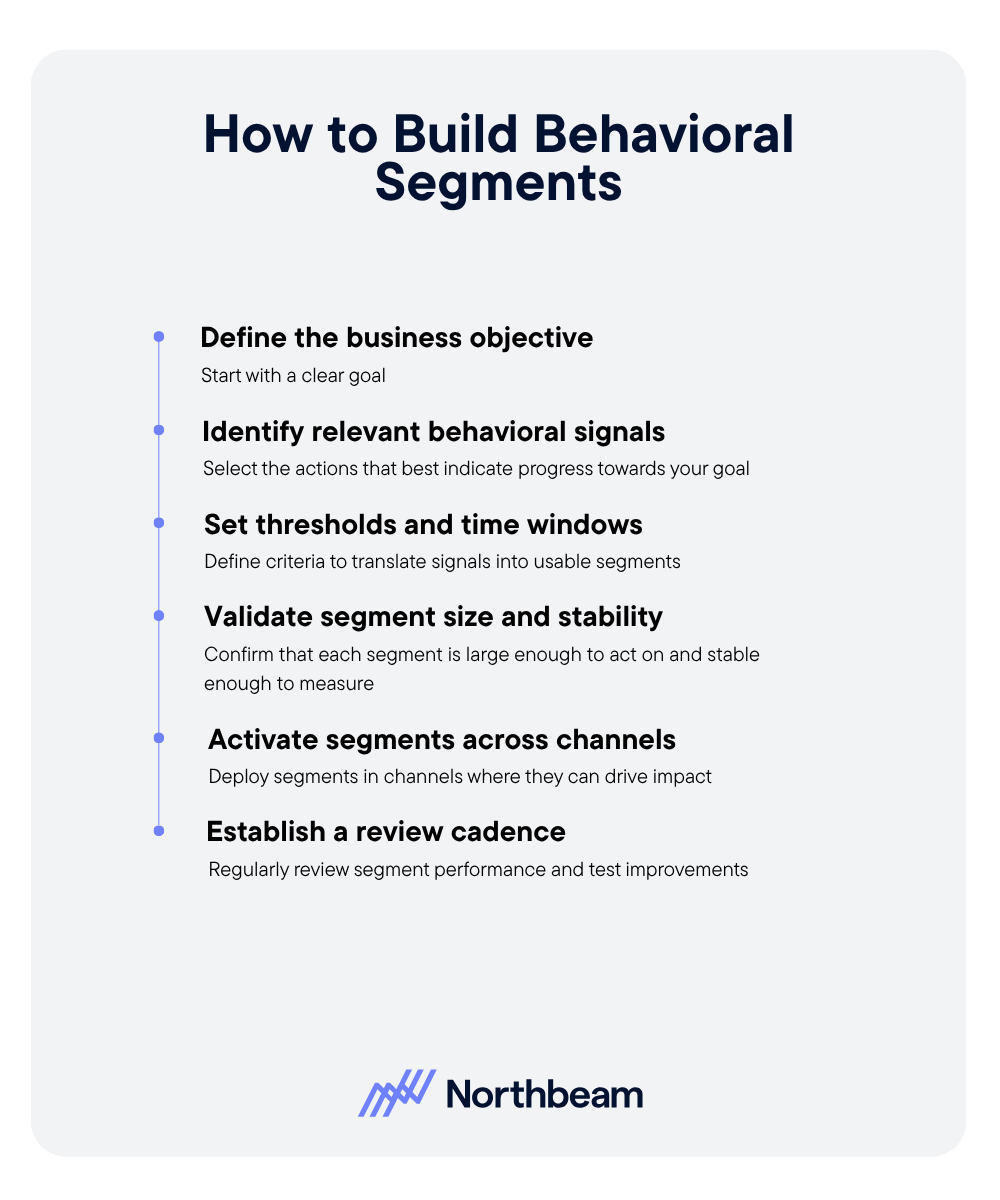
Building effective behavioral segments requires a structured approach that connects customer actions to clear business outcomes.
- Define the business objective first. Start with a clear goal, such as increasing conversion, improving retention, or driving expansion revenue. The objective should determine how segments are designed and how success is measured.
- Identify relevant behavioral signals. Select the actions that best indicate progress toward your goal. This may include purchases, product usage, engagement frequency, or high-intent behaviors like pricing page visits.
- Set thresholds and time windows. Translate signals into usable segments by defining criteria. For example, users who logged in three times in the past seven days, or customers who have not purchased in 60 days. Time windows ensure segments stay relevant.
- Validate segment size and stability. Confirm that each segment is large enough to act on and stable enough to measure. Very small or highly volatile segments can lead to unreliable results and inconsistent performance.
- Activate segments across channels. Deploy segments in the channels where they can drive impact, such as email, paid media, in-app messaging, or sales outreach. Ensure messaging aligns with the behavior that defines the segment.
- Establish a review cadence. Regularly review segment performance, refresh definitions as behavior changes, and test improvements. Behavioral segmentation is not static, it should evolve alongside your customers and business goals.
Measurement and Optimization of Behavioral Segments
Measuring behavioral segments ensures they drive meaningful outcomes, not just cleaner audience definitions. Effective teams track performance, diagnose issues, and continuously refine segments over time.
Core KPIs
Behavioral segments should be evaluated against business outcomes, not just activity.
Key metrics include:
- Conversion rate by segment
- Revenue per user
- Retention rate
- Engagement frequency
Diagnostic Checks
Beyond top-line metrics, diagnostic checks help validate whether segments are working as intended.
- Segment overlap analysis ensures audiences are distinct and not competing with each other.
- Segment decay measures how quickly behaviors become outdated, requiring refresh.
- Comparing performance lift against a non-segmented baseline helps confirm that segmentation is actually improving results.
Common Behavioral Segmentation Mistakes
Even well-designed behavioral segmentation strategies can break down in practice. Most issues come from how segments are defined, maintained, and activated over time.
Creating Too Many Micro-Segments
- Mistake: Over-segmenting audiences into highly specific groups that are too small to act on or measure reliably.
- Fix: Focus on a smaller set of high-impact segments that are large enough to drive meaningful results. Prioritize clarity and actionability over precision.
Using Stale Data
- Mistake: Building segments on outdated behaviors that no longer reflect current customer intent.
- Fix: Use rolling time windows and refresh segments regularly to ensure they reflect recent activity. Prioritize signals that update frequently.
Ignoring Sample Size Limitations
- Mistake: Making decisions based on segments that are too small or volatile, leading to misleading performance insights.
- Fix: Validate that segments meet minimum size thresholds before acting on them. Aggregate similar segments when needed to improve statistical reliability.
Failing to Align Segments With Messaging
- Mistake: Defining segments based on behavior but delivering generic or mismatched messaging that does not reflect that behavior.
- Fix: Ensure that messaging directly corresponds to the action that defines the segment. For example, high-intent users should receive conversion-focused messaging, while early-stage users need education.
Treating Segments as Static
- Mistake: Assuming segments remain valid over time, even as customer behavior changes.
- Fix: Treat segmentation as a dynamic system. Continuously monitor performance, update definitions, and test improvements to keep segments relevant and effective.
Behavioral Segmentation Toolkit
Effective behavioral segmentation depends on the systems that capture, define, and activate customer data across the stack.
Data Sources
Behavioral segmentation starts with reliable data inputs. Common sources include CRM systems, which store customer and transaction data; product analytics platforms, which track feature usage and engagement; and website tracking tools, which capture browsing behavior and on-site interactions.
Segmentation Engine
A segmentation engine translates raw behavioral data into usable audiences. This can include rule-based segmentation, where users are grouped based on defined criteria, or dynamic audiences that update automatically as behavior changes over time.
Activation
Segments create value when they are activated across channels. Common activation points include email campaigns, paid media targeting, and in-app messaging. Aligning segments with the right channels ensures that behavioral insights translate into relevant customer experiences and measurable outcomes.
How to Implement Behavioral Segmentation Strategy
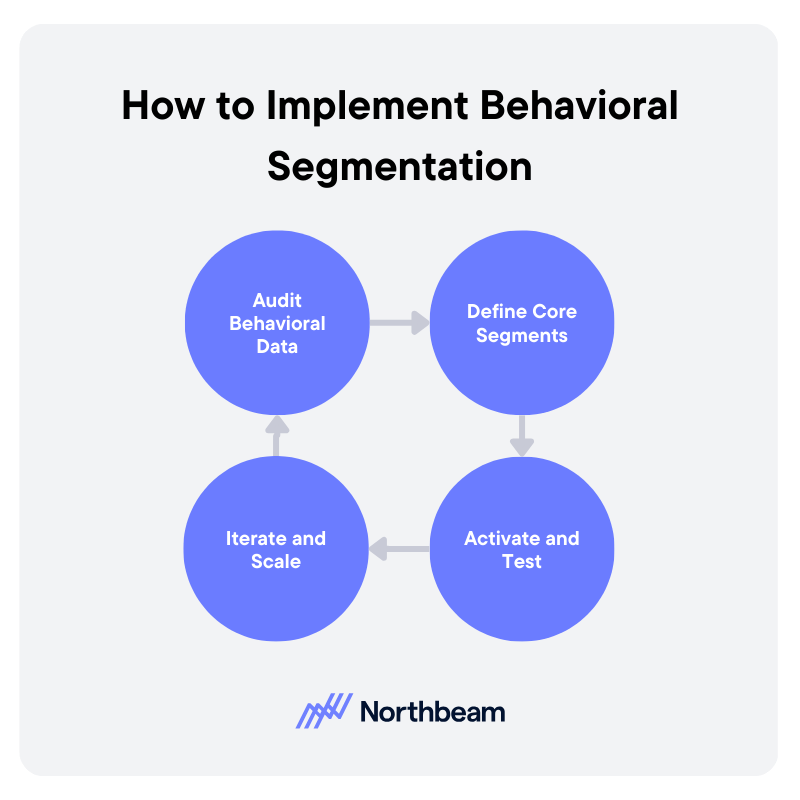
Turning behavioral segmentation into a repeatable system requires coordination across data, marketing, and product teams. A phased approach helps ensure segments are both actionable and measurable.
Audit Behavioral Data
Start by assessing what behavioral data is available and reliable. This includes CRM data, product analytics, website tracking, and campaign engagement signals. Identify gaps, inconsistencies, and areas where tracking needs to be improved. The goal is to build a clear inventory of usable signals.
Define Core Segments
Based on your business objectives, define a small set of core segments that will drive the most impact. These might include high-intent users, new customers, at-risk accounts, or power users. Document the logic, thresholds, and time windows for each segment to ensure consistency.
Activate and Test
Deploy segments across key channels such as email, paid media, in-app messaging, or sales outreach. Pair each segment with tailored messaging that reflects user behavior. Test performance through controlled experiments to validate that segmentation improves outcomes.
Iterate and Scale
Refine segment definitions based on performance data and expand usage across additional channels and teams. As segmentation matures, integrate it more deeply into campaign planning, personalization, and forecasting. Over time, this creates a scalable system that continuously improves with new data and insights.
From Audience Targeting to Actionable Growth
Behavioral segmentation shifts marketing from assumptions to observable action. By grounding audience strategy in what customers actually do, teams can prioritize the signals that matter most and deliver more relevant experiences across the lifecycle.
The most effective segmentation strategies begin with clear objectives, are built on reliable data, and are validated through measurement and experimentation. Without this discipline, segments risk becoming static labels rather than drivers of performance.
When supported by strong governance and continuous iteration, behavioral segmentation becomes a system for aligning data, decision-making, and execution to drive sustainable growth.





















































.avif)
























%25201.avif)


.avif)












.svg)
