




Revenue alone does not determine whether a business is healthy. A company can generate impressive sales and still struggle financially if the underlying costs of producing or delivering its products are too high.
Gross profit helps clarify this picture. It measures how much money remains after covering the direct costs required to deliver a product or service.
In this guide, we’ll explain what gross profit is, how to calculate gross profit, how it differs from net profit, and why it matters for marketers making growth and budget decisions. Understanding gross profit is essential for building sustainable, profitable growth.
What is gross profit?
Gross profit measures how much money a business keeps after paying the direct costs required to produce or deliver its product or service. It is one of the simplest and most important indicators of whether a company’s core operations are financially viable.
The key distinction is between revenue and profit. Revenue represents the total money generated from sales. Gross profit, by contrast, shows what remains after subtracting the cost of goods sold (COGS).
COGS includes the direct costs tied to delivering the product or service, such as materials, manufacturing, fulfillment, or service delivery labor.
Because it isolates production costs, gross profit acts as an early profitability filter. A company can generate strong revenue while still struggling financially if its direct costs are too high. Gross profit reveals whether the business model itself produces meaningful economic value before operating expenses like marketing, salaries, or rent are considered.
On financial statements, gross profit appears near the top of the income statement, directly below revenue and cost of goods sold. From there, operating expenses are subtracted to determine operating profit and eventually net profit.
For marketers and operators alike, gross profit provides a clear baseline for evaluating growth decisions.
The gross profit formula explained
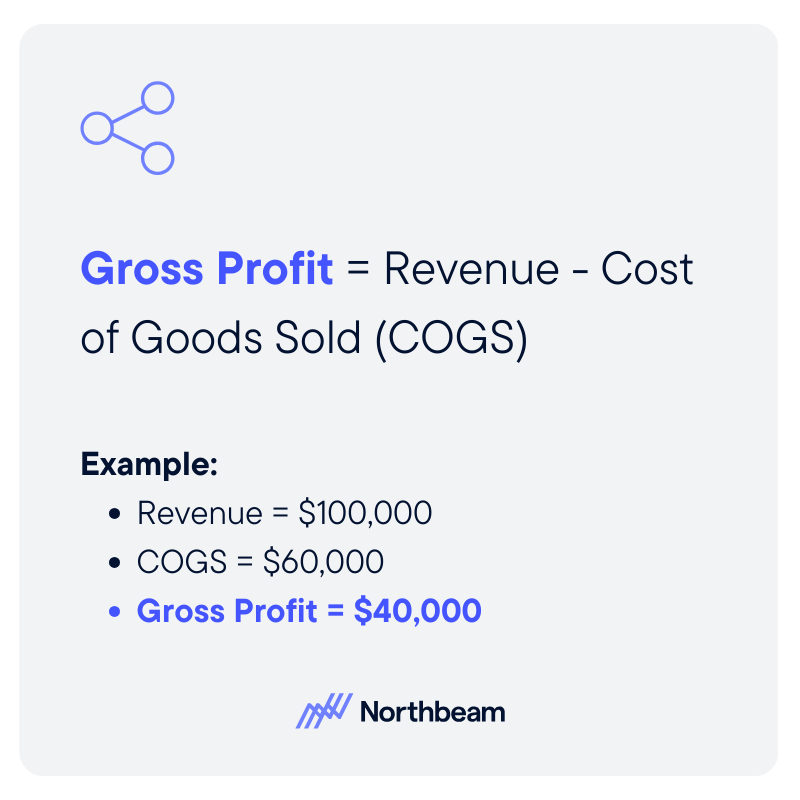
The gross profit formula is straightforward:
Gross Profit = Revenue – Cost of Goods Sold (COGS)
Revenue refers to the total income generated from selling products or services before any expenses are deducted. For example, if a company sells 1,000 units of a product at $50 each, the total revenue would be $50,000.
Cost of goods sold includes the direct costs required to produce or deliver those products or services:
- In a retail business, COGS might include manufacturing costs, wholesale purchase prices, packaging, and shipping.
- For a software company, COGS could include cloud infrastructure costs, payment processing fees, and customer support tied directly to delivering the service.
- In a service business, it might include the labor costs of employees who perform the service.
It is equally important to understand what does not count as COGS. Marketing expenses, office rent, executive salaries, and administrative overhead are typically classified as operating expenses rather than production costs. These costs affect overall profitability, but they are not included in the gross profit calculation.
For example, if a company generates $100,000 in revenue and spends $60,000 on cost of goods sold, the calculation would be:
Gross Profit = $100,000 – $60,000 = $40,000
That $40,000 represents the value remaining to cover operating expenses and generate profit.
Gross profit examples across business models
Gross profit works the same way across industries, but the types of costs included in COGS can vary significantly depending on the business model.
The examples below illustrate how gross profit appears in retail, SaaS, and service-based businesses, as well as how margins can differ across industries.
Retail Business (Physical Goods)
- Revenue: A clothing retailer sells 500 jackets at $120 each, generating $60,000 in revenue.
- COGS: The jackets cost $50 each from the manufacturer, for a total production cost of $25,000. Packaging and fulfillment add another $5,000.
- Gross profit: $60,000 – $30,000 = $30,000 gross profit.
Retail businesses typically have clear, product-level costs tied to inventory and fulfillment, which makes gross profit relatively straightforward to calculate.
SaaS or subscription business
- Revenue: A SaaS company generates $200,000 in monthly subscription revenue.
- COGS: Direct delivery costs include cloud hosting, customer support, and payment processing fees, totaling $50,000 per month.
- Gross profit: $200,000 – $50,000 = $150,000 gross profit.
Software businesses often have high gross margins because the cost of delivering additional users is relatively low once the platform is built.
Service business
- Revenue: A marketing agency generates $120,000 in project revenue in a month.
- COGS: The direct labor cost for the team delivering client work is $70,000.
- Gross profit: $120,000 – $70,000 = $50,000 gross profit.
In service businesses, labor is typically the primary component of COGS, making utilization and staffing efficiency key drivers of margin.
Gross Profit vs Net Profit vs Contribution Margin
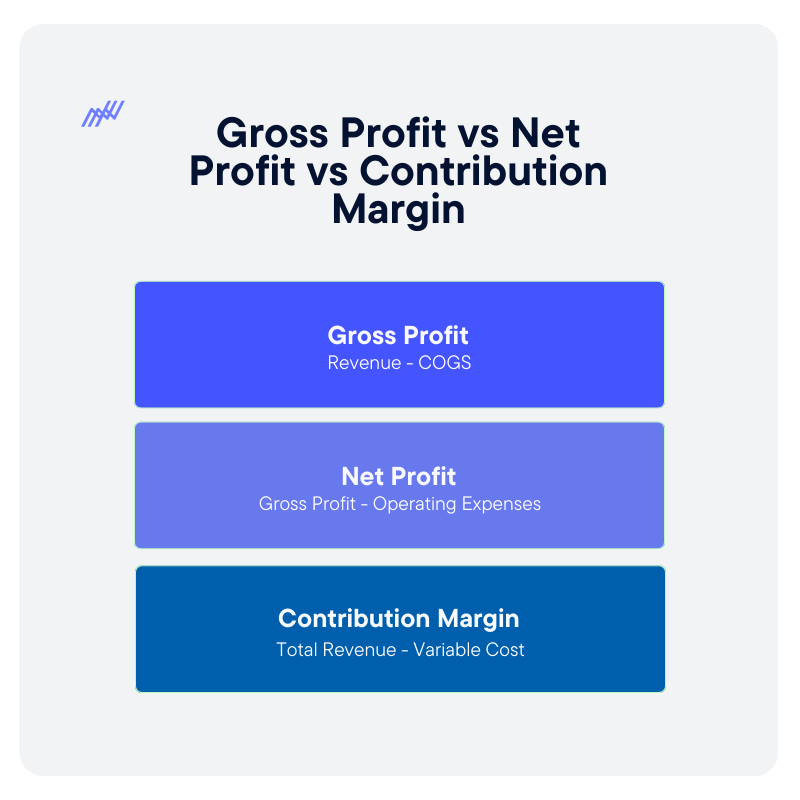
Understanding gross profit becomes easier when it is compared with other common profitability metrics, particularly net profit and contribution margin. Each metric captures a different stage of how revenue turns into profit.
Gross profit
Gross profit measures the money remaining after subtracting cost of goods sold (COGS) from revenue. It focuses only on the direct costs required to produce or deliver a product or service.
Because it isolates these production costs, gross profit reveals whether the core business model generates value before broader operating expenses are considered.
Net profit
Net profit represents the final profit of the business after all expenses are deducted. In addition to COGS, this includes operating costs such as marketing, salaries, rent, software subscriptions, and administrative overhead.
Taxes and interest expenses are also typically included in the calculation. A company may report strong gross profit but still have weak net profit if operating expenses are too high.
Contribution margin
Contribution margin measures how much revenue remains after subtracting variable costs, which are expenses that scale directly with sales volume.
This metric is often used in pricing and unit economics analysis because it shows how much each additional sale contributes toward covering fixed costs and generating profit.
Why gross profit matters for marketing
Gross profit plays a critical role in determining how much a company can afford to spend on marketing while still growing sustainably.
One of the most important relationships is between gross profit and customer acquisition cost (CAC). Marketing investments are ultimately funded by the profit generated from each sale, so if the gross profit per customer is too small, even efficient marketing campaigns can struggle to generate meaningful returns.
Gross profit also helps establish media efficiency guardrails. Marketing teams often evaluate performance using metrics like cost per click or cost per acquisition, but these metrics only tell part of the story. Without understanding gross profit, it becomes difficult to determine how much acquisition cost the business can tolerate while maintaining healthy margins.
Pricing and discount strategies also directly influence gross profit. Promotions may increase conversion rates and revenue in the short term, but they can also reduce the profit available to support marketing spend.
Similarly, different products within a catalog may carry very different margins. Marketing campaigns that prioritize lower-margin products can generate impressive revenue while contributing less profit to the business.
For these reasons, revenue growth alone can be misleading. A company that increases sales without protecting its gross profit may ultimately destroy value rather than create it.
Aligning marketing decisions with gross profit ensures that growth strengthens, rather than weakens, the underlying economics of the business.
Common gross profit mistakes and misinterpretations
Even though gross profit is a straightforward metric, it can be misinterpreted or calculated incorrectly. These mistakes can lead to flawed conclusions about profitability and growth performance.
Misclassifying costs
Businesses sometimes include expenses like marketing spend, software subscriptions, or administrative salaries in COGS even though these are operating expenses. This distorts the gross profit calculation and makes it harder to evaluate the true profitability of the product or service.
The solution is to define COGS clearly and apply that definition consistently across reporting periods.
Ignoring variable cost shifts
Gross profit can change even when revenue stays constant because the underlying costs of production fluctuate. Supplier price increases, higher shipping costs, or infrastructure expenses can quietly reduce margins over time.
Monitoring changes in unit costs and regularly reviewing cost assumptions helps ensure that gross profit remains an accurate reflection of operational economics.
Comparing gross profit without context
Gross profit figures are sometimes compared across products, campaigns, or companies without considering differences in pricing, cost structures, or business models. A higher gross profit number does not necessarily mean better performance.
Evaluating gross profit alongside revenue scale, margins, and cost structures provides a more meaningful comparison.
Focusing only on gross margin percentage
Gross margin percentage is useful, but it does not tell the whole story. A business can have high margins but low overall revenue, resulting in limited total profit.
Combining gross margin analysis with total gross profit and unit economics provides a clearer view of financial performance.
Gross profit measurement & governance checklist
Tracking gross profit consistently requires more than a single calculation. Organizations need supporting metrics, diagnostic checks, and clear governance practices to ensure margin insights translate into better decisions.
KPIs to Monitor Alongside Gross Profit
- Gross margin percentage: Shows gross profit as a share of revenue, making it easier to compare profitability across products, time periods, and business units.
- Customer acquisition cost (CAC): Helps determine whether marketing spend is sustainable relative to the profit generated from new customers.
- Contribution margin: Highlights how much revenue remains after variable costs, providing additional context for pricing and unit economics decisions.
- Average order value (AOV): Indicates how much revenue each transaction generates, which can directly influence total gross profit.
Diagnostic checks
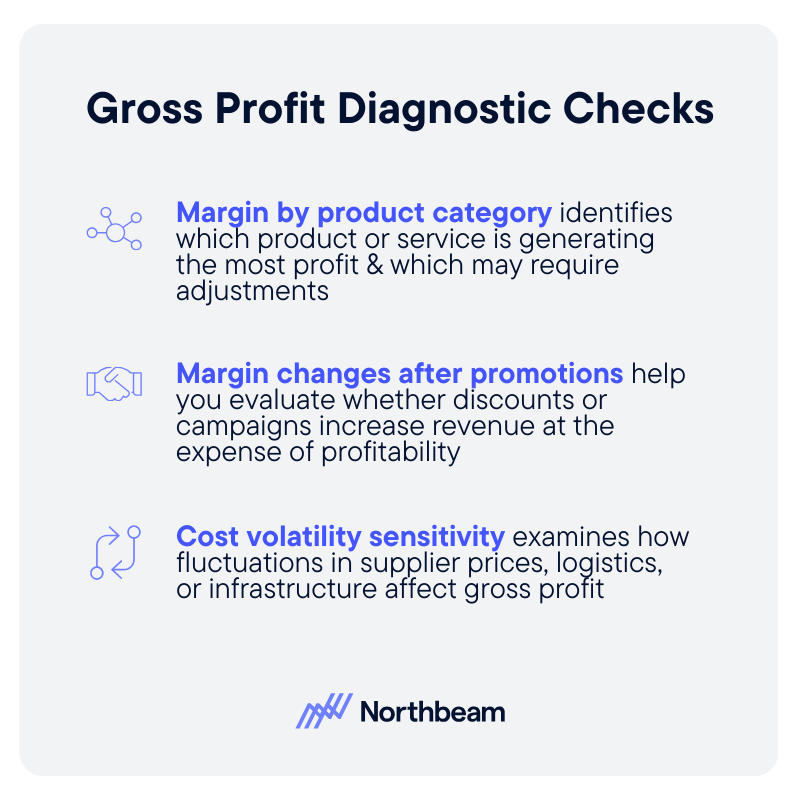
Margin by product category: Identifies which products or services generate the most profit and which may require pricing or cost adjustments.
- Margin changes after promotions: Evaluates whether discounts or campaigns increase revenue at the expense of profitability.
- Cost volatility sensitivity: Examines how fluctuations in supplier prices, logistics, or infrastructure costs affect gross profit.
Governance considerations
- Clear COGS definitions: Establish consistent rules for what expenses are included in cost of goods sold.
- Consistent reporting cadence: Track margins regularly so shifts in profitability are detected early.
- Alignment between marketing and finance: Ensure growth initiatives are evaluated against reliable margin data.
From revenue to real profitability
Gross profit shows how much value remains after the direct costs of producing or delivering a product or service are covered. Accurate classification of cost of goods sold is essential for making reliable margin decisions and understanding the true economics of the business.
For marketers, gross profit provides the guardrails for sustainable growth. Aligning acquisition spend with margin ensures campaigns generate real value, not just revenue. Protecting gross profit while scaling demand helps companies grow in a way that strengthens long-term profitability.



























































.avif)

























%25201.avif)



.avif)












.svg)
